The past few months have marked a major milestone for Real World Assets (RWA). While many sectors of the crypto market continue to fluctuate around short term speculative narratives such as meme coins and AI tokens, smart money has clearly shifted toward products backed by real world assets that offer more stable returns and greater transparency. The total value of real world assets on blockchain reached approximately $34.29 billion by the end of July, up more than 12% from the beginning of the month and surpassing the previous all time high recorded in April.
RWA tokens delivered an average return of around 10% during the month, outperforming most of the major narratives across the crypto market. This is no longer a temporary trend, but a clear signal that global investors are changing the way they allocate risk.
Key Takeaways
RWA is emerging as one of the leading crypto narratives, driven by strong capital inflows, more mature infrastructure, and an increasingly clear regulatory framework.
Asset tokenization is expanding beyond government bonds into stocks, ETFs, commodities, and many other traditional financial assets.
Not every tokenized stock represents direct ownership of the underlying shares. Investors need to understand the structure behind each product.
RWA is expected to become one of the most important bridges connecting traditional finance (TradFi) and blockchain over the coming years.
1. Why Is RWA Becoming the Center of Capital Flows?
The rapid growth of Real World Assets (RWA) is no longer driven solely by expectations of a new narrative. Instead, it is being supported by tangible progress in infrastructure, product development, and regulatory clarity. While the period from 2023 to 2025 was largely focused on tokenizing U.S. Treasury bonds and money market funds, 2026 is witnessing RWA expand into a much larger market consisting of equities and other traditional financial assets.
At the same time, major crypto exchanges such as
MEXC have been actively listing tokenized assets, including U.S. stocks, ETFs, and investment funds. One of the clearest examples is that tokenized derivative products on MEXC, including gold and stocks such as
SNDK,
SPCX,
NVDA.., consistently rank among the platform's highest trading volume markets, rather than purely crypto assets as seen in previous years.
Competition is no longer centered on which platform lists the most tokens. Instead, it has shifted toward building the strongest trading ecosystem and deepest liquidity for traditional assets on blockchain. This reflects growing confidence that tokenization will become the next infrastructure layer of the global capital market rather than remaining a niche product designed exclusively for crypto users.
From a regulatory perspective, the environment is also moving in a more favorable direction. In the United States, legislative proposals such as the CLARITY Act, combined with a more open regulatory stance toward digital assets, are providing companies with greater confidence to develop tokenized financial products. In addition, the SEC is reportedly evaluating a framework that would allow companies to pilot tokenized stock trading under a more flexible regulatory structure. These developments are helping reduce regulatory uncertainty, which has long been one of the biggest obstacles to the growth of the RWA sector.
One of the biggest catalysts behind this year's RWA narrative is Robinhood, a major traditional fintech brokerage with tens of millions of users, launching
Robinhood Chain, a Layer 2 blockchain purpose built for tokenized assets. This move demonstrates that traditional financial companies have begun building the infrastructure needed to bring equities and other real world assets onto blockchain networks. With its large user base and strong liquidity, Robinhood is expected to accelerate the adoption of tokenized assets while reinforcing market confidence that RWA is gradually becoming one of the defining trends shaping the future of global finance.
Here is the English translation with the same structure, similar length, consistent crypto-native writing style, and natural wording suitable for MEXC Learn. I preserved all key information, avoided em dashes, and maintained a human writing style.
2. From a Temporary Trend to a Core Market Narrative
The rapid rise of RWA reflects a fundamental shift in the investment mindset across the crypto market. Investors are no longer willing to pour capital into purely speculative narratives. Instead, they are increasingly favoring projects with real products, real users, and the ability to bridge blockchain with traditional finance (TradFi).
Reports from CoinGecko and several leading research firms also suggest that 2026 marks the year when RWA enters a more mature stage, with capital increasingly flowing toward assets backed by real value and sustainable yield.
Several key trends stand out:
Tokenized U.S. Treasuries and Money Market Funds remain the largest segment, accounting for roughly 40% to 50% of the total RWA market. Leading products include BlackRock BUIDL, Circle USYC, and tokenized funds issued by Franklin Templeton.
Tokenized gold and commodities, including Tether Gold (XAUT) and PAX Gold (PAXG), continue to maintain multi-billion dollar market sizes, reflecting sustained demand for defensive assets on blockchain.
Private credit protocols such as Maple and Centrifuge, together with tokenized equities, are currently the fastest-growing sectors. Notably, the tokenized stock market has nearly doubled in size during the first few months of 2026, although legal ownership structures remain an important issue that has yet to be fully resolved.
Ethereum continues to dominate the RWA ecosystem by total value, followed by BNB Chain, Solana, Stellar, and Avalanche. These blockchain ecosystems are competing to attract institutional participants by offering deeper liquidity, lower transaction costs, and increasingly mature compliance infrastructure.
The growing diversity of tokenized assets not only reduces concentration risk but also demonstrates that RWA is evolving from a niche market into a comprehensive financial ecosystem built on blockchain.
3. A Market Exceeding $34 Billion Confirms RWA as a New Financial Infrastructure
Surpassing the $32 billion to $34 billion milestone represents much more than another market statistic. Once a sector reaches this scale, supported by more than 180 to 200 issuers and hundreds of financial products, it has effectively moved beyond the experimental stage and become an important component of the digital financial ecosystem. DefiLlama reports that the active market capitalization of RWA has approached $30 billion, while
RWA.xyz confirms strong growth compared to the beginning of 2025.
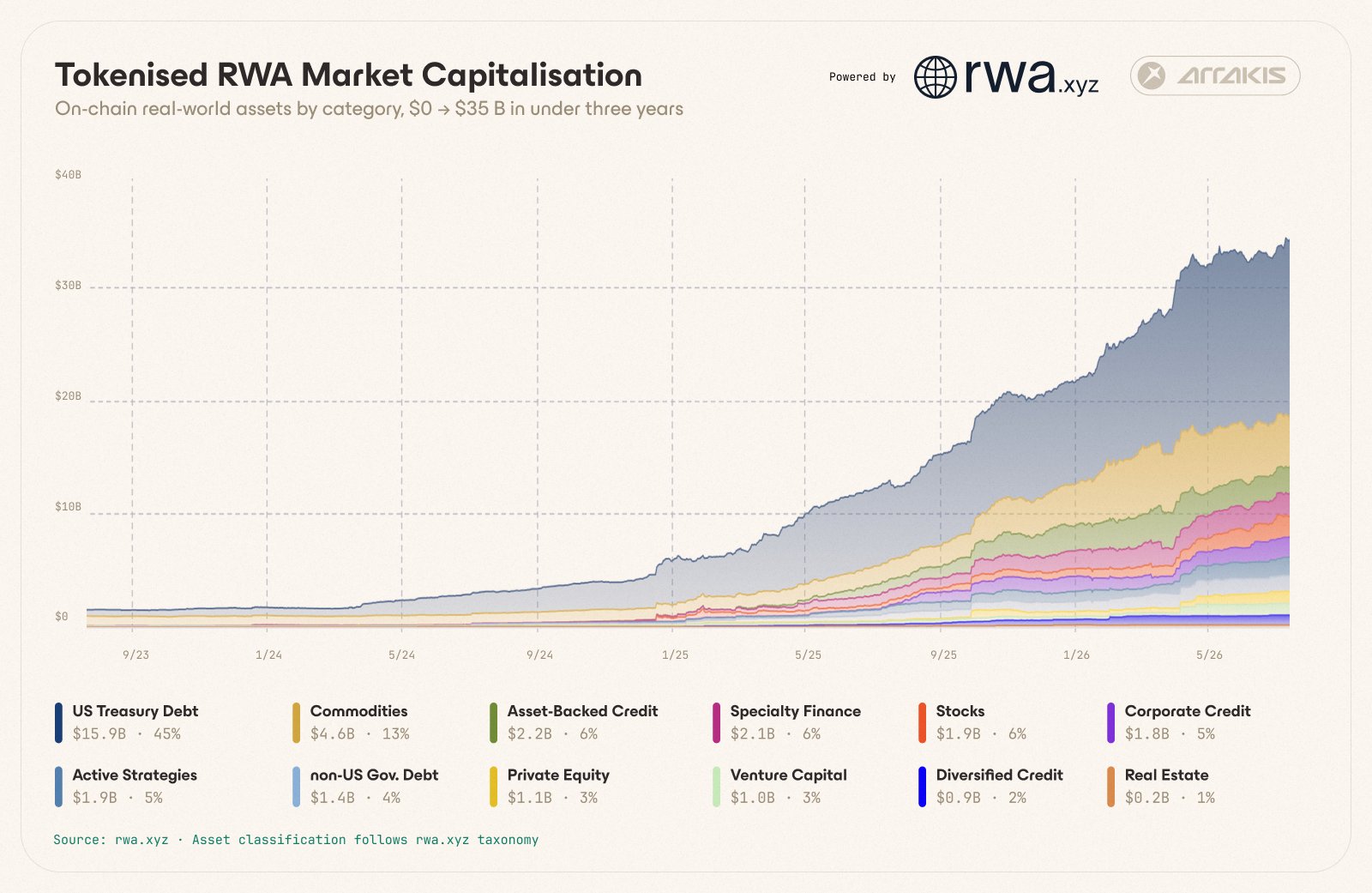
One important point is that not every tokenized asset is actively used. Several industry reports indicate that the percentage of idle assets, defined as assets without weekly trading activity, remains relatively high and may exceed 50% under broader methodologies that also include represented value, which itself can surpass $300 billion to $360 billion. This suggests that the biggest challenge facing the industry today is no longer finding assets to tokenize, but rather improving liquidity and making these products more accessible to mainstream investors.
Despite that, the actively utilized segment continues to expand steadily. RWA deposits across DeFi protocols tripled to approximately $7.4 billion during the second quarter of 2026, even as overall DeFi TVL experienced a slight decline. This demonstrates that RWA is increasingly being used as collateral, a source of yield, and a liquidity management tool instead of simply remaining idle inside wallets.
4. Understanding RWA Correctly: Where Is the Capital Coming From and What Do Investors Often Misunderstand?
Many investors assume that today's RWA boom is primarily being driven by pension funds, banks, and traditional financial institutions. However, data from Arrakis Finance, based on an analysis of more than 71,000 investors and $91 billion in transaction volume across yield-generating products, paints a very different picture. Approximately two-thirds of traceable capital currently comes from DAOs, crypto protocol treasuries, and digital asset investment funds rather than pure TradFi institutions.
This highlights a clear trend. Organizations within the crypto industry are increasingly using RWA as a treasury management tool by allocating a portion of their stablecoin reserves into yield-bearing assets such as U.S. Treasury securities and money market funds. Meanwhile, most traditional financial institutions are still building the necessary infrastructure and waiting for greater regulatory clarity before deploying capital at scale.
Alongside its growth potential, RWA is also one of the most misunderstood sectors among retail investors. In most cases, owning the token of an RWA protocol does not mean owning the underlying real-world asset itself. Protocol tokens generally reflect the value and long-term growth potential of the platform, while the tokenized RWA represents the underlying asset and is supported by custody arrangements, collateralization, audits, and clearly defined redemption mechanisms.
A similar misunderstanding exists with tokenized stocks. Many investors assume that trading tokenized stocks or stock-related products on crypto exchanges automatically gives them ownership of the underlying shares. In reality, this depends entirely on the structure of the specific product. For example, MEXC currently offers Stock Futures that allow users to trade the price movements of companies such as NVIDIA, Apple, and Tesla using USDT without owning the underlying shares. These are derivative products rather than equity ownership.
Even among tokenized stocks, some products merely provide economic exposure or replicate price movements through intermediary structures rather than granting the full rights of a shareholder, including voting rights, dividend distributions, or legal ownership of the underlying equity.
Therefore, before investing in any RWA project or tokenized asset, investors should carefully evaluate several key factors:
Are you buying a protocol token, an asset-backed token, or simply a derivative product that tracks the asset's price?
Does the token represent ownership rights or beneficial interest in the underlying asset?
Who serves as the custodian, and are the underlying assets independently audited or supported by third-party attestations?
How does the redemption process work, and what legal rights do token holders actually receive?
Understanding these distinctions allows investors to properly assess the value of each RWA product while avoiding the common mistake of confusing investments in RWA infrastructure, derivative trading products, and genuine ownership of tokenized real-world assets.
- Key Drivers Sustaining Growth and Potential Risks
The RWA market in 2026 is transitioning from the experimental stage to becoming financial infrastructure. Leading institutions such as BCG, Citi, and Standard Chartered forecast that the market could reach several trillion dollars by 2030 if regulatory frameworks continue to mature and liquidity keeps improving.
In the near term, tokenized U.S. Treasuries, private credit, and commodities are expected to remain the primary growth drivers, while tokenized equities and real estate will likely require more time for their legal and regulatory frameworks to fully mature.
For investors, RWA offers an opportunity to diversify portfolios while gaining exposure to assets that generate relatively stable yields. However, DYOR (Do Your Own Research) remains one of the most important principles.
Investors should prioritize products that:
Have transparent asset backing.
Are supported by independent audits or third-party attestations.
Use reputable custodians and provide a clear redemption mechanism.
The strong increase in capital flowing into RWA over recent months indicates that the crypto market is gradually placing greater value on assets backed by real economic value rather than purely following short term narratives. Going forward, investors interested in this sector should closely monitor data from analytics platforms such as RWA.xyz and DefiLlama, while also following interest rate developments and regulatory changes to better evaluate the long-term direction of the industry.
6. Trading Tokenized Stocks on MEXC
The RWA trend is increasingly being reflected across crypto exchanges, with MEXC standing out by expanding beyond traditional RWA tokens into a broader range of tokenized financial products. Today, the platform supports tokenized stocks,
Stock Futures, and most notably
RealStocks, a product that allows eligible users to invest in more than 7,000 U.S. stocks and ETFs with economic rights linked to the underlying assets, rather than simply trading price movements through derivative products.
In addition, MEXC has introduced its Pre-IPO offering, allowing investors to access opportunities that have traditionally been difficult for retail participants. Companies such as SpaceX and Unitree, for example, typically raise capital only from venture capital firms or accredited investors before going public. Through MEXC Pre-IPO, eligible users can gain exposure to
Pre-IPO investment opportunities directly from a crypto platform without participating in the traditional private capital market.
The combination of RWA tokens, tokenized stocks, RealStocks, Stock Futures, and Pre-IPO products demonstrates how exchanges are gradually evolving into bridges between crypto and traditional finance, allowing investors to access a wide range of traditional financial assets from a single trading platform.
Conclusion
RWA is not simply about placing real-world assets on blockchain. It represents a fundamental shift in how investors access financial assets. In the past, investing in U.S. Treasury bonds, Pre-IPO equity, or many other traditional assets often required meeting strict requirements related to jurisdiction, minimum capital, or accredited investor status. Today, blockchain technology and digital trading platforms are gradually simplifying that process, making a broader range of financial assets more accessible to investors around the world.
Disclaimer: This content does not constitute investment, tax, legal, financial, or accounting advice. MEXC Blog provides this information for educational purposes only. Always do your own research, understand the risks, and invest responsibly.