Bittensor Technical Analysis: Price Trades Near Resistance With Breakout Potential
Bittensor (TAO) is currently trading in a decisive technical zone, where price action is hovering near key resistance levels after a volatile period of correction and recovery. Following a strong rally earlier in the cycle, TAO has entered a consolidation phase, with price stabilizing between $300 and $340. This range is becoming increasingly important, as it represents a battleground between bullish continuation and bearish rejection.
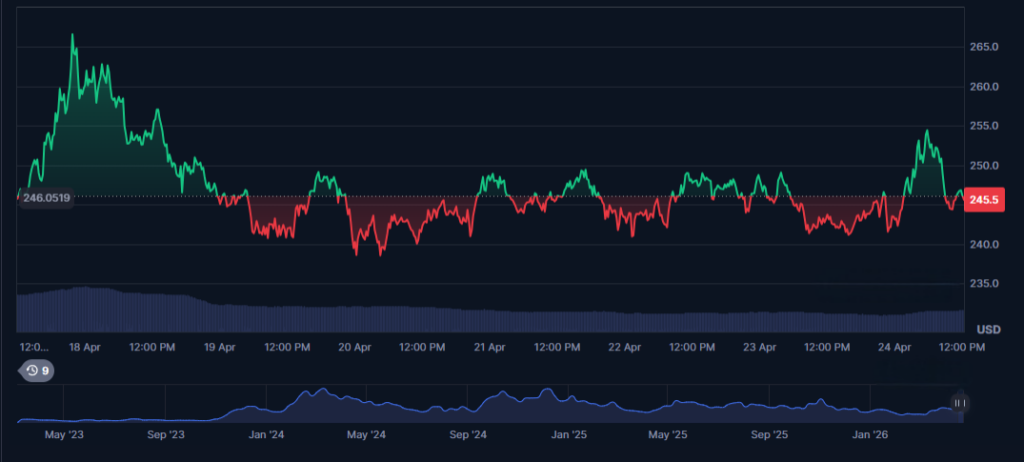
Recent data shows TAO trading around the $240–$310 range depending on market conditions, with notable fluctuations driven by both technical and fundamental developments. The tightening price structure suggests that a breakout—or breakdown—may be imminent.
Current Price Structure and Trend Formation
TAO’s recent price action reflects a post-correction consolidation pattern, following a sharp decline from highs near $370–$380. The pullback brought price down toward the $300 zone, where strong buying interest emerged.
This stabilization indicates that the market is forming a base structure, often seen before continuation moves. However, the inability to decisively break above resistance suggests that bullish momentum is still developing rather than fully established.
Technically, TAO remains above key moving averages in broader timeframes, which supports a neutral-to-bullish outlook, provided support levels continue to hold.
Key Support Levels
Support zones are critical for maintaining the current structure and preventing further downside.
- Immediate Support: $300 – Strong demand zone after recent correction
- Secondary Support: $280 – Previous accumulation level
- Major Support: $250 – Long-term structural support
Holding above $300 is crucial. A breakdown below this level could trigger a deeper correction, especially given recent volatility caused by large sell-offs and market uncertainty.
Notably, past price action shows strong buying interest near these levels, reinforcing their importance in maintaining bullish structure.
Resistance Levels to Watch
TAO is currently testing a key resistance zone that could determine its next move.
- Immediate Resistance: $320 – Short-term ceiling
- Key Breakout Level: $340 – Major rejection zone
- Major Resistance: $380 – Previous high
A confirmed breakout above $340, supported by strong volume, could trigger a rapid move toward $380 and beyond. Analysts have noted that a move above $380 would confirm bullish continuation into the next phase of the cycle.
However, repeated rejections at resistance may lead to extended consolidation or even downside pressure.
Volume and Momentum Indicators
Volume trends suggest increasing market participation, particularly during upward price movements. This indicates that buyers are actively accumulating during dips.
At the same time, momentum indicators such as RSI and MACD show mixed signals:
- RSI near neutral → indicates indecision
- MACD flattening → suggests slowing momentum
This combination is typical during pre-breakout phases, where volatility contracts before expansion.
Additionally, rising futures open interest indicates growing trader engagement, which often precedes major price moves.
Market Drivers and News Impact
AI Narrative and Sector Growth
Bittensor is one of the leading AI-focused cryptocurrencies, benefiting from the rapid expansion of artificial intelligence in the blockchain space. The token has gained significant attention as investors seek exposure to AI-driven networks.
This narrative continues to support long-term demand and bullish sentiment.
Institutional and Infrastructure Developments
Recent developments such as institutional-grade infrastructure and partnerships are improving accessibility for large investors. These advancements are considered bullish, as they unlock new liquidity and validate the network’s maturity.
Negative News and Governance Concerns
Despite bullish fundamentals, TAO has faced setbacks. A major sell-off occurred after a key subnet operator exited the network, raising concerns about decentralization and governance.
This event triggered sharp price declines and highlighted structural risks within the ecosystem.
Bullish Scenario: Breakout Above Resistance
If TAO successfully breaks above the $340 resistance level:
- Price could rally toward $380 and higher
- Increased volume would confirm strong buying pressure
- Positive AI sector sentiment could accelerate gains
Some projections suggest that TAO could target significantly higher levels in 2026 if momentum continues and adoption grows.
Bearish Scenario: Rejection and Pullback
If resistance holds and selling pressure increases:
- Price may drop back toward $300 support
- A breakdown below $300 could lead to $280 or $250
- Negative sentiment from governance concerns could amplify downside
Recent events show that TAO is highly sensitive to internal developments, making risk management essential.
Final Outlook
Bittensor is currently at a critical technical inflection point, with price consolidating just below major resistance. The range between $300 support and $340 resistance will likely determine the next major trend.
The combination of strong fundamentals—driven by AI adoption—and short-term risks—linked to governance concerns—creates a balanced but volatile setup.
For traders, the strategy is clear:
- Watch for a breakout above $340 for bullish confirmation
- Monitor $300 as a key support level for downside risk
As volatility compresses, the probability of a significant move increases. Whether that move is upward or downward will depend on volume, sentiment, and upcoming market catalysts.


You May Also Like

Trump administration targets Chinese firms exploiting US AI models

Newcastle United And Eddie Howe Are In A Tragic Bind