Administration officials will host law enforcement groups at the White House on Wednesday in a direct effort to address concerns that specific provisions in the CLARITY Act could hamper efforts to combat illicit finance, according to three sources familiar with the meetings cited by journalist Eleanor Terrett.
The gatherings come as the bill faces its most consequential test yet. Being placed on the Senate Legislative Calendar was the easy part, but getting enough votes for a floor vote is proving more complicated.
The provision under scrutiny is a developer-protection clause derived from the Blockchain Regulatory Certainty Act. Law enforcement groups argue it could create legal shields that make it harder to pursue investigations into crypto-related financial crimes. The concern is specific and structural rather than a broad ideological opposition to crypto regulation.
The bill’s ethics provisions represent a second unresolved issue that must be addressed before the legislation can advance to a full Senate debate.
Senate Momentum Continues Building
Despite the ongoing negotiations, key supporters remain optimistic.
Cynthia Lummis renewed her support for the legislation, warning that the United States risks falling behind if it fails to establish clear digital asset rules.
Former White House official Patrick Witt added that progress is being made behind the scenes. Discussions have continued since the Senate Banking Committee approved the bill in May, and negotiators are actively narrowing the list of unresolved issues.
Crypto Industry Unites Behind the Bill
The crypto industry is also ramping up pressure on lawmakers.
More than 200 organizations signed a joint letter urging Senate leaders to move the legislation forward. The list includes Coinbase, Ripple, Kraken, Circle, Andreessen Horowitz (a16z), and Binance.US.
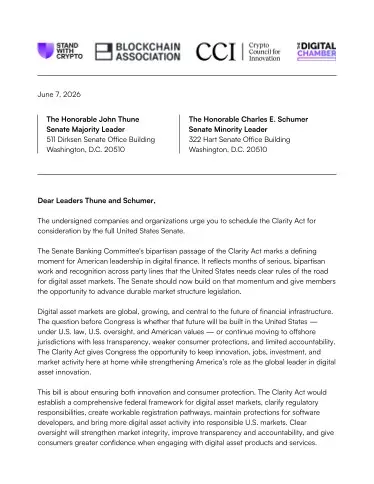
Supporters argue that the CLARITY Act would establish clear federal rules for digital assets, define regulatory responsibilities, and help keep crypto innovation inside the United States.
Brad Garlinghouse summed up the industry’s view by stating that this is the moment for the United States to lead on crypto regulation.
With negotiations intensifying and support growing, attention now shifts to whether lawmakers can resolve the remaining issues and bring the CLARITY Act to the Senate floor.