

Tether to Revive USDT on Bitcoin With RGB Rollout After Nine Years
Key highlights:
- Tether’s USDT will make a return to Bitcoin via the RGB protocol
- Bitcoin has to go head-to-head with Tron to emerge as the dominant blockchain for USDT
- USDT continues to trail USDC in stablecoin transaction volume in 2026
Emerging reports indicate that Tether-backed Utexo will issue the USDT stablecoin on Bitcoin in the coming weeks, using the RGB protocol. The move marks the return of USDT to the chain on which it was born as Tether jostles to hold its leading position from a raft of contenders.
USDT to make a comeback on Bitcoin
Tether-backed Utexo is spearheading the efforts to bring USDT to Bitcoin for the first time in nine years. Back in 2014, Tether’s USDT launched on Bitcoin via the Omni Layer but migrated to other chains due to high transaction costs.
“Finally, after eight years of development, we are the company that is launching USDT over Bitcoin with strong support from Tether,” said UTEXO co-founder Viktor Ihnatiuk.
Under the hood, Utexo is leaning on the RGB protocol, a smart contract system built on top of Bitcoin and the Lightning network. The RGB protocol allows users to issue stablecoins without modifying Bitcoin’s core code, offering a raft of functionalities.
Right off the bat, Ihnatiuk revealed that users will reap the benefits of Bitcoin’s UTXO model, providing advanced privacy. The company is betting on its deep integration with Tether and the absence of intermediaries charging fees and collecting data as an added privacy layer.
Ahead of launch, Utexo has tested the waters with a software development kit and a mint bridge, allowing users to move USDT across multiple chains without middlemen. Ihnatiuk noted that the commercial rollout, scheduled later in July, will support Tether’s USDT on native Bitcoin addresses, allowing users to transact over the Lightning Network with compatible wallets.
The launch will bring Bitcoin head-to-head with Tron, a blockchain that has cornered a lion’s share of USDT’s volume. Tron became the main chain for USDT through a combination of low transaction fees and rapid settlement speed. However, Utexo took swipes at Tron’s model of requiring fees to be paid in TRX to move USDT, branding it as red tape.
Tether faces stiff competition from Circle
New data from Visa indicates that Circle’s USDC has surpassed USDT in terms of transaction volume. In the first half of 2026, USDC snagged 70% of total global stablecoin transaction volume while USDT managed only 25%.
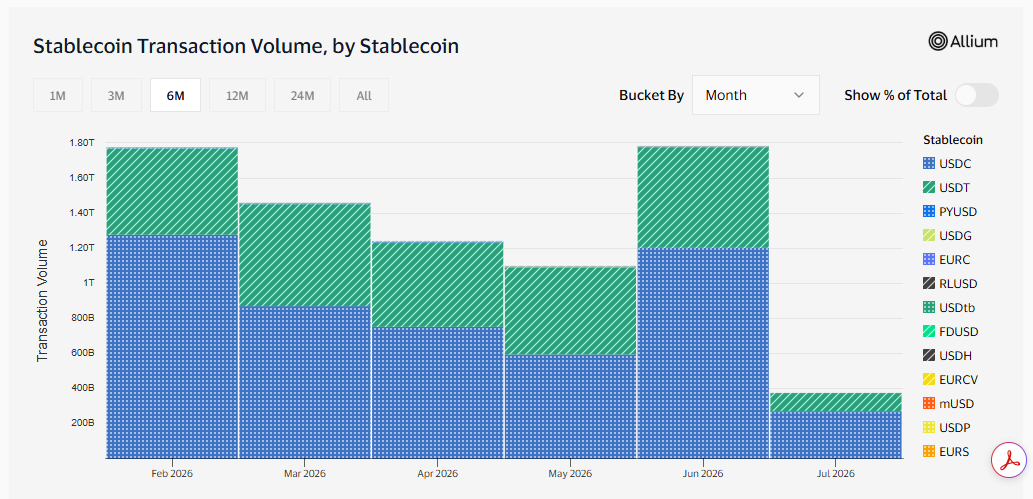
Source: Visa
For context, USDT led the market with 90% of global transaction volumes in 2020 while USDC accounted for under 10%. Circle CEO Jeremy Allaire cited “network effects and general platform utility combined with liquidity and regulatory clarity” as reasons for USDC’s recent dominance.
Meanwhile, USDT woes continue after Tether failed to get MiCA approval before the July 1 deadline, losing the entire EU market. Furthermore, ex-Tether CIO Richard Heathcote has put things in motion to sell part of his stake in the USDT issuer.
Despite the dominance of both stablecoin issuers, OpenUSD is tipped to snag market share from USDT and USDC. OUSD has since garnered a raft of institutional support, including finance sector heavyweights and technology companies


You May Also Like

Robotics Automation Prototyping: Engineering Kinetic Agility into End-Effectors

Bitcoin Exchange Binance Announces New Listings on its Futures Platform! Here Are the Details

Alabama Enacts Dual Legislative Breakthrough in Blockchain and Judicial Reform



