Analyze the performance of SDP and Moment-SOS relaxations on synthetic hyperbolic datasets.Analyze the performance of SDP and Moment-SOS relaxations on synthetic hyperbolic datasets.

Optimization Performance on Synthetic Gaussian and Tree Embeddings

Abstract and 1. Introduction

  1. Related Works

  2. Convex Relaxation Techniques for Hyperbolic SVMs

    3.1 Preliminaries

    3.2 Original Formulation of the HSVM

    3.3 Semidefinite Formulation

    3.4 Moment-Sum-of-Squares Relaxation

  3. Experiments

    4.1 Synthetic Dataset

    4.2 Real Dataset

  4. Discussions, Acknowledgements, and References

    \

A. Proofs

B. Solution Extraction in Relaxed Formulation

C. On Moment Sum-of-Squares Relaxation Hierarchy

D. Platt Scaling [31]

E. Detailed Experimental Results

F. Robust Hyperbolic Support Vector Machine

4.1 Synthetic Dataset

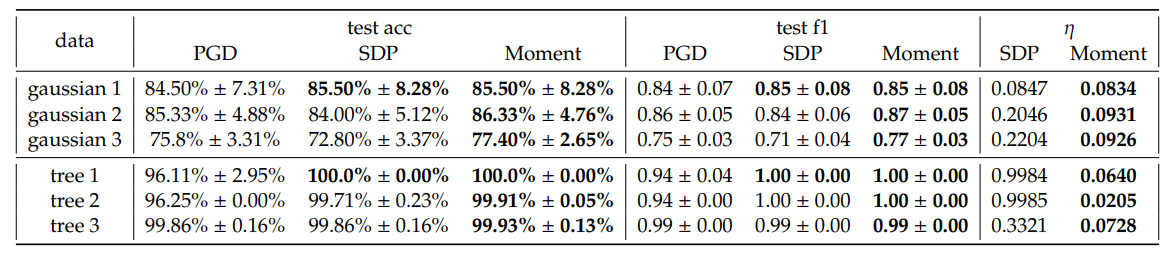
\ In general, we observe a small gain in average test accuracy and weighted F1 score from SDP and Moment relative to PGD. Notably, we observe that Moment often shows more consistent improvements compared to SDP, across most of the configurations. In addition, Moment gives smaller optimality gaps 𝜂 than SDP. This matches our expectation that Moment is tighter than the SDP.

\ Although in some case, for example when đŸ = 5, Moment achieves significantly smaller losses compared to both PGD and SDP, it is generally not the case. We emphasize that these losses are not direct measurements of the max-margin hyperbolic separators’ generalizability; rather, they are combinations of margin maximization and penalization for misclassification that scales with đ¶. Hence, the observation that the performance in test accuracy and weighted F1 score is better, even though the loss computed using extracted solutions from SDP and Moment is sometimes higher than that from PGD, might be due to the complicated loss landscape. More specifically, the observed increases in loss can be attributed to the intricacies of the landscape rather than the effectiveness of the optimization methods. Based on the accuracy and F1 score results, empirically SDP and Moment methods identify solutions that generalize better than those obtained by running gradient descent alone. We provide a more detailed analysis on the effect of hyperparameters in Appendix E.2 and runtime in Table 4. Decision boundary for Gaussian 1 is visualized in Figure 5.

\ Figure 3: Three Synthetic Gaussian (top row) and Three Tree Embeddings (bottom row). All features are in H2 but visualized through stereographic projection on B2. Different colors represent different classes. For tree dataset, the graph connections are also visualized but not used in training. The selected tree embeddings come directly from Mishne et al. [6].

\ Synthetic Tree Embedding. As hyperbolic spaces are good for embedding trees, we generate random tree graphs and embed them to H2 following Mishne et al. [6]. Specifically, we label nodes as positive if they are children of a specified node and negative otherwise. Our models are then evaluated for subtree classification, aiming to identify a boundary that includes all the children nodes within the same subtree. Such task has various practical applications. For example, if the tree represents a set of tokens, the decision boundary can highlight semantic regions in the hyperbolic space that correspond to the subtrees of the data graph. We emphasize that a common feature in such subtree classification task is data imbalance, which usually lead to poor generalizability. Hence, we aim to use this task to assess our methods’ performances under this challenging setting. Three embeddings are selected and visualized in Figure 3 and performance is summarized in Table 1. The runtime of the selected trees can be found in Table 4. Decision boundary of tree 2 is visualized in Figure 6.

\ Similar to the results of synthetic Gaussian datsets, we observe better performance from SDP and Moment compared to PGD, and due to data imbalance that GD methods typically struggle with, we have a larger gain in weighted F1 score in this case. In addition, we observe large optimality gaps for SDP but very tight gap for Moment, certifying the optimality of Moment even when class-imbalance is severe.

\ Table 1: Performance on synthetic Gaussian and tree dataset for đ¶ = 10.0: 5-fold test accuracy and weighted F1 score plus and minus 1 standard deviation, and the average relative optimality gap 𝜂 for SDP and Moment.
\

:::info Authors:

(1) Sheng Yang, John A. Paulson School of Engineering and Applied Sciences, Harvard University, Cambridge, MA (shengyang@g.harvard.edu);

(2) Peihan Liu, John A. Paulson School of Engineering and Applied Sciences, Harvard University, Cambridge, MA (peihanliu@fas.harvard.edu);

(3) Cengiz Pehlevan, John A. Paulson School of Engineering and Applied Sciences, Harvard University, Cambridge, MA, Center for Brain Science, Harvard University, Cambridge, MA, and Kempner Institute for the Study of Natural and Artificial Intelligence, Harvard University, Cambridge, MA (cpehlevan@seas.harvard.edu).

:::


:::info This paper is available on arxiv under CC by-SA 4.0 Deed (Attribution-Sharealike 4.0 International) license.

:::

\

Market Opportunity
Treehouse Logo
Treehouse Price(TREE)
$0.09569
$0.09569$0.09569
-0.42%
USD
Treehouse (TREE) Live Price Chart
Disclaimer: The articles reposted on this site are sourced from public platforms and are provided for informational purposes only. They do not necessarily reflect the views of MEXC. All rights remain with the original authors. If you believe any content infringes on third-party rights, please contact service@support.mexc.com for removal. MEXC makes no guarantees regarding the accuracy, completeness, or timeliness of the content and is not responsible for any actions taken based on the information provided. The content does not constitute financial, legal, or other professional advice, nor should it be considered a recommendation or endorsement by MEXC.

You May Also Like

The USDC Treasury burned $50 million worth of USDC on the Ethereum blockchain.

The USDC Treasury burned $50 million worth of USDC on the Ethereum blockchain.

PANews reported on January 22 that, according to Whale Alert monitoring, at 15:55 Beijing time, the USDC Treasury destroyed 50,000,000 USDC (approximately $50.01
Share
PANews2026/01/22 15:59
Crossmint Partners with MoneyGram for USDC Remittances in Colombia

Crossmint Partners with MoneyGram for USDC Remittances in Colombia

TLDR Crossmint enables MoneyGram’s new stablecoin payment app for cross-border transfers. The new app allows USDC transfers from the US to Colombia, boosting financial inclusion. MoneyGram offers USDC savings and Visa-linked spending for Colombian users. The collaboration simplifies cross-border payments with enterprise-grade blockchain tech. MoneyGram, a global leader in remittance services, launched its stablecoin-powered cross-border [...] The post Crossmint Partners with MoneyGram for USDC Remittances in Colombia appeared first on CoinCentral.
Share
Coincentral2025/09/18 21:02
Whales Dump 200 Million XRP in Just 2 Weeks – Is XRP’s Price on the Verge of Collapse?

Whales Dump 200 Million XRP in Just 2 Weeks – Is XRP’s Price on the Verge of Collapse?

Whales offload 200 million XRP leaving market uncertainty behind. XRP faces potential collapse as whales drive major price shifts. Is XRP’s future in danger after massive sell-off by whales? XRP’s price has been under intense pressure recently as whales reportedly offloaded a staggering 200 million XRP over the past two weeks. This massive sell-off has raised alarms across the cryptocurrency community, as many wonder if the market is on the brink of collapse or just undergoing a temporary correction. According to crypto analyst Ali (@ali_charts), this surge in whale activity correlates directly with the price fluctuations seen in the past few weeks. XRP experienced a sharp spike in late July and early August, but the price quickly reversed as whales began to sell their holdings in large quantities. The increased volume during this period highlights the intensity of the sell-off, leaving many traders to question the future of XRP’s value. Whales have offloaded around 200 million $XRP in the last two weeks! pic.twitter.com/MiSQPpDwZM — Ali (@ali_charts) September 17, 2025 Also Read: Shiba Inu’s Price Is at a Tipping Point: Will It Break or Crash Soon? Can XRP Recover or Is a Bigger Decline Ahead? As the market absorbs the effects of the whale offload, technical indicators suggest that XRP may be facing a period of consolidation. The Relative Strength Index (RSI), currently sitting at 53.05, signals a neutral market stance, indicating that XRP could move in either direction. This leaves traders uncertain whether the XRP will break above its current resistance levels or continue to fall as more whales sell off their holdings. Source: Tradingview Additionally, the Bollinger Bands, suggest that XRP is nearing the upper limits of its range. This often points to a potential slowdown or pullback in price, further raising concerns about the future direction of the XRP. With the price currently around $3.02, many are questioning whether XRP can regain its footing or if it will continue to decline. The Aftermath of Whale Activity: Is XRP’s Future in Danger? Despite the large sell-off, XRP is not yet showing signs of total collapse. However, the market remains fragile, and the price is likely to remain volatile in the coming days. With whales continuing to influence price movements, many investors are watching closely to see if this trend will reverse or intensify. The coming weeks will be critical for determining whether XRP can stabilize or face further declines. The combination of whale offloading and technical indicators suggest that XRP’s price is at a crossroads. Traders and investors alike are waiting for clear signals to determine if the XRP will bounce back or continue its downward trajectory. Also Read: Metaplanet’s Bold Move: $15M U.S. Subsidiary to Supercharge Bitcoin Strategy The post Whales Dump 200 Million XRP in Just 2 Weeks – Is XRP’s Price on the Verge of Collapse? appeared first on 36Crypto.
Share
Coinstats2025/09/17 23:42