The post U.S. Treasury Buys Back $2.8 Billion in Debt Securities appeared first on Coinpedia Fintech News The U.S. Treasury recently repurchased $2.8 billion ofThe post U.S. Treasury Buys Back $2.8 Billion in Debt Securities appeared first on Coinpedia Fintech News The U.S. Treasury recently repurchased $2.8 billion of

U.S. Treasury Buys Back $2.8 Billion in Debt Securities

CLARITY Act

The post U.S. Treasury Buys Back $2.8 Billion in Debt Securities appeared first on Coinpedia Fintech News

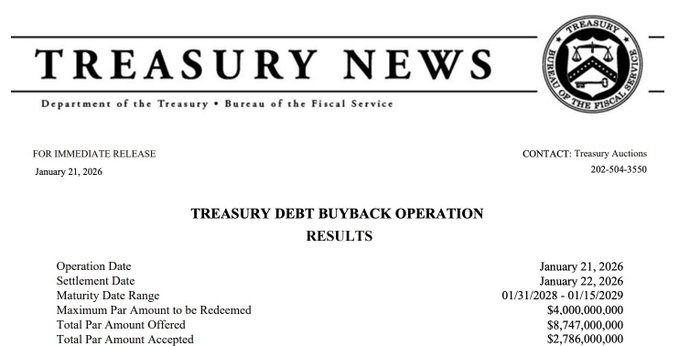
The U.S. Treasury recently repurchased $2.8 billion of its own debt, a move that sent a strong signal across bond markets. While bond yields stayed steady near 4.25%, showing no panic or stress. 

These buybacks help manage liquidity, but also change how investors think about the crypto market next.

U.S. Treasury Buys Back $2.8 Billion

The U.S. Treasury is again buying back its own debt, including a recent $2.8 billion purchase of bonds due in 2028–2029. However, the dealer has offered about $8.7 billion, but the Treasury accepted only 32%, showing a careful and targeted approach to improve trading in less active bonds.

The Treasury has not always used buybacks. Between 2000 and 2002, the Treasury bought back over $67.5 billion in debt to improve liquidity and manage maturities. After many quiet years, buybacks returned as market conditions changed.
U.S. Treasury Buys Back $2.8 Billion in Debt Securities

Last year, in 2025, the Treasury carried out its largest buyback ever, repurchasing $10 billion in debt from $22.87 billion in offers. 

This showed strong demand from institutions and a growing use of buybacks to manage the bond market.

Bond Yields Remain Stable at 4.25%

After the buyback, Treasury yields stayed near 4.25%. This showed that markets were not shocked by the move. Some investors saw it as a sign of strength, while others raised concerns about long-term demand for U.S. debt.

Still, the steady yield suggests confidence that the government is managing its debt carefully.

Unlike Federal Reserve actions such as quantitative easing, this buyback used existing cash, not newly created money. 

What This Means For Crypto Market 

Many in the crypto community see these moves as part of “macro liquidity conditions” that influence crypto prices. When liquidity tightens and yields rise, crypto often weakens. 

But if bond markets show stress or if yields fall, capital can rotate back into Bitcoin and other digital assets.

Meanwhile, U.S. debt buybacks don’t just affect bonds. They change how money flows in global markets, and that flow reaches crypto, too. As of now, the total crypto market cap has seen a slight rise to $3.2 trillion

Market Opportunity
Union Logo
Union Price(U)
$0.00245
$0.00245$0.00245
-0.72%
USD
Union (U) Live Price Chart
Disclaimer: The articles reposted on this site are sourced from public platforms and are provided for informational purposes only. They do not necessarily reflect the views of MEXC. All rights remain with the original authors. If you believe any content infringes on third-party rights, please contact service@support.mexc.com for removal. MEXC makes no guarantees regarding the accuracy, completeness, or timeliness of the content and is not responsible for any actions taken based on the information provided. The content does not constitute financial, legal, or other professional advice, nor should it be considered a recommendation or endorsement by MEXC.

You May Also Like

The Channel Factories We’ve Been Waiting For

The Channel Factories We’ve Been Waiting For

The post The Channel Factories We’ve Been Waiting For appeared on BitcoinEthereumNews.com. Visions of future technology are often prescient about the broad strokes while flubbing the details. The tablets in “2001: A Space Odyssey” do indeed look like iPads, but you never see the astronauts paying for subscriptions or wasting hours on Candy Crush.  Channel factories are one vision that arose early in the history of the Lightning Network to address some challenges that Lightning has faced from the beginning. Despite having grown to become Bitcoin’s most successful layer-2 scaling solution, with instant and low-fee payments, Lightning’s scale is limited by its reliance on payment channels. Although Lightning shifts most transactions off-chain, each payment channel still requires an on-chain transaction to open and (usually) another to close. As adoption grows, pressure on the blockchain grows with it. The need for a more scalable approach to managing channels is clear. Channel factories were supposed to meet this need, but where are they? In 2025, subnetworks are emerging that revive the impetus of channel factories with some new details that vastly increase their potential. They are natively interoperable with Lightning and achieve greater scale by allowing a group of participants to open a shared multisig UTXO and create multiple bilateral channels, which reduces the number of on-chain transactions and improves capital efficiency. Achieving greater scale by reducing complexity, Ark and Spark perform the same function as traditional channel factories with new designs and additional capabilities based on shared UTXOs.  Channel Factories 101 Channel factories have been around since the inception of Lightning. A factory is a multiparty contract where multiple users (not just two, as in a Dryja-Poon channel) cooperatively lock funds in a single multisig UTXO. They can open, close and update channels off-chain without updating the blockchain for each operation. Only when participants leave or the factory dissolves is an on-chain transaction…
Share
BitcoinEthereumNews2025/09/18 00:09
‘Sinners’ Earns 16 Oscar Nominations, Shattering All-Time Record

‘Sinners’ Earns 16 Oscar Nominations, Shattering All-Time Record

The post ‘Sinners’ Earns 16 Oscar Nominations, Shattering All-Time Record appeared on BitcoinEthereumNews.com. Topline “Sinners” shattered a 75-year-old record
Share
BitcoinEthereumNews2026/01/23 02:34
‘Return To Silent Hill’ Is The Worst-Reviewed Video Game Movie In 19 Years

‘Return To Silent Hill’ Is The Worst-Reviewed Video Game Movie In 19 Years

The post ‘Return To Silent Hill’ Is The Worst-Reviewed Video Game Movie In 19 Years appeared on BitcoinEthereumNews.com. Return to Silent Hil Return to Silent Hil
Share
BitcoinEthereumNews2026/01/23 02:19