

Aptos Plans to Launch Confidential APT for Institutional and Compliant Use Cases
- Aptos is set to introduce confidential APT on the mainnet following an upcoming software release and the passing of AIP 143.
- Confidential APT gives users the option to encrypt token balances and transaction amounts while keeping sender and receiver identity visible on-chain.
Aptos has announced plans to launch confidential APT, a primitive at the protocol level that will allow users to hide balances and transaction amounts while keeping their on-chain identity visible. The network says the confidential APT will be fit for institutional use and will enable compliant use cases in payments, trading, and asset management.
In a longer post, Aptos Labs founding engineer, Sherry Xiao, broke down why the network needs confidential APT if it’s to attract mainstream users, especially the larger institutions.
Users now have two options: they can opt for public blockchains like Bitcoin, which expose all their information, or go for privacy chains like Monero, which hide it. While the second option may appeal to many, it faces regulatory pushback as authorities need to guarantee that criminals are not using blockchain networks. This option also prohibits the participation of institutional users who require private yet compliant infrastructure.
Xiao stated:
She says that the goal for confidential APT is to have ‘onchain Venmos’ on Aptos, operating alongside institutional settlement systems, all powered by the same native confidentiality guarantees.
Confidential APT to Lure Institutions to Aptos
Confidential APT is a protocol-level feature that does not require smart contracts. It will be entirely opt-in for any user, and those who prefer full transparency can continue operating as they do today.
It will encrypt how much a user sends and the amount the sender and receiver hold in their wallets. Users can always choose selective disclosure, where they reveal the hidden details only to trusted parties. To guarantee that validity remains provable, Aptos will enable zero-knowledge proofs to verify that every transaction is legitimate and that there is no double-spending.
To provide confidentiality as a stack, Aptos has introduced two key features. The first is on the identity layer through its keyless accounts: users can now authenticate transactions through Google and Apple accounts without linking their identity to an on-chain address. ZK proofs will verify the authorization without revealing the authorizer.
The other is on the intent layer, where the network has proposed an encrypted mempool. On Aptos, like most blockchains, once a transaction is submitted and enters the mempool, validators can see the full transaction details before they order these transactions into a block. With confidential APT, the validators will see that there’s a valid transaction to be sequenced, but won’t be able to read the contents until the block is ready to be recorded on the chain.
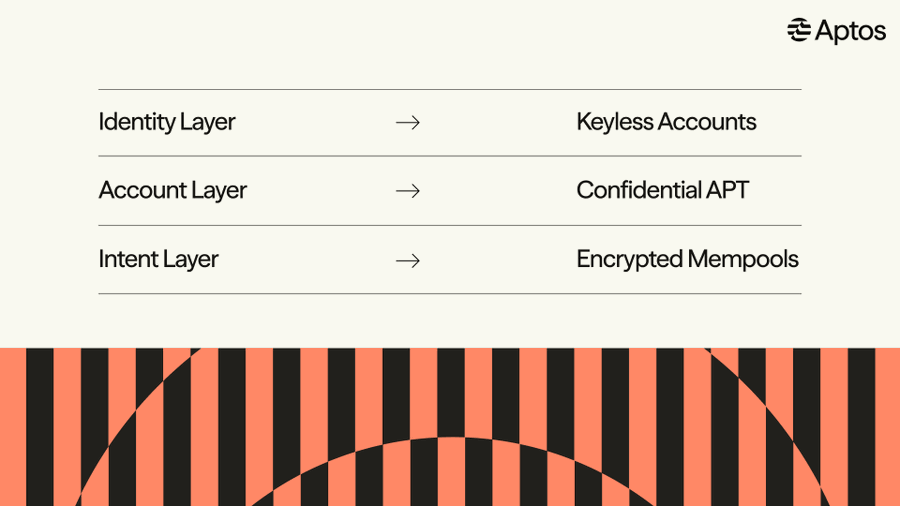 Image courtesy of Sherry Xiao.
Xiao summed up confidential APT as “a deliberate design decision to ensure the network can support serious financial use cases at scale.”
She added:
The proposal comes days after Juicyway revealed it had picked Aptos to power its $3 billion payments system.
]]>You May Also Like

Solana Price Prediction: Litecoin Latest Updates As Pepeto Gains Buzz With Analysts Calling 100x Potential

Taiko and Chainlink to Unleash Reliable Onchain Data for DeFi Ecosystem
