A growing share of Bitcoin supply has slipped underwater, with CryptoQuant contributor Darkfost arguing that the market is now sitting much closer to historicalA growing share of Bitcoin supply has slipped underwater, with CryptoQuant contributor Darkfost arguing that the market is now sitting much closer to historical

43% of Bitcoin Supply Is In Loss As Market Nears Bear Territory

2026/03/09 16:30
3 min read
For feedback or concerns regarding this content, please contact us at crypto.news@mexc.com

A growing share of Bitcoin supply has slipped underwater, with CryptoQuant contributor Darkfost arguing that the market is now sitting much closer to historical bear-phase conditions than to a confirmed bull trend. His latest charts show 43% of Bitcoin supply held in UTXOs is currently in loss, leaving just 57% in profit.

Darkfost is looking at the distribution of supply across Bitcoin’s unspent transaction outputs, a way of tracking how much coin supply is sitting above or below cost basis. In his reading, that metric has reached a zone that has historically marked the boundary between advancing bull markets and broader corrections.

“Roughly one out of two investors is currently at a loss. More precisely, this refers to the supply held within each UTXO on Bitcoin. At the moment, 43% of that supply is in loss,” he wrote on X. He added that “historically, as the histogram shows, we usually see around 75% of the supply in profit,” describing that level as a “rough boundary between a bull trend and a market correction.”

Bitcoin percent supply in profit

That framing is central to the thesis. When the share of supply in profit rises back above roughly 75%, Darkfost said, bull trends have typically “confirmed and accelerated.” When more supply starts falling into loss, the opposite tends to happen: corrections deepen, confidence weakens and the market begins to resemble prior bear-market structures. With Bitcoin now at 57% supply in profit, he said conditions look “closer to those seen during deep bear market phases.”

Still, he did not present the current setup as a one-way collapse. Darkfost said the market is showing signs of stabilization, which he linked to the current consolidation phase. But he also warned that the process may not be finished. “It is still possible that the market moves lower in order to shake out LTHs further and push the share of supply in loss toward around 45%, a level that has been reached during previous bear markets,” he wrote.

Macro Backdrop Weighs On Bitcoin

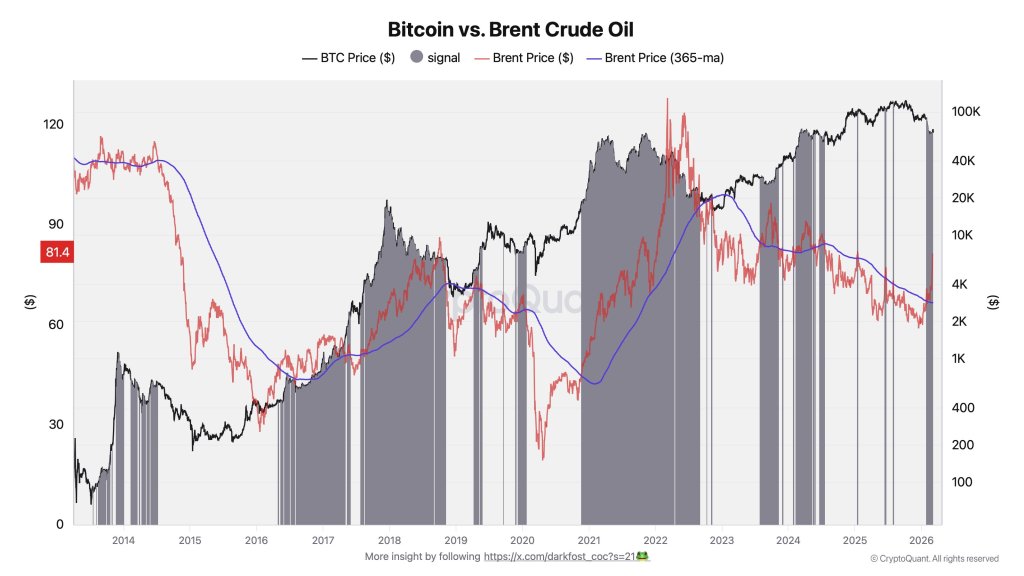
His second chart ties that on-chain deterioration to a macro backdrop that has become less supportive for risk assets. As tensions around the Strait of Hormuz intensified, Darkfost argued, oil’s rally has added another layer of pressure to Bitcoin.

“Since the beginning of the year, oil has gained more than 60%, a dramatic increase reflecting market concerns over the geopolitical situation,” he wrote. “This is not surprising, given that the Strait of Hormuz accounts for about 20% of global daily oil exports and nearly 35% of oil transported by sea. Any incident that blocks the strait or disrupts transit therefore has an immediate impact on oil prices.”
Bitcoin vs. Brent Crude Oil

He extended that argument beyond energy markets. Higher oil prices, he said, feed directly into inflation expectations and broader financial-market stress, a combination that has historically not favored speculative assets. “For a volatile and risky asset like Bitcoin, this type of environment is unfavorable,” Darkfost wrote. “Historically, periods when oil prices regain strength often coincide with BTC end-of-cycle phases. These moments also signal geopolitical tensions, which are not conducive to risk-taking or exposure to more speculative assets.”

Taken together, the two charts sketch a market that is not yet definitively in a bear trend but is drifting toward a zone where that label becomes harder to dismiss. The immediate question is whether Bitcoin can rebuild the share of supply back into profit and reclaim the historical 75% threshold, or whether macro stress and further long-term-holder selling push the market deeper into loss territory first.

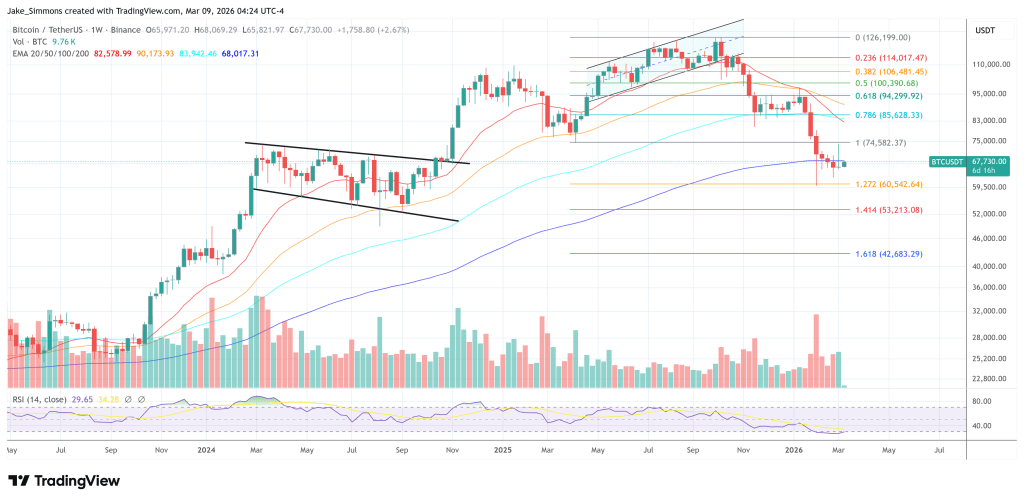
At press time, BTC traded at $67,730.
Bitcoin price chart
Market Opportunity
Notcoin Logo
Notcoin Price(NOT)
$0.000395
$0.000395$0.000395
+2.65%
USD
Notcoin (NOT) Live Price Chart
Disclaimer: The articles reposted on this site are sourced from public platforms and are provided for informational purposes only. They do not necessarily reflect the views of MEXC. All rights remain with the original authors. If you believe any content infringes on third-party rights, please contact crypto.news@mexc.com for removal. MEXC makes no guarantees regarding the accuracy, completeness, or timeliness of the content and is not responsible for any actions taken based on the information provided. The content does not constitute financial, legal, or other professional advice, nor should it be considered a recommendation or endorsement by MEXC.

You May Also Like

The Channel Factories We’ve Been Waiting For

The Channel Factories We’ve Been Waiting For

The post The Channel Factories We’ve Been Waiting For appeared on BitcoinEthereumNews.com. Visions of future technology are often prescient about the broad strokes while flubbing the details. The tablets in “2001: A Space Odyssey” do indeed look like iPads, but you never see the astronauts paying for subscriptions or wasting hours on Candy Crush.  Channel factories are one vision that arose early in the history of the Lightning Network to address some challenges that Lightning has faced from the beginning. Despite having grown to become Bitcoin’s most successful layer-2 scaling solution, with instant and low-fee payments, Lightning’s scale is limited by its reliance on payment channels. Although Lightning shifts most transactions off-chain, each payment channel still requires an on-chain transaction to open and (usually) another to close. As adoption grows, pressure on the blockchain grows with it. The need for a more scalable approach to managing channels is clear. Channel factories were supposed to meet this need, but where are they? In 2025, subnetworks are emerging that revive the impetus of channel factories with some new details that vastly increase their potential. They are natively interoperable with Lightning and achieve greater scale by allowing a group of participants to open a shared multisig UTXO and create multiple bilateral channels, which reduces the number of on-chain transactions and improves capital efficiency. Achieving greater scale by reducing complexity, Ark and Spark perform the same function as traditional channel factories with new designs and additional capabilities based on shared UTXOs.  Channel Factories 101 Channel factories have been around since the inception of Lightning. A factory is a multiparty contract where multiple users (not just two, as in a Dryja-Poon channel) cooperatively lock funds in a single multisig UTXO. They can open, close and update channels off-chain without updating the blockchain for each operation. Only when participants leave or the factory dissolves is an on-chain transaction…
Share
BitcoinEthereumNews2025/09/18 00:09
Solana Price Prediction: ARK Projects $300B Liquidity Rebound as Pepeto Targets 267x From Presale

Solana Price Prediction: ARK Projects $300B Liquidity Rebound as Pepeto Targets 267x From Presale

After months of pressure on risk assets, the tide may finally be turning. ARK Invest expects roughly $300 billion to flow back into markets as the Treasury General
Share
Techbullion2026/03/10 09:06
Nasdaq-listed crypto treasury GD Culture to add 7,500 BTC after Pallas Capital acquisition closes

Nasdaq-listed crypto treasury GD Culture to add 7,500 BTC after Pallas Capital acquisition closes

Those tokens are worth around $876 million at current prices, making GDC among the top 15 largest publicly traded bitcoin holders.
Share
Coinstats2025/09/18 04:19