The long-term vision of XRP has often been debated within the crypto market, where price speculation and retail trading tend to dominate the narrative. The proponentsThe long-term vision of XRP has often been debated within the crypto market, where price speculation and retail trading tend to dominate the narrative. The proponents

Why XRP’s Long-Term Vision Lies In The Internet Of Value Stack

2026/03/10 03:00
3 min read
For feedback or concerns regarding this content, please contact us at crypto.news@mexc.com

The long-term vision of XRP has often been debated within the crypto market, where price speculation and retail trading tend to dominate the narrative. The proponents of the asset argue that XRP’s core purpose extends beyond short-term market cycles. Instead, they view it as a key component of the emerging concept of the Internet of Value,  and enable the seamless transfer of money and assets across global networks as easily as information moves across the internet.

XRP’s long-term significance has never been rooted in retail speculation, but in its potential fit-in-purpose utility within an emerging Internet of Value infrastructure. Analyst Rob Cunningham has mentioned on X that the world markets advance toward regulated digital commodity venues, clearer token classification, and tokenized movement of value across interoperable rails. Thus, assets designed for fast settlement, liquidity bridging, and neutral transfer between networks become relevant.

How The Internet Of Value Requires Interoperable Assets

Cunningham noted that regulatory developments such as the Clarity Act framework are not designed as an XRP bill, and no law can guarantee XRP adoption. However, clearer market structure legislation could address one of its long-standing challenges in the US: legal ambiguity, which is an inference from the legislation’s structure and purpose, not a promise.

Related Reading: Cardano Founder Shares What To Expect For XRP If The Clarity ACT Is Passed

Analyst Cunningham frames this transition as the “shipping container moment” for finance, meaning the financial world is standardising the movement of value, similar to how it standardised the movement of goods. When this shift happens, the winners are rarely the loudest brands, but it’s the rails, standards, and protocols that reduce friction across the system.

From this perspective, the growth of Distributed Ledger Technology (DLT) adoption signals a deeper transformation of truth, and settlement and ownership are being re-architected at the protocol level. Cunningham views this trend as a “sound-money renaissance” focused less on nostalgia and more on restoring transparent rules and reliable measurements for digital finance.

Related Reading: Pundit Explains How XRP Becomes A Global Reserve Asset

In that broader macro context, the debate around the Clarity Act reflects a decision about whether the US will lead the digital asset transition through clear legislation or allow innovation to remain in regulatory ambiguity. Meanwhile, the XRP implications become strongest in a world that requires neutral, fast, and interoperable value transfer under well-defined rules, where the macro-direction is increasingly favourable, as the regulated utility will ultimately matter more than the narrative cycle in the market.

A Liquidity Shift Is Unfolding In The XRP Market

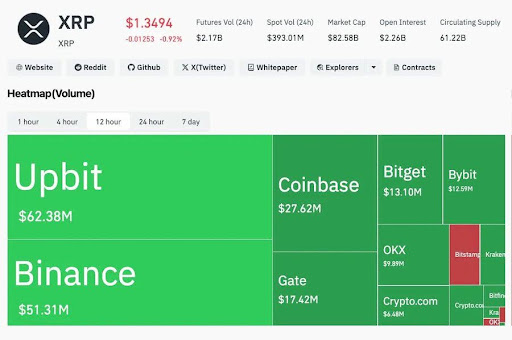
A notable shift is emerging in the XRP market liquidity. Crypto commentator XFinanceBull revealed that the data from exchange heatmaps shows that Upbit has recently moved into the top position for XRP trading volume, surpassing major global platforms such as Binance and Coinbase.
XRP

This development shows that market liquidity is positioning before the broader narratives become recognised. According to XFinanceBull, the surge in XRP activity on a South Korean exchange suggests that regional traders are betting on the network.

XRP
Market Opportunity
XRP Logo
XRP Price(XRP)
$1,3875
$1,3875$1,3875
+2,01%
USD
XRP (XRP) Live Price Chart
Disclaimer: The articles reposted on this site are sourced from public platforms and are provided for informational purposes only. They do not necessarily reflect the views of MEXC. All rights remain with the original authors. If you believe any content infringes on third-party rights, please contact crypto.news@mexc.com for removal. MEXC makes no guarantees regarding the accuracy, completeness, or timeliness of the content and is not responsible for any actions taken based on the information provided. The content does not constitute financial, legal, or other professional advice, nor should it be considered a recommendation or endorsement by MEXC.

You May Also Like

The Channel Factories We’ve Been Waiting For

The Channel Factories We’ve Been Waiting For

The post The Channel Factories We’ve Been Waiting For appeared on BitcoinEthereumNews.com. Visions of future technology are often prescient about the broad strokes while flubbing the details. The tablets in “2001: A Space Odyssey” do indeed look like iPads, but you never see the astronauts paying for subscriptions or wasting hours on Candy Crush.  Channel factories are one vision that arose early in the history of the Lightning Network to address some challenges that Lightning has faced from the beginning. Despite having grown to become Bitcoin’s most successful layer-2 scaling solution, with instant and low-fee payments, Lightning’s scale is limited by its reliance on payment channels. Although Lightning shifts most transactions off-chain, each payment channel still requires an on-chain transaction to open and (usually) another to close. As adoption grows, pressure on the blockchain grows with it. The need for a more scalable approach to managing channels is clear. Channel factories were supposed to meet this need, but where are they? In 2025, subnetworks are emerging that revive the impetus of channel factories with some new details that vastly increase their potential. They are natively interoperable with Lightning and achieve greater scale by allowing a group of participants to open a shared multisig UTXO and create multiple bilateral channels, which reduces the number of on-chain transactions and improves capital efficiency. Achieving greater scale by reducing complexity, Ark and Spark perform the same function as traditional channel factories with new designs and additional capabilities based on shared UTXOs.  Channel Factories 101 Channel factories have been around since the inception of Lightning. A factory is a multiparty contract where multiple users (not just two, as in a Dryja-Poon channel) cooperatively lock funds in a single multisig UTXO. They can open, close and update channels off-chain without updating the blockchain for each operation. Only when participants leave or the factory dissolves is an on-chain transaction…
Share
BitcoinEthereumNews2025/09/18 00:09
Solana Price Prediction: ARK Projects $300B Liquidity Rebound as Pepeto Targets 267x From Presale

Solana Price Prediction: ARK Projects $300B Liquidity Rebound as Pepeto Targets 267x From Presale

After months of pressure on risk assets, the tide may finally be turning. ARK Invest expects roughly $300 billion to flow back into markets as the Treasury General
Share
Techbullion2026/03/10 09:06
Nasdaq-listed crypto treasury GD Culture to add 7,500 BTC after Pallas Capital acquisition closes

Nasdaq-listed crypto treasury GD Culture to add 7,500 BTC after Pallas Capital acquisition closes

Those tokens are worth around $876 million at current prices, making GDC among the top 15 largest publicly traded bitcoin holders.
Share
Coinstats2025/09/18 04:19