This article applies a free and fair economy model to analyze pure exchange economies and markets with transferable payoff.This article applies a free and fair economy model to analyze pure exchange economies and markets with transferable payoff.

Game Theory and Exchange Economies: A New Model for Pure Exchange and Transferable Payoff

2025/09/17 23:30
3 min read
For feedback or concerns regarding this content, please contact us at crypto.news@mexc.com

Abstract and 1. Introduction

  1. A free and fair economy: definition, existence and uniqueness

    2.1 A free economy

    2.2 A free and fair economy

  2. Equilibrium existence in a free and fair economy

    3.1 A free and fair economy as a strategic form game

    3.2 Existence of an equilibrium

  3. Equilibrium efficiency in a free and fair economy

  4. A free economy with social justice and inclusion

    5.1 Equilibrium existence and efficiency in a free economy with social justice

    5.2 Choosing a reference point to achieve equilibrium efficiency

  5. Some applications

    6.1 Teamwork: surplus distribution in a firm

    6.2 Contagion and self-enforcing lockdown in a networked economy

    6.3 Bias in academic publishing

    6.4 Exchange economies

  6. Contributions to the closely related literature

  7. Conclusion and References

Appendix

6.4 Exchange economies

In this section, we apply our theory to pure exchange economies (Section 6.4.1) and markets with transferable payoff (Section 6.4.2).

\ 6.4.1 Pure exchange economies

\
\
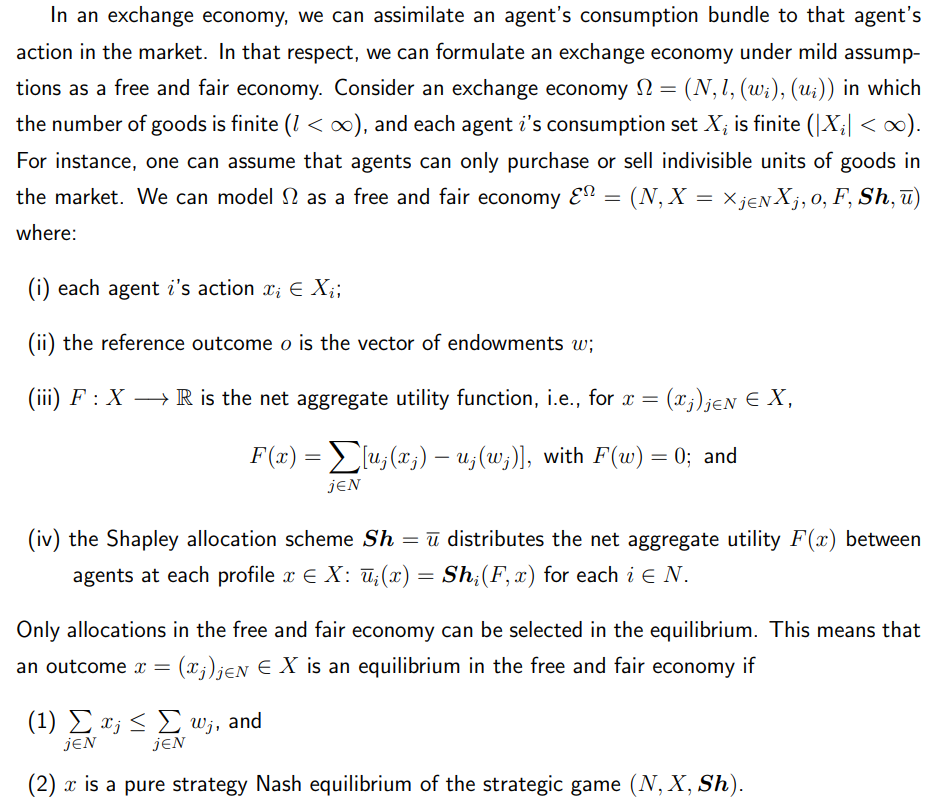
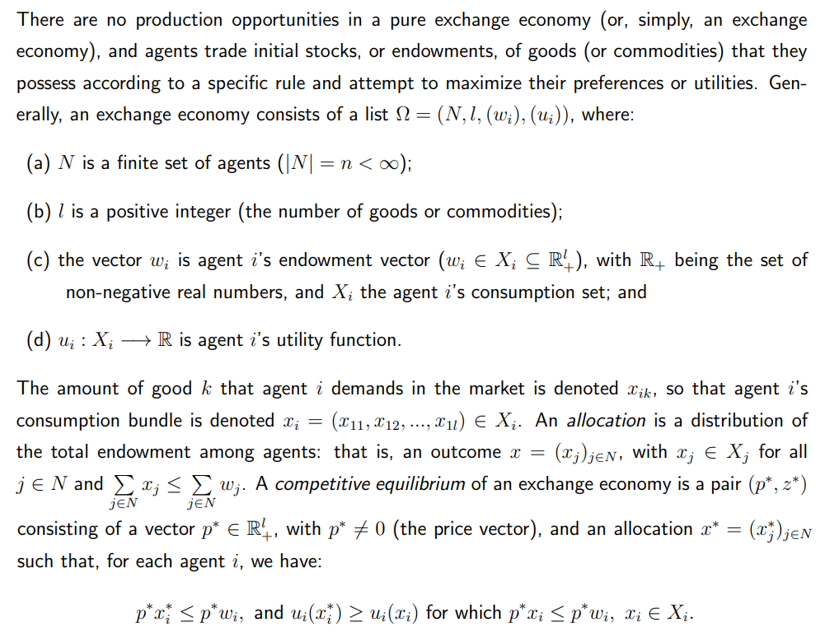
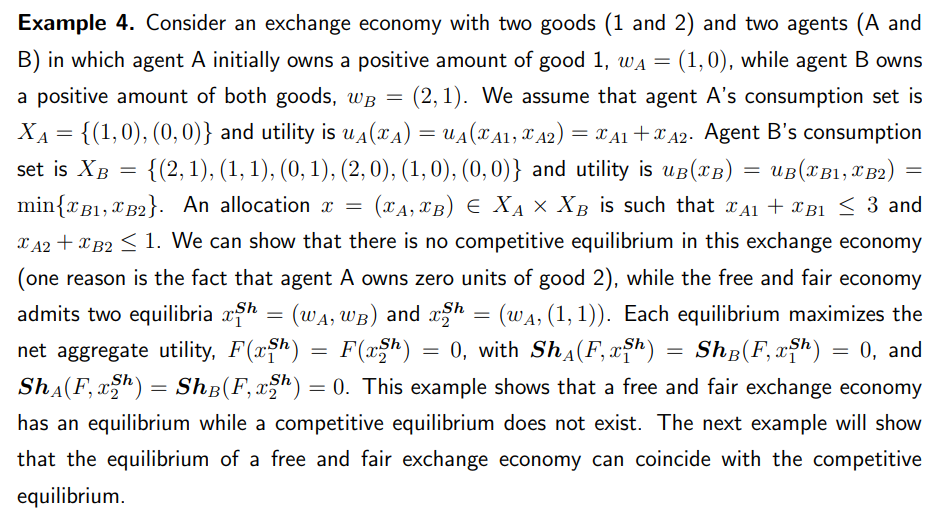
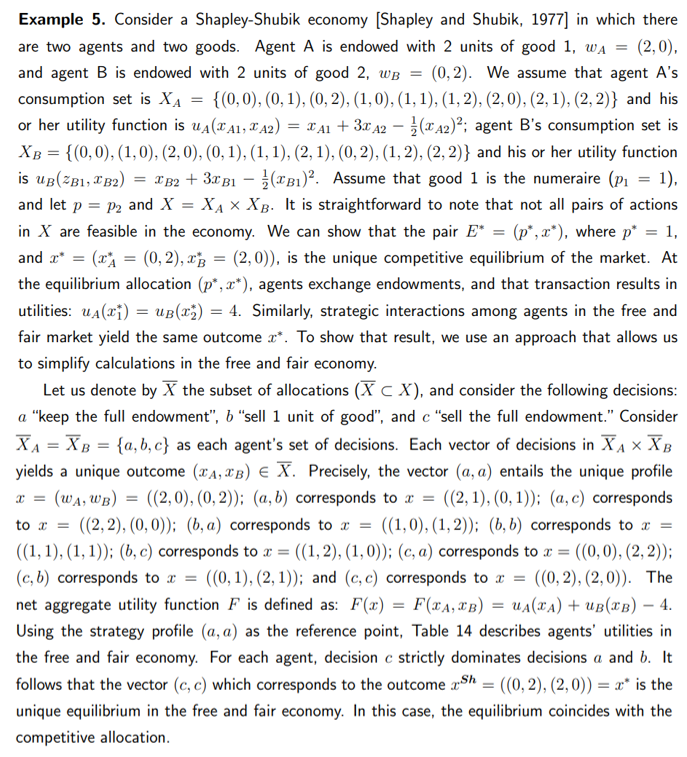
\ Our model differs from the exchange economy in at least two important respects. First, the incentive mechanism is different. Second, the equilibrium prediction from free exchanges between agents in both economies is different in general. A competitive equilibrium exists in an exchange economy when some assumptions exist on agents’ utilities and endowments. For instance, when utilities are continuous, strictly increasing, and quasi-concave and each agent initially owns a positive amount of each good in the market, a competitive equilibrium exists, and many equilibria might arise. However, under such assumptions on agents’ utilities, the net aggregate utility function F is strictly increasing, and thanks to Theorem 2, the free and fair economy admits a unique equilibrium. Additionally, it is not necessary to impose any assumptions on utilities and endowments to guarantee the existence of an equilibrium in a free and fair economy. We illustrate these points in the following examples.

\
\
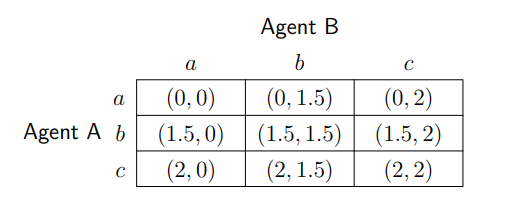
\ Table 14: Utilities in the free and fair economy
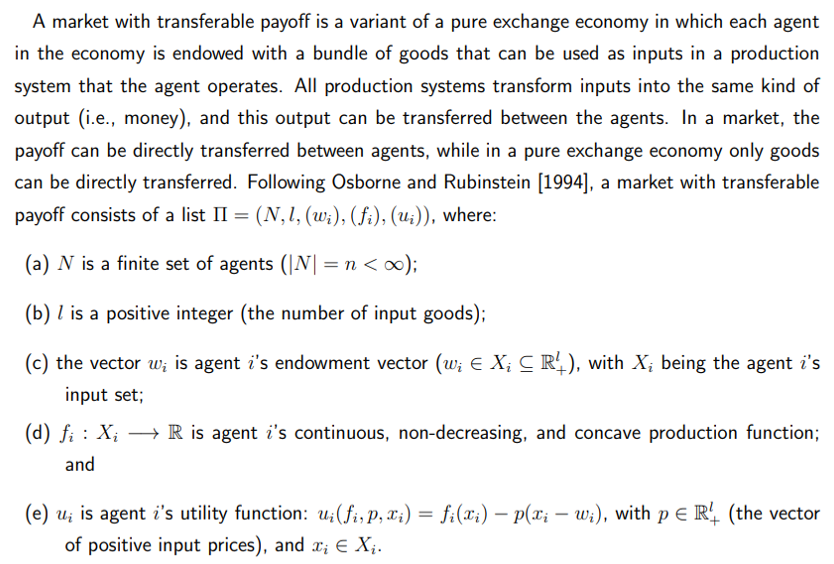
\ 6.4.2 Markets with transferable payoff

\
\
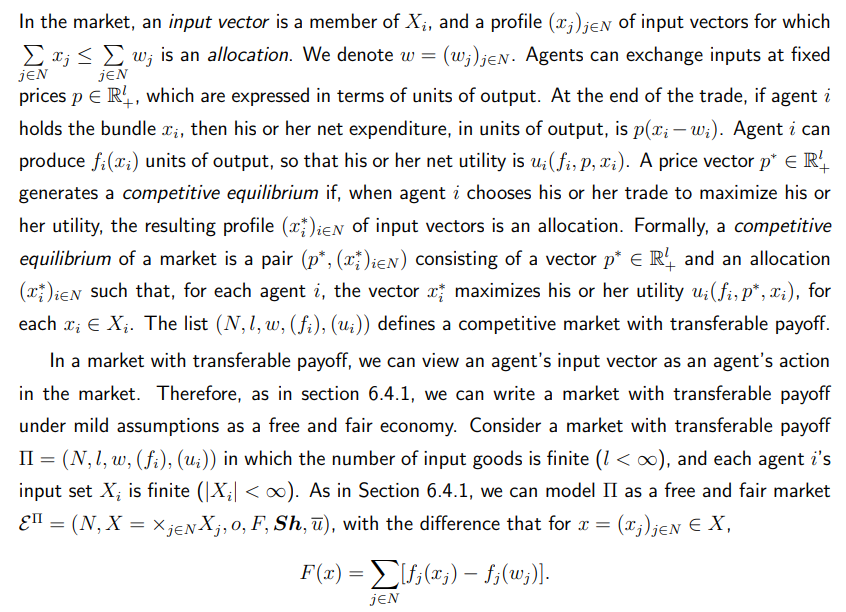
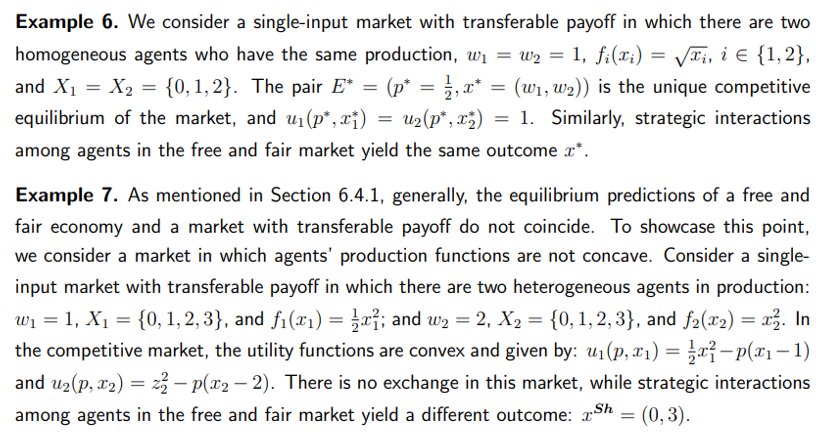
\ As in the analysis in section 6.4.1 below, we provide examples that show similarities (Example 6) and differences (Example 7) between the predictions of free and fair markets and markets with transferable payoff.

\
\

:::info Authors:

(1) Ghislain H. Demeze-Jouatsa, Center for Mathematical Economics, University of Bielefeld (demeze jouatsa@uni-bielefeld.de);

(2) Roland Pongou, Department of Economics, University of Ottawa (rpongou@uottawa.ca);

(3) Jean-Baptiste Tondji, Department of Economics and Finance, The University of Texas Rio Grande Valley (jeanbaptiste.tondji@utrgv.edu).

:::


:::info This paper is available on arxiv under CC BY 4.0 DEED license.

:::

\

Market Opportunity
SQUID MEME Logo
SQUID MEME Price(GAME)
$31.1045
$31.1045$31.1045
+0.02%
USD
SQUID MEME (GAME) Live Price Chart
Disclaimer: The articles reposted on this site are sourced from public platforms and are provided for informational purposes only. They do not necessarily reflect the views of MEXC. All rights remain with the original authors. If you believe any content infringes on third-party rights, please contact crypto.news@mexc.com for removal. MEXC makes no guarantees regarding the accuracy, completeness, or timeliness of the content and is not responsible for any actions taken based on the information provided. The content does not constitute financial, legal, or other professional advice, nor should it be considered a recommendation or endorsement by MEXC.
Tags:

You May Also Like

Hex Trust Adds Custody and Staking for Lido’s stETH, Expanding Institutional Access to Ethereum Rewards

Hex Trust Adds Custody and Staking for Lido’s stETH, Expanding Institutional Access to Ethereum Rewards

The post Hex Trust Adds Custody and Staking for Lido’s stETH, Expanding Institutional Access to Ethereum Rewards appeared on BitcoinEthereumNews.com. Crypto custodian Hex Trust has integrated custody and staking support for stETH, the liquid staking token issued by Lido that represents nearly a quarter of all staked ether. The move allows institutional clients to stake ETH and manage stETH directly from Hex Trust’s custody platform, combining staking rewards with secure, regulated infrastructure. Institutional investors often face barriers when engaging with staking, such as operational complexity and counterparty risks, Hex Trust said. The custody firm’s one-click staking feature removes these hurdles, enabling clients to access staking rewards and decentralized finance (DeFi) liquidity tools without setting up their own infrastructure, according to a press release. stETH holders can also deploy their tokens across decentralized finance, including lending, collateral and restaking strategies. “For institutional investors, efficiency and security are not just preferences—they are necessities,” said Calvin Shen, chief commercial officer at Hex Trust. “Our solution provides that critical combination.” The integration reflects a wider shift in crypto markets where institutions are demanding secure pathways into decentralized finance. By combining custody and staking within one platform, Hex Trust positions itself as a bridge for traditional investors seeking exposure to Ethereum’s staking economy. Clients can now access the new services through Hex Trust’s platform. Source: https://www.coindesk.com/business/2025/09/17/hex-trust-adds-custody-and-staking-for-lido-s-steth-expanding-institutional-access-to-ethereum-rewards
Share
BitcoinEthereumNews2025/09/18 03:18
Should You Buy DeepSnitch AI After Launch? Here’s Why Traders Are Still Watching $DSNT

Should You Buy DeepSnitch AI After Launch? Here’s Why Traders Are Still Watching $DSNT

Detroit is officially stepping into the massive legal battle between Coinbase and the state of Michigan over the future of prediction markets. But the question
Share
Blockonomi2026/03/29 00:02
Satoshi, Coinbase, BlackRock: Who Owns the Most Bitcoin in 2026?

Satoshi, Coinbase, BlackRock: Who Owns the Most Bitcoin in 2026?

Satoshi holds 1.1M BTC, Coinbase 982K, BlackRock 775K. See who owns the most Bitcoin in 2026, from governments to crypto whales. Bitcoin ownership is more concentrated
Share
LiveBitcoinNews2026/03/29 00:00