

When relief becomes debt: Nigerians confront the hidden cost of COVID-19 funds
In the middle of the economic uncertainty that followed the COVID-19 pandemic, many Nigerians turned to every available support system to survive. Some filled out online forms shared across WhatsApp groups and Facebook pages, hoping for government assistance to cushion the hardship brought by lockdowns, job losses, and rising living costs.
For some, money eventually entered their accounts. They believed it was a government grant. But years later, deductions began, marking the beginning of some of their woes.
Since December 2025, several Nigerians have raised concerns over unexpected debits linked to the COVID-19 Targeted Credit Facility (TCF) disbursed through NIRSAL Microfinance Bank. While some beneficiaries acknowledge they knowingly applied for loans, others insist they were unaware they had accepted repayable funds.
The growing complaints reveal a troubling mix of poor communication, financial confusion, and disputes over repayment calculations.

At the height of the pandemic, the Federal Government introduced intervention schemes aimed at helping households and small businesses survive the economic downturn. One of the popular ones was the COVID-19 Targeted Credit Facility managed by NIRSAL Microfinance Bank.
A staff member of NIRSAL Microfinance Bank, who spoke to Technext, insisted that the facility was clearly described as a loan. According to the staff member, the name of the intervention itself made this clear, as it was tagged the COVID-19 Targeted Credit Facility Loan.
The issue has sparked frustration among recipients who believed the funds were part of emergency government relief distributed during the pandemic.
A COVID-19 loan that became a burden years later
One of the affected beneficiaries, Emmanuel David, said he has been visiting the NIRSAL Microfinance Bank office for over three months to complain about what he described as excessive deductions from his account.
According to him, each visit ended almost the same way. He said bank officials told him there were network issues, leaving him without the clarity he needed.
“The process has been slow and exhausting. I’ve been coming here for over three months to complain, but they’ve said there’s no network each time,” he said.
Unlike some beneficiaries who thought the money was a grant, David said he knew from the onset that it was a loan. He said he saw the application link on a platform in August 2020 and applied for ₦180,000.
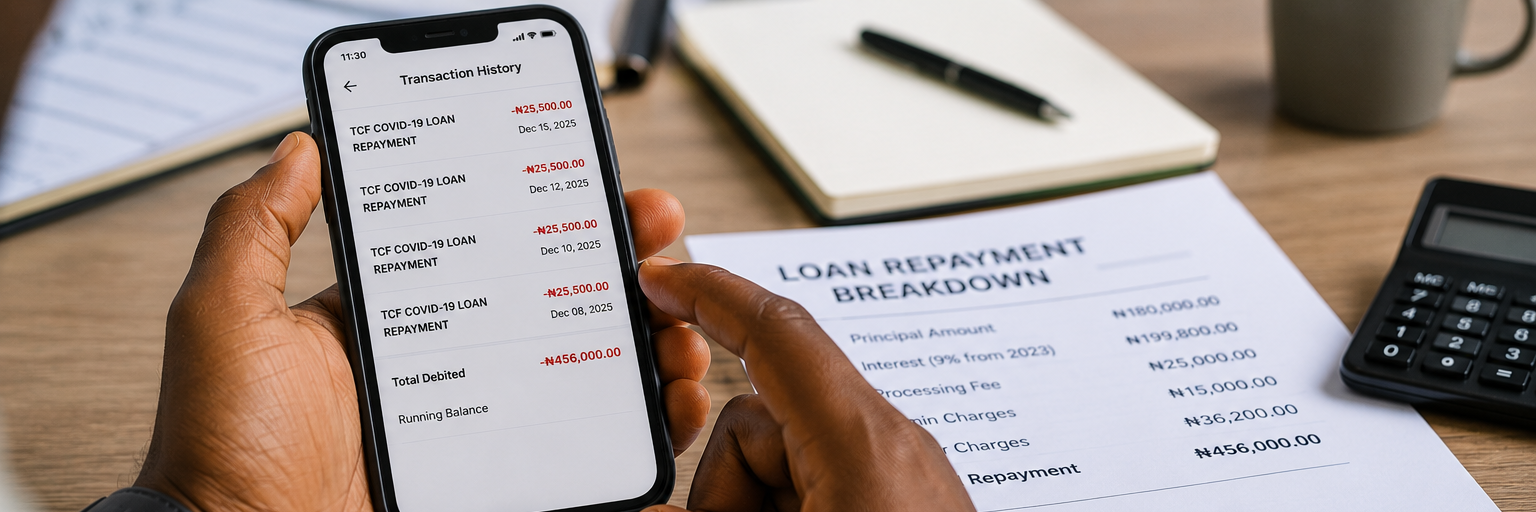
But after charges were deducted, he received ₦164,000.
Emmanuel said the understanding at the time was that the first year would be interest-free, after which a 5% interest rate would apply. But by December 2025, deductions began from his account and eventually rose to ₦456,000.
Concerned by the amount, he requested a breakdown from the bank. It was after reviewing the figures that he said he discovered the interest rate had increased from the 5% he expected to 9% in 2023.
“How does a ₦180,000 loan become ₦456,000?” he asked while recounting his experience.
After calculating the deductions against the loan he received and the interest charged, Emmanuel said he believes he was overcharged by ₦208,000.
He added that the bank later asked him to write a letter requesting an “excess fee reversal,” promising to refund the difference.
Complaints from people who say they never received loans
Even more concerning are cases involving individuals who claim they never received any COVID-19 loan at all.
Some affected persons said they approached the bank after noticing deductions from their accounts or being contacted over outstanding repayments. Instead of investigating possible errors or fraud, they alleged they were instructed to open accounts with NIRSAL Microfinance Bank and submit letters for the “liquidation” of the COVID-19 TCF loan.
 A customer service representative
The complaints have also raised concerns among some beneficiaries about possible documentation errors or identity misuse, although there is currently no public evidence confirming widespread fraud.
As complaints continue to surface, some beneficiaries are now urging others who received the COVID-19 loans to carefully review their repayment records.
Borrowers whose deductions appear higher than expected are being advised to request a full breakdown of charges and formally apply for reversals where discrepancies exist.
The situation also highlights broader concerns about financial literacy and communication during emergency interventions. While the COVID-19 funds may have provided temporary relief during a national crisis, the aftermath is leaving some Nigerians with lingering questions about transparency, consent, and accountability.
Read also: Nigeria Q1 2026 GDP: Trade and real estate outweigh tech


You May Also Like
Berkshire Hathaway (BRK.B) Strikes $6.8B Deal for Taylor Morrison in Abel’s First Mega-Acquisition

Euro wavers amid mixed Eurozone data, rising geopolitical tensions
![[Rappler’s Best] Tony Meloto falls](https://www.rappler.com/tachyon/2026/05/pope-leo-magnifica-humanitas-vatican-may-25-2026-reuters.jpg?resize=75%2C75&crop=83px%2C0px%2C800px%2C800px)
[Rappler’s Best] Tony Meloto falls


Trending News
More
