

How much is $1 in cryptocurrency today?
FinancePolice aims to keep the explanation simple and practical so everyday readers can reproduce the calculation. Use this as a starting point, then verify the live price and fee schedule on the primary sources listed in the article before making any trades.
Quick answer: what $1 in cryptocurrency means
When you ask, “How much is $1 in cryptocurrency today?” the starting point is simple: take a live spot price and divide one US dollar by that price to get a raw coin quantity. This is the basic math behind any converter and the first number to show users, the pre-fee amount, then compare it to a post-fee result.
The raw conversion is only a starting point because quoted results can differ across venues. Exchanges publish fees and some use spreads, and order execution can cause slippage that changes the final amount you receive. For many large-cap coins, the difference between pre-fee and post-fee is tiny; for low-liquidity tokens the difference can be much larger.
To be clear, the raw quantity formula is quantity = 1 / live spot price, which gives the pre-fee amount that a converter should display first. For practical conversions and transparency, show both the pre-fee amount and a post-fee estimate so readers can see the impact of costs.
Why use aggregated spot prices and where they come from
Aggregators combine prices from many exchanges to provide a single spot price, often using volume-weighted averages and filters that remove outliers. That combined spot price is the usual starting point for a quick $1-to-coin conversion because it reduces the noise from any single venue and gives a documented authoritative number. CoinGecko API documentation

Using an aggregator is practical because it returns a single value you can call regularly, which helps a live crypto price converter remain simple and predictable. Aggregation choices and filtering rules matter most for illiquid tokens, where a few trades or a single exchange can skew the apparent price more than with large-cap coins. (See our crypto category for related coverage.)
Aggregator APIs usually publish methodology pages and rate limits you should review before building a converter, and developer pages explain how the spot price is computed and aggregated. CoinMarketCap methodology
Where to get a live spot price (Product)
Common sources for a live spot price include aggregator APIs and direct exchange feeds. Aggregators are fast and documented; direct exchange APIs give venue-specific quotes that may reflect local spreads and order-book depth.
Aggregator APIs usually publish methodology pages and rate limits you should review before building a converter, and developer pages explain how the spot price is computed and aggregated. You can also use the CoinMarketCap API as a direct documented data source.
Step-by-step: how to compute what $1 buys in crypto
Follow clear steps so the result is auditable. Step 1, fetch the live spot price from your chosen source. Step 2, compute raw quantity = 1 / spot price to get the pre-fee number. These two steps give the basic, transparent conversion any reader can reproduce. CoinGecko API documentation
Step 3, apply explicit fees. If an exchange charges a percentage fee, multiply the raw quantity by (1 – fee rate) to get a post-fee estimate. If the exchange publishes a fixed fee per trade, subtract the USD fee first and then divide to get quantity. Show both pre-fee and post-fee so users can compare the impact of fees directly.
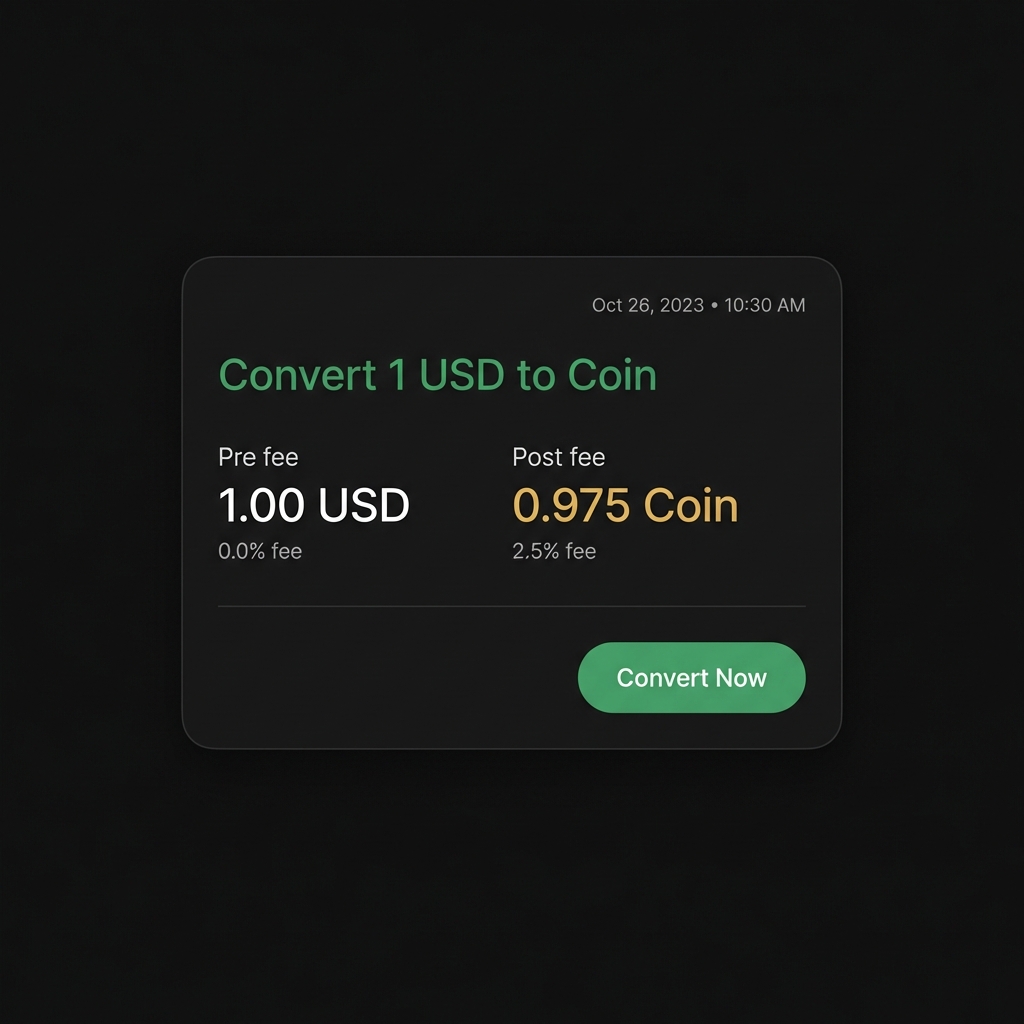
Step 4, estimate slippage and add a slippage buffer if the token is low-liquidity. Step 5, display both numbers with the data source, timestamp, and any fee assumptions so the conversion is auditable.
Adjusting for fees and advertised spreads (CTA)
Exchanges publish maker and taker fees and may apply a spread; consult the exchange fee page before you trade and compare pre-fee and post-fee amounts to see the real difference.
Advertise with FinancePolice
Check the exchange fee page mentioned in this article and compare the pre-fee and post-fee numbers to understand your expected net amount.
Contact FinancePolice about advertising
Some venues present their cost as a visible spread rather than an explicit percentage. To apply a fee factor, either multiply the raw quantity by (1 – fee rate) for percentage fees or compute the net USD available after fixed fees and divide by the spot price for fixed-fee models.
Slippage and liquidity: the implicit execution cost
Slippage is the price movement between submitting an order and its execution and it comes from trading against the order book. For small $1 buys of large-cap tokens the order size is tiny relative to depth, so slippage tends to be negligible in practice. Investopedia slippage definition
For low-liquidity tokens slippage can be large even for small dollar amounts, because order-book depth may be thin and a single market order can move the price. A practical way to estimate slippage is to inspect the order book or use a very small test order and observe the execution price versus the quoted price.
Exchange differences and fee schedules (Question)
Two exchanges can publish the same nominal price but result in different post-fee quantities because of differing fee schedules, spreads, and execution rules. Always check the exchange help or fee page to confirm maker and taker rates before trading. Coinbase fees
Retail execution differences matter: minimum order sizes, different available order types, and whether the venue supports immediate settlement or requires additional steps can change the final amount you receive.
Fetch a reputable live spot price, compute raw quantity = 1 / price, then adjust for explicit fees and expected slippage to estimate the post-fee amount.
When comparing venues, record the fee assumptions, timestamp, and the exact API or feed used so you can reproduce and audit the numbers if needed.
APIs and building a practical converter (Tool)
Keep the data flow minimal: fetch the spot price, compute the raw quantity, apply fee factors, add a slippage buffer if needed, and show both pre-fee and post-fee estimates with a timestamp and source. Use caching and respect rate limits to avoid stale or blocked requests. CoinGecko developer docs
compute a $1-to-coin estimate including fees and slippage
display pre-fee and post-fee estimates
Decision criteria: when to use an aggregator vs a direct exchange quote
Choose a data source based on your needs. Use an aggregator when you want a quick, representative spot price and minimal complexity. Aggregators are useful for a fast live crypto price converter because they provide a single published price rather than many venue snapshots. CoinMarketCap methodology
Use a direct exchange quote when you will execute on that exchange and need an exact post-execution estimate that reflects that venue’s spreads and order-book depth. If the token is low-liquidity, check both to see how much the aggregator and the exchange differ.
Common mistakes and pitfalls to avoid
A frequent error is treating an aggregator spot price as the final execution price without adjusting for fees and slippage; this produces overly optimistic results for low-liquidity tokens. Cache freshness and rate limits can also produce stale results if not handled correctly. CoinGecko API documentation
Another mistake is ignoring explicit exchange fees found on fee pages or assuming every venue charges the same maker/taker rates. Always verify fee pages and include the fee assumptions in any public converter output.
Concrete examples: BTC and ETH walkthroughs
Use the raw quantity formula conceptually for Bitcoin or Ethereum: take the spot price and compute 1 / spot price to get the pre-fee coin amount. For large-cap tokens like BTC and ETH slippage is usually negligible for a $1 trade because order-book depth on major venues is typically sufficient. Chainalysis market liquidity analysis (see our BTC price analysis)
Next, apply an exchange fee factor to the raw quantity to estimate a post-fee amount. If an exchange charges a percentage fee, the math is straightforward: post-fee quantity = raw quantity * (1 – fee rate). If the venue uses a spread, factor that into the effective price before dividing.
Always double-check the exchange’s fee page and, when necessary, inspect order-book depth before trusting the post-fee estimate for a final trade decision. Binance trading fee schedule
Small-cap tokens and extra caution
Small-cap tokens behave differently because thin order books and low trade volume mean large spreads and high slippage for even small-dollar orders. In these cases, the aggregator spot price may not reflect the price at which you can actually buy. Chainalysis market liquidity analysis
Practical safety checks include viewing 24-hour trade volume, inspecting the live order book, and preferring limit orders or tiny test buys. If liquidity metrics look poor, display a slippage warning or apply a conservative buffer to the post-fee estimate.
A one-minute checklist to reproduce the conversion yourself
Five quick steps to reproduce a $1 conversion: fetch a live spot price, compute raw quantity = 1 / price, apply an explicit fee factor or subtract fixed fees, estimate slippage based on order-book depth, and show both pre-fee and post-fee numbers with timestamp and source. CoinGecko API documentation
Record the data source, the timestamp, and the fee assumptions so the conversion is auditable. Consider doing a tiny test order where supported to confirm your estimates match execution.
Conclusion: practical next steps and resources
Recap the flow: get an aggregated spot price or an exchange quote, compute raw quantity, apply fees and a slippage buffer when needed, and present both pre-fee and post-fee numbers for transparency. Use aggregator methodology pages and exchange fee pages to verify assumptions before trading. Visit Finance Police for related coverage.
Before trading, check the exchange fee schedule and consider a small test execution if you plan to buy a low-liquidity token. Treat $1 conversions as illustrative for understanding the steps and likely net amount rather than a promise of exact execution results.
Divide 1 USD by the live spot price to get the pre-fee coin quantity, then apply fees or spreads for a post-fee estimate.
Yes, explicit fees and spreads reduce the post-fee amount; for large-cap tokens the effect is usually small, but it can be meaningful for low-liquidity tokens.
Use reputable aggregator APIs or the exchange you plan to trade on, and verify rate limits and methodology before relying on the number.
Remember that these steps help you estimate likely outcomes; the final execution price can still vary with market conditions and the venue you use.
References
- https://www.coingecko.com/en/api
- https://coinmarketcap.com/alexandria/article/how-coinmarketcap-calculates-cryptocurrency-prices
- https://financepolice.com/advertise/
- https://financepolice.com/category/crypto/
- https://coinmarketcap.com/api/
- https://financepolice.com/
- https://www.investopedia.com/terms/s/slippage.asp
- https://help.coinbase.com/en/coinbase/trading-and-funding/fees/fees
- https://docs.coingecko.com/
- https://blog.chainalysis.com/reports/crypto-market-liquidity-2024
- https://www.binance.com/en/fee/schedule
- https://financepolice.com/bitcoin-price-analysis-btc-slips-below-90000-as-leveraged-liquidations-rock-market/
You May Also Like

‘His And Hers’ Finally Dethroned In Netflix’s Top 10 List By A New Show

United States B2C Ecommerce Business Report 2025: Amazon, Walmart, Apple, Home Depot, Target Lead the $1.8 Trillion Market, Instacart, DoorDash, Uber Eats Expanded Their Presence – Forecast to 2029 – ResearchAndMarkets.com
