

Canton Price Hits a New All-Time High as Crypto Markets Slide—What’s Fueling the Rally?

The post Canton Price Hits a New All-Time High as Crypto Markets Slide—What’s Fueling the Rally? appeared first on Coinpedia Fintech News
With a 5% to 6% increase over the past 24 hours, the Canton price surged to a new ATH at $0.1812, being the top performer. The volume has also increased reasonably by 45%, reaching close to $45 million, which has backed the rally. This move came as most cryptos, including Bitcoin and Ethereum, were experiencing significant upward pressure
Such decoupling is rare during market-wide sell-offs and often signals a different set of drivers at play. As a utility-driven asset tied to Canton, steady demand combined with thin liquidity has magnified upside, enabling the token to outperform despite broader risk-off conditions.
With risk appetite fading elsewhere, Canton’s strength has raised a key question: what is fueling this rally, and why is it unfolding despite the broader market weakness?
Canton Price Prediction for February 2026: Will CC Price Rise to $0.5?
Canton’s rally has stood out sharply against a weakening crypto market, with the price pushing to a fresh all-time high near $0.1812 before entering consolidation. Unlike broader altcoins reacting to Bitcoin’s decline, CC has maintained upside structure, supported by steady spot demand and limited sell pressure. The latest price action suggests the market is transitioning from pure momentum into evaluation mode, where the sustainability of the breakout will depend on how well key support levels and volume dynamics hold.
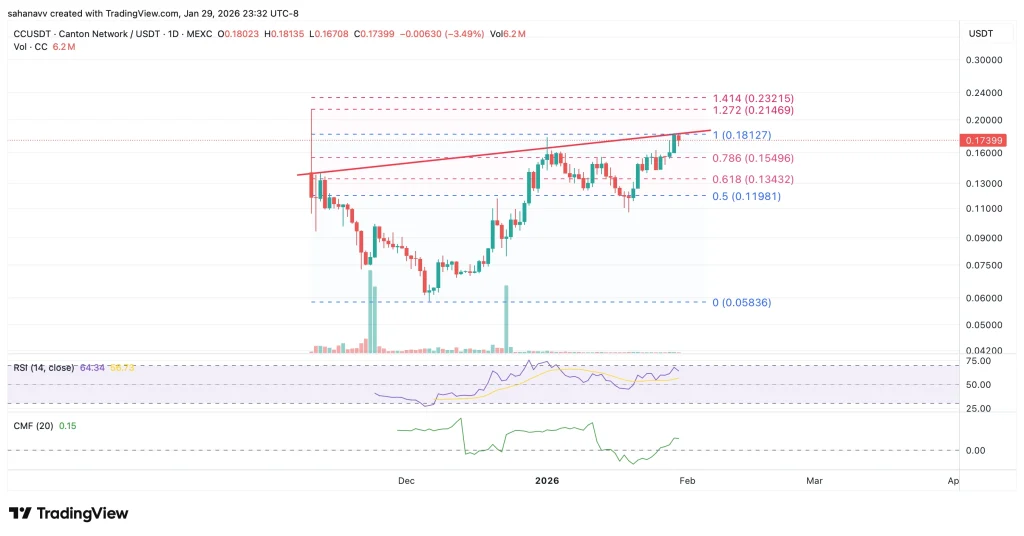
The daily chart shows CC trading above its 0.786 Fibonacci level at $0.155, keeping the bullish structure intact after the ATH breakout. Price remains supported by an ascending trendline, while the RSI holds above 60, signalling sustained momentum rather than exhaustion. The Chaikin Money Flow at ~0.15 confirms positive capital inflows despite the minor pullback. As long as CC holds above the $0.155–$0.150 zone, the trend favours continuation toward higher Fibonacci extensions.
The Final Verdict
Technically, Canton remains in early-stage price discovery, supported by strong momentum indicators and positive money flow. However, a move to $0.50 by February 2026 would require a near-vertical expansion far beyond current Fibonacci extensions, which is unlikely without a major acceleration in volume and demand. A more realistic path would involve consolidation above $0.15, followed by a gradual push toward $0.23–$0.30. While the broader trend remains bullish, $0.50 appears ambitious in the near term without fresh catalysts.
You May Also Like

Shibarium May No Longer Turbocharge Shiba Inu Price Rally, Here’s Reason

Shiba Inu to Encrypt All Transactions by Q2 2026 as Privacy Era Takes Hold
