The dominant force in this cycle comes from institutions. The four major cryptocurrencies, BTC, ETH, SOL, and BNB, have all hit new highs, but only BTC and BNB have continued to rise by over 40% since breaking through their all-time highs. SOL achieved a breakout earlier this year thanks to Trump's coin launch, while ETH experienced a revaluation mid-year driven by DAT buying, but neither has yet reached a new high. The Federal Reserve cut interest rates last night. How far can this round of institutional-led market trends go? 1. The institutional configuration logic of the three major currencies The positioning of crypto assets directly determines their long-term value, and different positioning corresponds to different institutional configuration logic. Bitcoin: The anti-inflation property of digital gold Positioned as "digital gold," its long-term logic is strongly tied to the fiat currency inflation cycle. Data shows that its market capitalization growth is synchronized with Global M2 and negatively correlated with the US dollar index. Its core value lies in its "inflation resistance" and value preservation and appreciation, making it a fundamental target for institutional investment. Ethereum: The Institutional Narrative Dividend of the World Computer Positioned as the "World Computer," although the foundation's "Layer 2 scaling" narrative has failed to gain traction in the capital market, its stable system, with 10 years of zero downtime, has capitalized on the development of institutional narratives such as US dollar stablecoins, RWAs, and the tokenization of US stocks. It has shrugged off the collapse of the Web3 narrative, and with the crucial push from DAT, has achieved a revaluation of its market capitalization. Ethereum, with its stability and security, will become the settlement network for institutional applications. Solana: The Active Advantage of Online Capital Markets Positioned as an "Internet Capital Market," Solana (ICM) stands for on-chain asset issuance, trading, and clearing. It has experienced a resurgence following the collapse of FTX. Year-to-date, it accounts for 46% of on-chain trading volume, with over 3 million daily active users year-round, making it the most active blockchain network. Solana, with its superior performance and high liquidity, will be the catalyst for the crypto-native on-chain trading ecosystem. The three platforms have distinct positioning, leading to different institutional investment logic. Traditional financial institutions first understand the value of Bitcoin, then consider developing their institutional business based on Ethereum, and finally, perhaps recognize the value of on-chain transactions. This is a typical path: question, understand, and become a part of it. Second, institutional holdings of the three major currencies show gradient differences The institutional holdings data of BTC, ETH, and SOL show obvious gradient differences, which also reflects the degree and rhythm of institutions' recognition of these three projects. Chart by: IOBC Capital From the comparison, we can see that institutional holdings of BTC and ETH account for > 18% of the circulating supply; SOL currently only accounts for 9.5%, and there may be room for replenishment. 3. SOL DAT: New Trends in Crypto Concept Stocks In the past month or so, 18 SOL DAT companies have come onto the scene, directly pushing SOL up by more than 50% from its August low. The louder SOL DAT company: Chart by: IOBC Capital Among the existing SOL DAT companies, Forward Industries, led by Multicoin Capital founder Kyle Samani, may become the SOL DAT leader. Unlike BTC DAT, which simply hoards coins, many SOL DAT companies will build their own Solana Validators, so that this is not limited to the "NAV game". Instead of simply waiting for token appreciation, they will continue to obtain cash flow income through the Validator business. This strategy is equivalent to "hoarding coins + mining", which is both long-term and profitable in the short term. 4. Crypto Concept Stocks: A Mapping of Capital Market Betting Crypto concept stocks are a new bridge between traditional capital and the crypto market. The degree of recognition of various Crypto businesses by the traditional financial market is also reflected in the stock price performance of crypto concept stocks. Chart by: IOBC Capital Looking back at the crypto stocks that have seen significant gains this round, we can see two common characteristics: 1. Only by betting big can a valuation reassessment be achieved. There are 189 publicly listed companies holding BTC, but only 30 hold 70% of their stock market capitalization, and only 12 hold more than 10,000 BTC—and these 12 have seen significant gains. A similar pattern is observed among listed ETH DATs. A superficial DAT strategy can only cause short-term stock price fluctuations and cannot substantially boost stock market capitalization or liquidity. 2. Business synergy can amplify commercial value. Transforming a single-point business into a multifaceted industry chain layout can amplify commercial value. For example, Robinhood, through its expansion into cryptocurrency trading, real-world asset trading (RRE), and participation in the USDG stablecoin, has formed a closed-loop business cycle for capital flow, leading to record highs in its stock price. Conversely, while Trump Media has also invested heavily in crypto (holding BTC, applying for an ETH ETF, and issuing tokens like Trump, Melania, and WLFI), the lack of synergy between its businesses has ultimately led to a lackluster market response to both its stock and its token. Ending The project philosophies of Bitcoin, Ethereum, and Solana correspond to three instincts of human beings when facing the future: survival, order, and flow.The dominant force in this cycle comes from institutions. The four major cryptocurrencies, BTC, ETH, SOL, and BNB, have all hit new highs, but only BTC and BNB have continued to rise by over 40% since breaking through their all-time highs. SOL achieved a breakout earlier this year thanks to Trump's coin launch, while ETH experienced a revaluation mid-year driven by DAT buying, but neither has yet reached a new high. The Federal Reserve cut interest rates last night. How far can this round of institutional-led market trends go? 1. The institutional configuration logic of the three major currencies The positioning of crypto assets directly determines their long-term value, and different positioning corresponds to different institutional configuration logic. Bitcoin: The anti-inflation property of digital gold Positioned as "digital gold," its long-term logic is strongly tied to the fiat currency inflation cycle. Data shows that its market capitalization growth is synchronized with Global M2 and negatively correlated with the US dollar index. Its core value lies in its "inflation resistance" and value preservation and appreciation, making it a fundamental target for institutional investment. Ethereum: The Institutional Narrative Dividend of the World Computer Positioned as the "World Computer," although the foundation's "Layer 2 scaling" narrative has failed to gain traction in the capital market, its stable system, with 10 years of zero downtime, has capitalized on the development of institutional narratives such as US dollar stablecoins, RWAs, and the tokenization of US stocks. It has shrugged off the collapse of the Web3 narrative, and with the crucial push from DAT, has achieved a revaluation of its market capitalization. Ethereum, with its stability and security, will become the settlement network for institutional applications. Solana: The Active Advantage of Online Capital Markets Positioned as an "Internet Capital Market," Solana (ICM) stands for on-chain asset issuance, trading, and clearing. It has experienced a resurgence following the collapse of FTX. Year-to-date, it accounts for 46% of on-chain trading volume, with over 3 million daily active users year-round, making it the most active blockchain network. Solana, with its superior performance and high liquidity, will be the catalyst for the crypto-native on-chain trading ecosystem. The three platforms have distinct positioning, leading to different institutional investment logic. Traditional financial institutions first understand the value of Bitcoin, then consider developing their institutional business based on Ethereum, and finally, perhaps recognize the value of on-chain transactions. This is a typical path: question, understand, and become a part of it. Second, institutional holdings of the three major currencies show gradient differences The institutional holdings data of BTC, ETH, and SOL show obvious gradient differences, which also reflects the degree and rhythm of institutions' recognition of these three projects. Chart by: IOBC Capital From the comparison, we can see that institutional holdings of BTC and ETH account for > 18% of the circulating supply; SOL currently only accounts for 9.5%, and there may be room for replenishment. 3. SOL DAT: New Trends in Crypto Concept Stocks In the past month or so, 18 SOL DAT companies have come onto the scene, directly pushing SOL up by more than 50% from its August low. The louder SOL DAT company: Chart by: IOBC Capital Among the existing SOL DAT companies, Forward Industries, led by Multicoin Capital founder Kyle Samani, may become the SOL DAT leader. Unlike BTC DAT, which simply hoards coins, many SOL DAT companies will build their own Solana Validators, so that this is not limited to the "NAV game". Instead of simply waiting for token appreciation, they will continue to obtain cash flow income through the Validator business. This strategy is equivalent to "hoarding coins + mining", which is both long-term and profitable in the short term. 4. Crypto Concept Stocks: A Mapping of Capital Market Betting Crypto concept stocks are a new bridge between traditional capital and the crypto market. The degree of recognition of various Crypto businesses by the traditional financial market is also reflected in the stock price performance of crypto concept stocks. Chart by: IOBC Capital Looking back at the crypto stocks that have seen significant gains this round, we can see two common characteristics: 1. Only by betting big can a valuation reassessment be achieved. There are 189 publicly listed companies holding BTC, but only 30 hold 70% of their stock market capitalization, and only 12 hold more than 10,000 BTC—and these 12 have seen significant gains. A similar pattern is observed among listed ETH DATs. A superficial DAT strategy can only cause short-term stock price fluctuations and cannot substantially boost stock market capitalization or liquidity. 2. Business synergy can amplify commercial value. Transforming a single-point business into a multifaceted industry chain layout can amplify commercial value. For example, Robinhood, through its expansion into cryptocurrency trading, real-world asset trading (RRE), and participation in the USDG stablecoin, has formed a closed-loop business cycle for capital flow, leading to record highs in its stock price. Conversely, while Trump Media has also invested heavily in crypto (holding BTC, applying for an ETH ETF, and issuing tokens like Trump, Melania, and WLFI), the lack of synergy between its businesses has ultimately led to a lackluster market response to both its stock and its token. Ending The project philosophies of Bitcoin, Ethereum, and Solana correspond to three instincts of human beings when facing the future: survival, order, and flow.

After the interest rate cut, how far can the institutional bull market go?

2025/09/18 19:00

The dominant force in this cycle comes from institutions.

The four major cryptocurrencies, BTC, ETH, SOL, and BNB, have all hit new highs, but only BTC and BNB have continued to rise by over 40% since breaking through their all-time highs. SOL achieved a breakout earlier this year thanks to Trump's coin launch, while ETH experienced a revaluation mid-year driven by DAT buying, but neither has yet reached a new high.

The Federal Reserve cut interest rates last night. How far can this round of institutional-led market trends go?

1. The institutional configuration logic of the three major currencies

The positioning of crypto assets directly determines their long-term value, and different positioning corresponds to different institutional configuration logic.

Bitcoin: The anti-inflation property of digital gold

Positioned as "digital gold," its long-term logic is strongly tied to the fiat currency inflation cycle. Data shows that its market capitalization growth is synchronized with Global M2 and negatively correlated with the US dollar index. Its core value lies in its "inflation resistance" and value preservation and appreciation, making it a fundamental target for institutional investment.

Ethereum: The Institutional Narrative Dividend of the World Computer

Positioned as the "World Computer," although the foundation's "Layer 2 scaling" narrative has failed to gain traction in the capital market, its stable system, with 10 years of zero downtime, has capitalized on the development of institutional narratives such as US dollar stablecoins, RWAs, and the tokenization of US stocks. It has shrugged off the collapse of the Web3 narrative, and with the crucial push from DAT, has achieved a revaluation of its market capitalization. Ethereum, with its stability and security, will become the settlement network for institutional applications.

Solana: The Active Advantage of Online Capital Markets

Positioned as an "Internet Capital Market," Solana (ICM) stands for on-chain asset issuance, trading, and clearing. It has experienced a resurgence following the collapse of FTX. Year-to-date, it accounts for 46% of on-chain trading volume, with over 3 million daily active users year-round, making it the most active blockchain network. Solana, with its superior performance and high liquidity, will be the catalyst for the crypto-native on-chain trading ecosystem.

The three platforms have distinct positioning, leading to different institutional investment logic. Traditional financial institutions first understand the value of Bitcoin, then consider developing their institutional business based on Ethereum, and finally, perhaps recognize the value of on-chain transactions. This is a typical path: question, understand, and become a part of it.

Second, institutional holdings of the three major currencies show gradient differences

The institutional holdings data of BTC, ETH, and SOL show obvious gradient differences, which also reflects the degree and rhythm of institutions' recognition of these three projects.
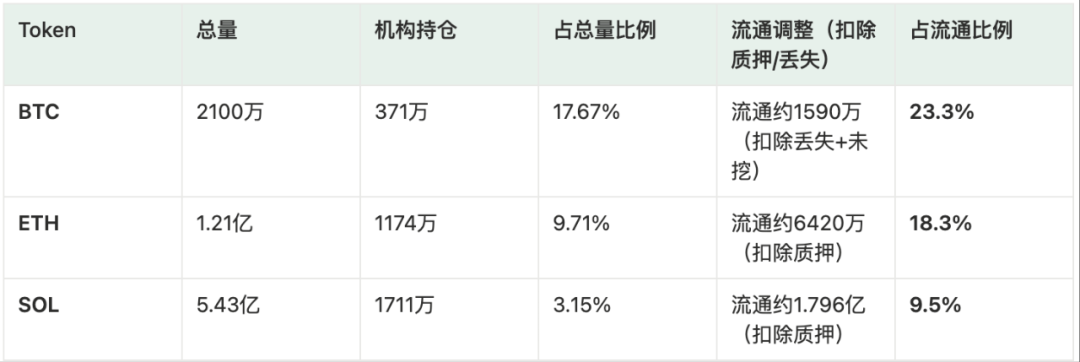
 Chart by: IOBC Capital

From the comparison, we can see that institutional holdings of BTC and ETH account for > 18% of the circulating supply; SOL currently only accounts for 9.5%, and there may be room for replenishment.

In the past month or so, 18 SOL DAT companies have come onto the scene, directly pushing SOL up by more than 50% from its August low.

The louder SOL DAT company:
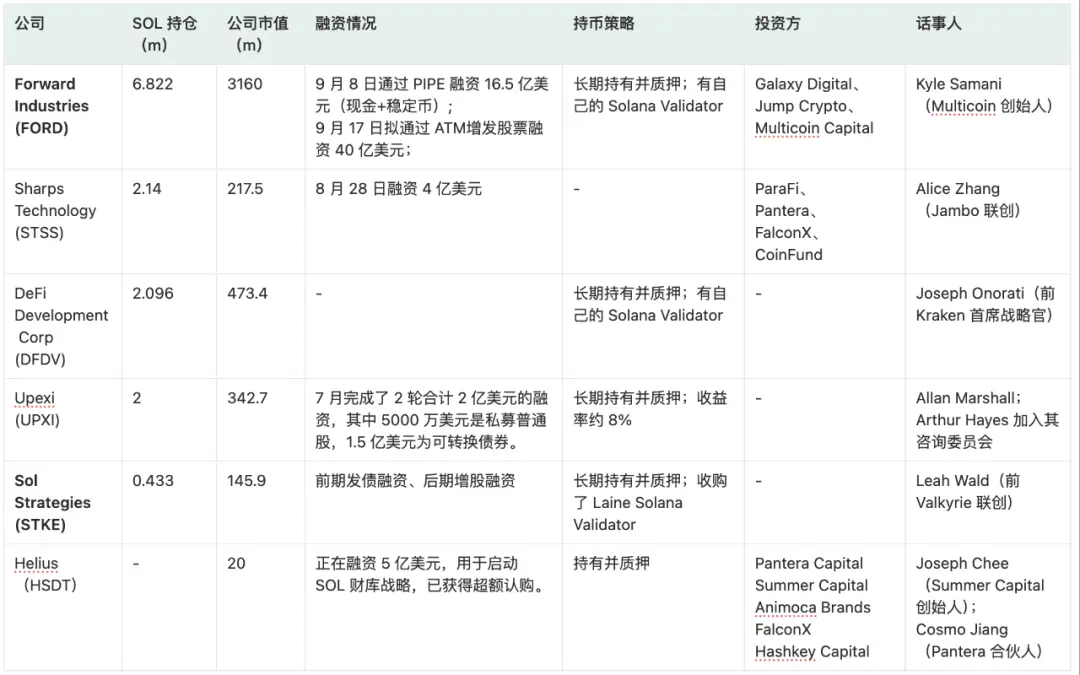
 Chart by: IOBC Capital

Among the existing SOL DAT companies, Forward Industries, led by Multicoin Capital founder Kyle Samani, may become the SOL DAT leader.

Unlike BTC DAT, which simply hoards coins, many SOL DAT companies will build their own Solana Validators, so that this is not limited to the "NAV game". Instead of simply waiting for token appreciation, they will continue to obtain cash flow income through the Validator business. This strategy is equivalent to "hoarding coins + mining", which is both long-term and profitable in the short term.

4. Crypto Concept Stocks: A Mapping of Capital Market Betting

Crypto concept stocks are a new bridge between traditional capital and the crypto market. The degree of recognition of various Crypto businesses by the traditional financial market is also reflected in the stock price performance of crypto concept stocks.
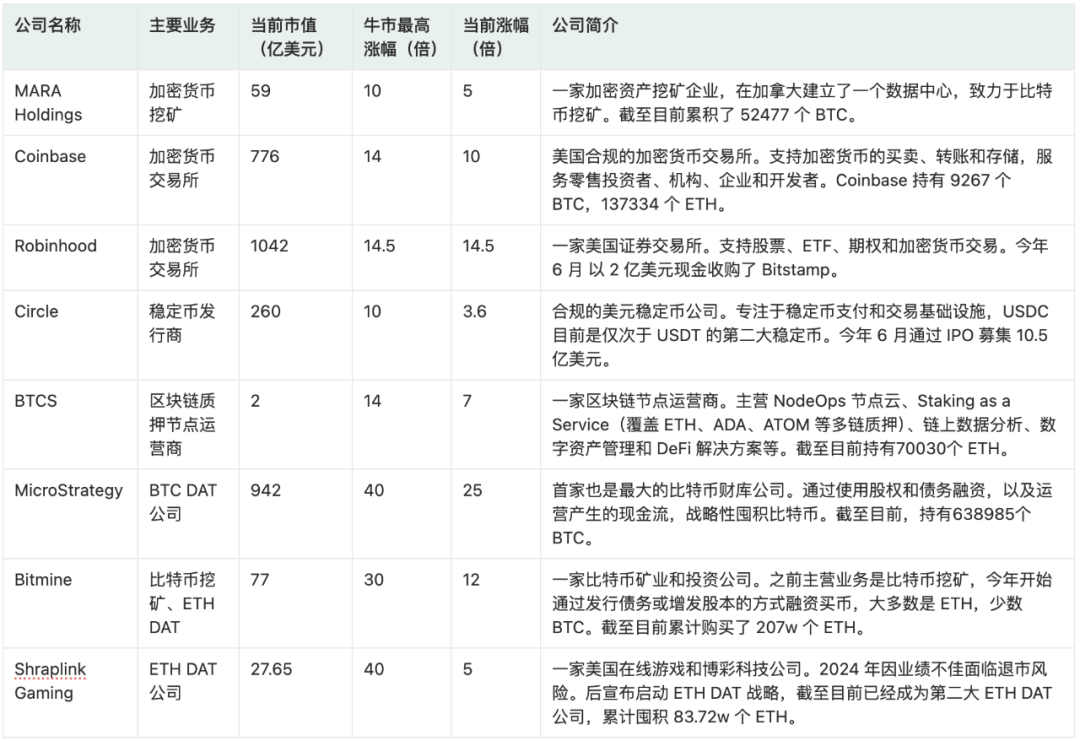
 Chart by: IOBC Capital

Looking back at the crypto stocks that have seen significant gains this round, we can see two common characteristics:

1. Only by betting big can a valuation reassessment be achieved. There are 189 publicly listed companies holding BTC, but only 30 hold 70% of their stock market capitalization, and only 12 hold more than 10,000 BTC—and these 12 have seen significant gains. A similar pattern is observed among listed ETH DATs. A superficial DAT strategy can only cause short-term stock price fluctuations and cannot substantially boost stock market capitalization or liquidity.

2. Business synergy can amplify commercial value. Transforming a single-point business into a multifaceted industry chain layout can amplify commercial value. For example, Robinhood, through its expansion into cryptocurrency trading, real-world asset trading (RRE), and participation in the USDG stablecoin, has formed a closed-loop business cycle for capital flow, leading to record highs in its stock price. Conversely, while Trump Media has also invested heavily in crypto (holding BTC, applying for an ETH ETF, and issuing tokens like Trump, Melania, and WLFI), the lack of synergy between its businesses has ultimately led to a lackluster market response to both its stock and its token.

Ending

The project philosophies of Bitcoin, Ethereum, and Solana correspond to three instincts of human beings when facing the future: survival, order, and flow.

Market Opportunity
Solana Logo
Solana Price(SOL)
$130.19
$130.19$130.19
-0.20%
USD
Solana (SOL) Live Price Chart
Disclaimer: The articles reposted on this site are sourced from public platforms and are provided for informational purposes only. They do not necessarily reflect the views of MEXC. All rights remain with the original authors. If you believe any content infringes on third-party rights, please contact service@support.mexc.com for removal. MEXC makes no guarantees regarding the accuracy, completeness, or timeliness of the content and is not responsible for any actions taken based on the information provided. The content does not constitute financial, legal, or other professional advice, nor should it be considered a recommendation or endorsement by MEXC.

You May Also Like

Why It Could Outperform Pepe Coin And Tron With Over $7m Already Raised

Why It Could Outperform Pepe Coin And Tron With Over $7m Already Raised

The post Why It Could Outperform Pepe Coin And Tron With Over $7m Already Raised appeared on BitcoinEthereumNews.com. Crypto News 17 September 2025 | 20:26 While meme tokens like Pepe Coin and established networks such as Tron attract headlines, many investors are now searching for projects that combine innovation, revenue-sharing and real-world utility. BlockchainFX ($BFX), currently in presale at $0.024 ahead of an expected $0.05 launch, is quickly becoming one of the best cryptos to buy today. With $7m already secured and a unique model spanning multiple asset classes, it is positioning itself as a decentralised super app and a contender to surpass older altcoins. Early Presale Pricing Creates A Rare Entry Point BlockchainFX’s presale pricing structure has been designed to reward early participants. At $0.024, buyers secure a lower entry price than later rounds, locking in a cost basis more than 50% below the projected $0.05 launch price. As sales continue to climb beyond $7m, each new stage automatically increases the token price. This built-in mechanism creates a clear advantage for early investors and explains why the project is increasingly cited in “best presales to buy now” discussions across the crypto space. High-Yield Staking Model Shares Platform Revenue Beyond its presale appeal, BlockchainFX is creating a high-yield staking model that gives holders a direct share of platform revenue. Every time a trade occurs on its platform, 70% of trading fees flow back into the $BFX ecosystem: 50% of collected fees are automatically distributed to stakers in both BFX and USDT. 20% is allocated to daily buybacks of $BFX, adding demand and price support. Half of the bought-back tokens are permanently burned, steadily reducing supply. Rewards are based on the size of each member’s BFX holdings and capped at $25,000 USDT per day to ensure sustainability. This structure transforms token ownership from a speculative bet into an income-generating position, a rare feature among today’s altcoins. A Multi-Asset Platform…
Share
BitcoinEthereumNews2025/09/18 03:35
U.Today Crypto Review: Ethereum (ETH) Loses 30-Day Progress, Shiba Inu’s (SHIB) End of Bears; Bitcoin’s (BTC) Last Recovery Chance

U.Today Crypto Review: Ethereum (ETH) Loses 30-Day Progress, Shiba Inu’s (SHIB) End of Bears; Bitcoin’s (BTC) Last Recovery Chance

The post U.Today Crypto Review: Ethereum (ETH) Loses 30-Day Progress, Shiba Inu’s (SHIB) End of Bears; Bitcoin’s (BTC) Last Recovery Chance appeared on BitcoinEthereumNews
Share
BitcoinEthereumNews2026/01/22 10:51
Headwind Helps Best Wallet Token

Headwind Helps Best Wallet Token

The post Headwind Helps Best Wallet Token appeared on BitcoinEthereumNews.com. Google has announced the launch of a new open-source protocol called Agent Payments Protocol (AP2) in partnership with Coinbase, the Ethereum Foundation, and 60 other organizations. This allows AI agents to make payments on behalf of users using various methods such as real-time bank transfers, credit and debit cards, and, most importantly, stablecoins. Let’s explore in detail what this could mean for the broader cryptocurrency markets, and also highlight a presale crypto (Best Wallet Token) that could explode as a result of this development. Google’s Push for Stablecoins Agent Payments Protocol (AP2) uses digital contracts known as ‘Intent Mandates’ and ‘Verifiable Credentials’ to ensure that AI agents undertake only those payments authorized by the user. Mandates, by the way, are cryptographically signed, tamper-proof digital contracts that act as verifiable proof of a user’s instruction. For example, let’s say you instruct an AI agent to never spend more than $200 in a single transaction. This instruction is written into an Intent Mandate, which serves as a digital contract. Now, whenever the AI agent tries to make a payment, it must present this mandate as proof of authorization, which will then be verified via the AP2 protocol. Alongside this, Google has also launched the A2A x402 extension to accelerate support for the Web3 ecosystem. This production-ready solution enables agent-based crypto payments and will help reshape the growth of cryptocurrency integration within the AP2 protocol. Google’s inclusion of stablecoins in AP2 is a massive vote of confidence in dollar-pegged cryptocurrencies and a huge step toward making them a mainstream payment option. This widens stablecoin usage beyond trading and speculation, positioning them at the center of the consumption economy. The recent enactment of the GENIUS Act in the U.S. gives stablecoins more structure and legal support. Imagine paying for things like data crawls, per-task…
Share
BitcoinEthereumNews2025/09/18 01:27