

U.S. Dollar Posts Largest Weekly Decline Since April Following Jobs Report
Key Takeaways
- Greenback stabilized near a two-week low following disappointing June employment figures that dampened Federal Reserve rate hike speculation
- Japanese yen remains vulnerable near four-decade lows around 161-162 versus the dollar, fueling intervention speculation
- Minutes from the Fed’s June policy meeting set for release this week, though new leadership may limit forward guidance
- Euro maintained position near $1.1435 while sterling traded around $1.3351, both sliding marginally on Monday
- Seoul inaugurated 24-hour onshore dollar-won trading operations in a historic market development
The greenback showed modest strength on Monday but continues trading near its lowest point in two weeks following last week’s disappointing U.S. employment report that dampened speculation about additional Federal Reserve interest rate increases. Meanwhile, the Japanese yen remains precariously positioned near a four-decade weak point, keeping market participants vigilant for potential government market intervention.
Greenback Weakens Following Disappointing Employment Report
The dollar index, measuring the currency’s performance against a basket of six major counterparts, hovered around 100.9 during early Monday sessions. This follows last week’s 0.5% decline — marking its most significant weekly retreat since April.
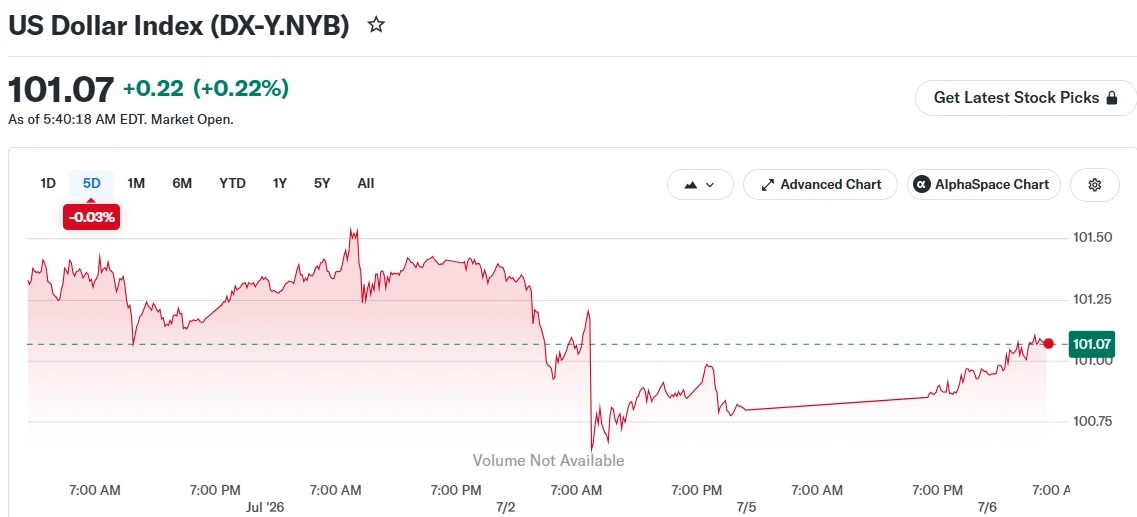 US Dollar Index (DX-Y.NYB)
The catalyst was June’s nonfarm payrolls data, revealing a sharp deceleration in employment growth. This development sparked questions about whether the Federal Reserve possesses sufficient justification to continue its rate-hiking campaign.
Nevertheless, the downside remained limited. The unemployment rate actually declined, which OCBC strategists indicated reflects continued labor market tightness. They preserved their forecast calling for modest 2-3% dollar gains during the latter half of 2026.
The euro maintained its position at $1.1435, hovering near a two-week peak. Sterling traded at $1.3351. Both currencies experienced approximately 0.1% declines on Monday as the dollar regained some ground.
Declining oil prices have contributed to moderating inflation worries, which similarly influenced reduced rate-hike expectations.
Market attention now shifts to the Federal Reserve’s June meeting minutes, scheduled for release later this week. Policymakers during that gathering reportedly adopted a more hawkish stance due to persistent inflation pressures.
However, newly appointed Fed Chair Kevin Warsh has indicated the central bank has provided excessive forward guidance historically. Commonwealth Bank of Australia analysts cautioned the minutes might deliver less clarity than typically expected as a consequence.
Japanese Currency Near Four-Decade Weakness, Intervention Speculation Persists
The yen exchanged hands at approximately 161.57-161.82 against the dollar on Monday, barely removed from the 162.84 level reached last week — representing the weakest position since 1986.
The Bank of Japan implemented a rate increase in June and suggested additional hikes could materialize. Nevertheless, the substantial differential between U.S. and Japanese interest rates continues exerting considerable downward pressure on the yen.
Japanese authorities have issued verbal cautions against speculative yen selling in recent weeks. Tokyo last conducted market intervention during late April and early May, driving the dollar-yen exchange rate down toward 155. The pair swiftly recovered back above 160.
Analysts remain split on whether any fresh intervention would produce enduring effects. OCBC strategists suggested intervention alone probably cannot reverse the pair’s trajectory without genuine shifts in economic fundamentals.
ING analysts emphasized that more hawkish messaging from the Bank of Japan remains necessary to prevent dollar-yen from ascending further.
Marc Chandler of Bannockburn Global Forex observed that options market dynamics indicate major investors have been purchasing short-dated dollar puts as insurance against an unexpected intervention action.
In other developments, South Korea’s won remained stable as Seoul introduced 24-hour onshore dollar-won trading, representing a milestone toward achieving developed market classification on the MSCI index. The Chinese yuan and Singapore dollar both weakened slightly.
The post U.S. Dollar Posts Largest Weekly Decline Since April Following Jobs Report appeared first on Blockonomi.


You May Also Like

15 pusat pemindahan kekal bencana operasi berperingkat mulai tahun ini

Dave Portnoy Vows To Ride Bitcoin To Zero After Buying At $100K

Intel (INTC) Stock Climbs to $120.35 as Institutional Buying Accelerates



