Macro investor Michael Green, who is known as the Cassandra of Passive Investing, has sharpened his critique of Bitcoin, arguing that its design makes it economically brittle and socially corrosive, setting up a winner-takes-all outcome “like a Monopoly game.” In an interview with journalist Phil Rosen, Green said “the most important thing to understand is […]Macro investor Michael Green, who is known as the Cassandra of Passive Investing, has sharpened his critique of Bitcoin, arguing that its design makes it economically brittle and socially corrosive, setting up a winner-takes-all outcome “like a Monopoly game.” In an interview with journalist Phil Rosen, Green said “the most important thing to understand is […]

Bitcoin Could End ‘Like A Monopoly Game,’ Claims Wall Street Cassandra Michael Green

2025/11/26 11:00

Macro investor Michael Green, who is known as the Cassandra of Passive Investing, has sharpened his critique of Bitcoin, arguing that its design makes it economically brittle and socially corrosive, setting up a winner-takes-all outcome “like a Monopoly game.”

In an interview with journalist Phil Rosen, Green said “the most important thing to understand is that Bitcoin has marketed itself as multiple different things to try to appeal to investors at various points in time,” but has failed on its original brief. Under the Satoshi white paper, he noted, BTC was meant to be “a peer-to-peer payment system” that removed the dependence of payment rails on banks. “By moving to a distributed ledger and a peer-to-peer system, we’d be able to get banks out of the system.”

“That’s been a total failure,” he argued. “There are almost no real transactions that are occurring in Bitcoin. We have tons of transaction activity in speculative markets trading Bitcoin, but the actual quantity of retail transactions or peer-to-peer payments that occur over the Bitcoin network are remarkably small.”

Green distinguished between emergency government “money printing” and day-to-day bank credit. “There’s money printing that comes from the government, in which they largely are trying to smooth over mistakes that have been made,” he said, describing stimulus as a way to “basically create a do-over by printing money.”

More frequent, he added, is the expansion of money when banks lend: when a bank grants a $1,000 loan, “they simply created a new account for you called your checking account that has $1,000 in it… That expansion is totally normal and it has a credit function associated with it.”

“Bitcoin destroys the ability to do that because it was intentionally designed to skip the banking system,” Green contended. Rather than a full credit system, “it is effectively just a monetary system where what you’re really seeing is Bitcoin is effectively the tokens that are paid to the accounting firms that keep the blockchain in order… every Bitcoin that’s out there is basically a payment to Deloitte & Touche.”

Why Bitcoin Is Supposedly A ‘Monopoly Game’

Because its supply is capped and banks cannot create new BTC via lending, “no new money can be created. There is no capacity for mistake forgiveness in that type of framework,” he said. That makes the system “very limiting. Interest rates and credit spreads are just too high for a real economy framework.” Despite dramatic price gains, he concluded, Bitcoin “hasn’t emerged as a payment system” or “in any meaningful economic context.”

Green’s harshest criticism was distributional. “Because we have a finite quantity of it, ultimately, that means everybody who is born after the Bitcoin has been released finds themselves in deficit,” he said. He compared this to “a serf living off land in the 14th century that didn’t belong to you,” where “there was no other land that would ever become available to you.” That, he argued, “creates a deeply unequal society.”

Although he said he “was an early adopter of Bitcoin” and initially thought it was “a really interesting idea” of private money, he now believes “if you run through the simulation, Bitcoin, because there is a finite quantity of tokens, means that it basically plays like a Monopoly game.”

In that game, “you can’t add additional players as the game is being played… because they’re just going to lose very quickly. They don’t have any other properties. They don’t have any other money.” “How does every game of Monopoly end?” he asked. “Someone wins. With a single winner.”

“That’s exactly what we’ve seen within Bitcoin,” Green maintained, citing “increased concentration” and a Gini coefficient “beyond anything we’ve ever seen in the real world.” Instead of democratizing access, he argued, Bitcoin builds “a system that ultimately collapses upon itself and locks people out. Far from democratizing access, it does the exact opposite.”

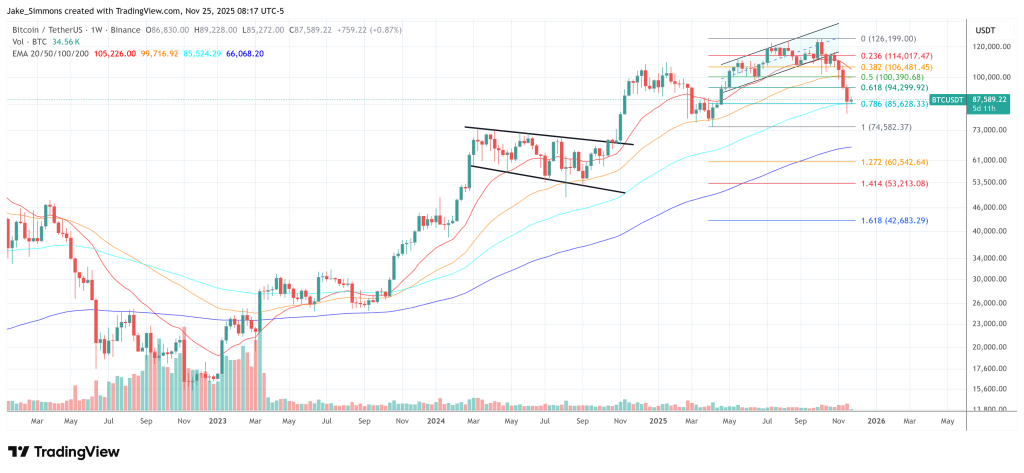
At press time, BTC traded at $87,589.
Bitcoin price
Disclaimer: The articles reposted on this site are sourced from public platforms and are provided for informational purposes only. They do not necessarily reflect the views of MEXC. All rights remain with the original authors. If you believe any content infringes on third-party rights, please contact service@support.mexc.com for removal. MEXC makes no guarantees regarding the accuracy, completeness, or timeliness of the content and is not responsible for any actions taken based on the information provided. The content does not constitute financial, legal, or other professional advice, nor should it be considered a recommendation or endorsement by MEXC.

You May Also Like

Jerome Powell’s Press Conference: Crucial Insights Unveiled for the Market’s Future

Jerome Powell’s Press Conference: Crucial Insights Unveiled for the Market’s Future

BitcoinWorld Jerome Powell’s Press Conference: Crucial Insights Unveiled for the Market’s Future The financial world, including the dynamic cryptocurrency market, often hangs on every word from the Federal Reserve. Recently, Jerome Powell’s press conference following the Federal Open Market Committee (FOMC) meeting concluded, leaving investors and analysts dissecting his remarks for clues about the future economic direction. This event is always a pivotal moment, shaping expectations for inflation, interest rates, and the overall stability of global markets. What Were the Key Takeaways from Jerome Powell’s Press Conference? During Jerome Powell’s press conference, the Fed Chair provided an update on the central bank’s monetary policy decisions and its economic outlook. His statements often reiterate the Fed’s dual mandate: achieving maximum employment and stable prices. This time was no different, with a strong emphasis on managing persistent inflation. Key points from the recent discussion included: Inflation Control: Powell emphasized the Fed’s unwavering commitment to bringing inflation back down to its 2% target. He reiterated that the fight against rising prices remains the top priority, even if it entails some economic slowdown. Interest Rate Policy: While the Fed’s stance on future interest rate adjustments was discussed, the path remains data-dependent. Powell indicated that decisions would continue to be made meeting-by-meeting, based on incoming economic data. Economic Projections: The updated Summary of Economic Projections (SEP) offered insights into the Fed’s forecasts for GDP growth, unemployment, and inflation. These projections help market participants gauge the central bank’s expectations for the economy’s trajectory. Quantitative Tightening (QT): The ongoing process of reducing the Fed’s balance sheet, known as quantitative tightening, was also a topic. This reduction in liquidity in the financial system has broad implications for asset prices. How Did Jerome Powell’s Remarks Impact Cryptocurrency Markets? The conclusion of Jerome Powell’s press conference often sends ripples through traditional financial markets, and cryptocurrencies are increasingly sensitive to these macroeconomic shifts. Digital assets, once thought to be uncorrelated, now frequently react to the Fed’s monetary policy signals. Higher interest rates, for instance, tend to make riskier assets like cryptocurrencies less attractive. This is because investors might prefer safer, interest-bearing investments. Consequently, we often see increased volatility in Bitcoin (BTC) and Ethereum (ETH) prices immediately following such announcements. The tightening of financial conditions, driven by the Fed, reduces overall liquidity in the system, which can put downward pressure on asset valuations across the board. However, some argue that this growing correlation signifies crypto’s increasing integration into the broader financial ecosystem. It suggests that institutional investors and mainstream finance are now paying closer attention to digital assets, treating them more like other risk-on investments. Navigating the Economic Landscape After Jerome Powell’s Press Conference For cryptocurrency investors, understanding the implications of Jerome Powell’s press conference is crucial for making informed decisions. The Fed’s policy trajectory directly influences the availability of capital and investor sentiment, which are key drivers for crypto valuations. Here are some actionable insights for navigating this environment: Stay Informed: Regularly monitor Fed announcements and economic data releases. Understanding the macroeconomic backdrop is as important as analyzing individual crypto projects. Assess Risk Tolerance: In periods of economic uncertainty and tighter monetary policy, a reassessment of personal risk tolerance is wise. Diversification within your crypto portfolio and across different asset classes can mitigate potential downsides. Focus on Fundamentals: While market sentiment can be swayed by macro news, projects with strong fundamentals, clear use cases, and robust development teams tend to perform better in the long run. Long-Term Perspective: Cryptocurrency markets are known for their volatility. Adopting a long-term investment horizon can help weather short-term fluctuations driven by macro events like Fed meetings. The challenges include potential continued volatility and reduced liquidity. However, opportunities may arise from market corrections, allowing strategic investors to accumulate assets at lower prices. In summary, Jerome Powell’s press conference provides essential guidance on the Fed’s economic strategy. Its conclusions have a profound impact on financial markets, including the dynamic world of cryptocurrencies. Staying informed, understanding the nuances of monetary policy, and maintaining a strategic investment approach are paramount for navigating the evolving economic landscape. The Fed’s actions underscore the interconnectedness of traditional finance and the burgeoning digital asset space. Frequently Asked Questions (FAQs) Q1: What is the Federal Open Market Committee (FOMC)? A1: The FOMC is the monetary policy-making body of the Federal Reserve System. It sets the federal funds rate target and directs open market operations, influencing the availability of money and credit in the U.S. economy. Q2: How do the Fed’s interest rate decisions typically affect cryptocurrency markets? A2: Generally, when the Fed raises interest rates, it makes borrowing more expensive and reduces liquidity in the financial system. This often leads investors to shy away from riskier assets like cryptocurrencies, potentially causing prices to decline. Conversely, lower rates can stimulate investment in riskier assets. Q3: What does “data-dependent” mean in the context of Fed policy? A3: “Data-dependent” means that the Federal Reserve’s future monetary policy decisions, such as interest rate adjustments, will primarily be based on the latest economic data. This includes inflation reports, employment figures, and GDP growth, rather than a predetermined schedule. Q4: Should I change my cryptocurrency investment strategy based on Jerome Powell’s press conference? A4: While it’s crucial to be aware of the macroeconomic environment shaped by Jerome Powell’s press conference, drastic changes to a well-researched investment strategy may not always be necessary. It’s recommended to review your portfolio, assess your risk tolerance, and consider if your strategy aligns with the current economic outlook, focusing on long-term fundamentals. If you found this analysis helpful, please consider sharing it with your network! Your insights and shares help us reach more readers interested in the intersection of traditional finance and the exciting world of cryptocurrencies. Spread the word! To learn more about the latest crypto market trends, explore our article on key developments shaping Bitcoin price action. This post Jerome Powell’s Press Conference: Crucial Insights Unveiled for the Market’s Future first appeared on BitcoinWorld.
Share
Coinstats2025/09/18 16:25