The post Ledger Flags Unpatchable MediaTek Chip Flaw Risking Crypto appeared on BitcoinEthereumNews.com. Ledger Donjon shows EM pulses can break MediaTek Dimensity 7300 boot ROM Attackers gain EL3 control within minutes once the timing window is mapped Ledger says smartphone wallets face lasting risk and need secure-element hardware Security researchers at Ledger have identified a critical, unpatchable vulnerability in the silicon architecture of MediaTek’s Dimensity 7300 processor, effectively shattering the “Root of Trust” for millions of Android devices.  The findings, published by Ledger’s Donjon unit, detail a hardware-level exploit that allows attackers to bypass all security layers and seize control of the device’s most privileged execution mode.  The ‘Silicon Permanence’ Problem The vulnerability resides in the Boot ROM, the immutable “read-only” code baked into the processor during manufacturing. Because this code is etched into the silicon, it cannot be altered or patched by over-the-air (OTA) software updates. The investigation focused on the MediaTek MT6878, a 4 nanometer system on chip used in numerous Android handsets. According to the report, the vulnerability resides in the processor’s boot ROM, a read only component that drives the initial startup sequence. Because that logic is baked into silicon and cannot be rewritten, the defect remains permanent for devices built on the affected chip. Related: Ledger Exposes Potential Security Flaw in Trezor Wallets During testing, researchers applied short electromagnetic pulses at carefully measured intervals during the boot process. This interference allowed them to bypass memory-access protections and elevate execution to EL3, the top privilege tier in the ARM architecture. Once the timing window was identified, each laboratory attempt took roughly one second and succeeded between 0.1% and 1% of the time, enabling a complete compromise in minutes. Unpatchable Flaw Undermines Smartphone Wallet Security The research details how such attacks could weaken smartphone based private key storage even further. The team noted that users already face threats from malware,… The post Ledger Flags Unpatchable MediaTek Chip Flaw Risking Crypto appeared on BitcoinEthereumNews.com. Ledger Donjon shows EM pulses can break MediaTek Dimensity 7300 boot ROM Attackers gain EL3 control within minutes once the timing window is mapped Ledger says smartphone wallets face lasting risk and need secure-element hardware Security researchers at Ledger have identified a critical, unpatchable vulnerability in the silicon architecture of MediaTek’s Dimensity 7300 processor, effectively shattering the “Root of Trust” for millions of Android devices.  The findings, published by Ledger’s Donjon unit, detail a hardware-level exploit that allows attackers to bypass all security layers and seize control of the device’s most privileged execution mode.  The ‘Silicon Permanence’ Problem The vulnerability resides in the Boot ROM, the immutable “read-only” code baked into the processor during manufacturing. Because this code is etched into the silicon, it cannot be altered or patched by over-the-air (OTA) software updates. The investigation focused on the MediaTek MT6878, a 4 nanometer system on chip used in numerous Android handsets. According to the report, the vulnerability resides in the processor’s boot ROM, a read only component that drives the initial startup sequence. Because that logic is baked into silicon and cannot be rewritten, the defect remains permanent for devices built on the affected chip. Related: Ledger Exposes Potential Security Flaw in Trezor Wallets During testing, researchers applied short electromagnetic pulses at carefully measured intervals during the boot process. This interference allowed them to bypass memory-access protections and elevate execution to EL3, the top privilege tier in the ARM architecture. Once the timing window was identified, each laboratory attempt took roughly one second and succeeded between 0.1% and 1% of the time, enabling a complete compromise in minutes. Unpatchable Flaw Undermines Smartphone Wallet Security The research details how such attacks could weaken smartphone based private key storage even further. The team noted that users already face threats from malware,…

Ledger Flags Unpatchable MediaTek Chip Flaw Risking Crypto

2025/12/05 04:59
  • Ledger Donjon shows EM pulses can break MediaTek Dimensity 7300 boot ROM
  • Attackers gain EL3 control within minutes once the timing window is mapped
  • Ledger says smartphone wallets face lasting risk and need secure-element hardware

Security researchers at Ledger have identified a critical, unpatchable vulnerability in the silicon architecture of MediaTek’s Dimensity 7300 processor, effectively shattering the “Root of Trust” for millions of Android devices. 

The findings, published by Ledger’s Donjon unit, detail a hardware-level exploit that allows attackers to bypass all security layers and seize control of the device’s most privileged execution mode. 

The ‘Silicon Permanence’ Problem

The vulnerability resides in the Boot ROM, the immutable “read-only” code baked into the processor during manufacturing. Because this code is etched into the silicon, it cannot be altered or patched by over-the-air (OTA) software updates.

The investigation focused on the MediaTek MT6878, a 4 nanometer system on chip used in numerous Android handsets. According to the report, the vulnerability resides in the processor’s boot ROM, a read only component that drives the initial startup sequence. Because that logic is baked into silicon and cannot be rewritten, the defect remains permanent for devices built on the affected chip.

Related: Ledger Exposes Potential Security Flaw in Trezor Wallets

During testing, researchers applied short electromagnetic pulses at carefully measured intervals during the boot process. This interference allowed them to bypass memory-access protections and elevate execution to EL3, the top privilege tier in the ARM architecture. Once the timing window was identified, each laboratory attempt took roughly one second and succeeded between 0.1% and 1% of the time, enabling a complete compromise in minutes.

Unpatchable Flaw Undermines Smartphone Wallet Security

The research details how such attacks could weaken smartphone based private key storage even further. The team noted that users already face threats from malware, remote exploitation and supply chain issues, and that a hardware level weakness expands the surface that determined attackers can probe. The report adds that digital wallet applications on consumer phones are exposed because they rely on general purpose components that were never engineered to resist hands on electrical fault attacks.

A cryptocurrency wallet functions by holding a user’s public and private keys and facilitating asset transfers. Software wallets operate on devices connected to the internet, while hardware wallets store keys offline within dedicated secure elements designed to withstand both physical and digital intrusion attempts.

In comments included within the report, MediaTek stated that electromagnetic fault-injection attacks were outside the intended security scope for the MT6878, noting that the chipset was designed for mass-market electronics rather than high-security systems. The company added that products requiring elevated protection, such as hardware wallets, should incorporate countermeasures specifically built for EMFI resistance.

Ledger’s team concluded that devices based on the MT6878 remain exposed because the underlying flaw is embedded in unmodifiable silicon. They added that secure-element components remain essential for individuals who depend on self-custody or conduct sensitive cryptographic operations, since smartphones cannot reasonably exclude hardware attack scenarios.

Related: Apple MacOS/iOS Security Flaw: CZ Warns Crypto Users at Risk

Disclaimer: The information presented in this article is for informational and educational purposes only. The article does not constitute financial advice or advice of any kind. Coin Edition is not responsible for any losses incurred as a result of the utilization of content, products, or services mentioned. Readers are advised to exercise caution before taking any action related to the company.

Source: https://coinedition.com/crypto-wallet-risk-ledger-donjon-exposes-mediatek-chips-security-flaw/

Disclaimer: The articles reposted on this site are sourced from public platforms and are provided for informational purposes only. They do not necessarily reflect the views of MEXC. All rights remain with the original authors. If you believe any content infringes on third-party rights, please contact service@support.mexc.com for removal. MEXC makes no guarantees regarding the accuracy, completeness, or timeliness of the content and is not responsible for any actions taken based on the information provided. The content does not constitute financial, legal, or other professional advice, nor should it be considered a recommendation or endorsement by MEXC.

You May Also Like

XRP Whales Sell $780 Million, Will Price Fall Below $2?

XRP Whales Sell $780 Million, Will Price Fall Below $2?

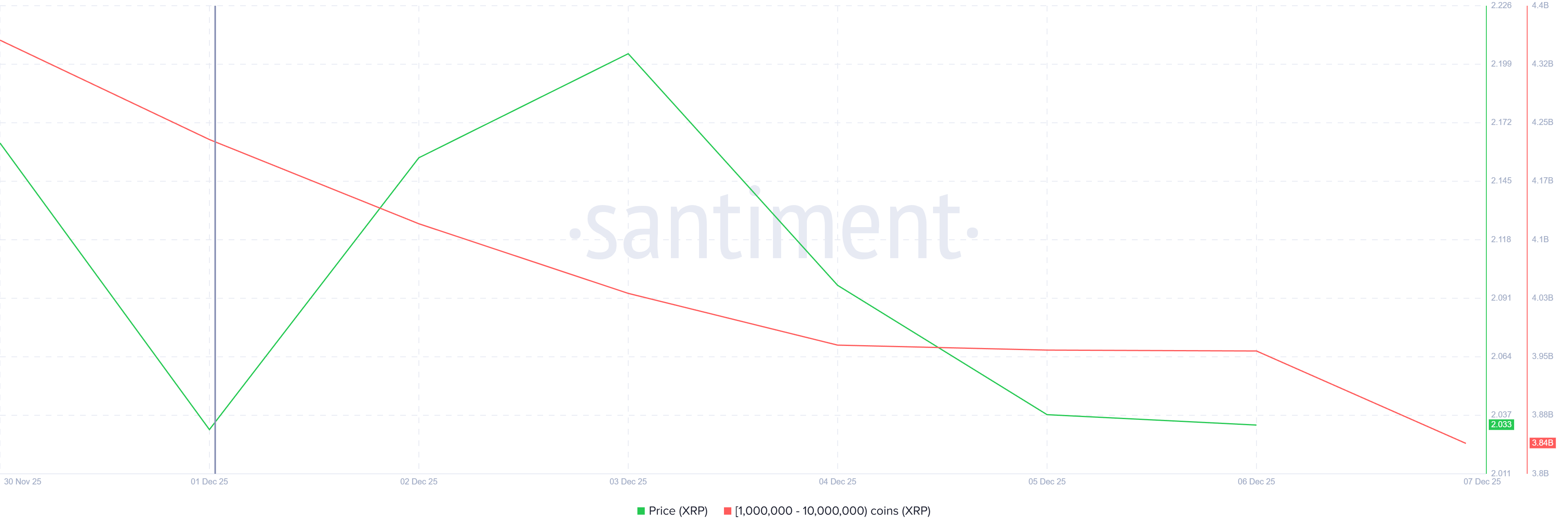
XRP price has returned to the critical $2 level after repeated failed breakout attempts, reflecting uncertainty across the market.  Each attempt to rally above near-term resistance has been met with selling pressure, pulling the altcoin back toward this psychological floor. XRP Holders Are In A Tug Of War Whales have begun offloading substantial portions of their holdings. Over the past seven days, wallets holding between 1 million and 10 million XRP have sold more than 390 million XRP, worth over $783 million at current prices.  This level of distribution shows clear frustration among high-value holders who expected a stronger recovery. Such selling typically weighs heavily on market sentiment, especially when driven by a cohort that can significantly influence liquidity. Want more token insights like this? Sign up for Editor Harsh Notariya’s Daily Crypto Newsletter here. XRP Whale Holding. Source: Santiment Despite whale distribution, long-term holders are counteracting downward pressure. HODL Waves data shows that the share of XRP supply held by the 1-year to 2-year cohort increased from 8.58 percent to 9.81 percent in the past week.  This signals growing conviction among maturing holders who acquired XRP less than a year ago and are now opting to retain their tokens through volatility. This steadiness is helping stabilize XRP at $2, softening the impact of whale selling. XRP HODL Waves. Source: Glassnode XRP Price Notes A Dip XRP is trading at $2.00 at the time of writing, a crucial psychological and technical support level. In recent days, price movements have repeatedly gravitated back to this point, confirming its importance in maintaining market structure. Given the opposing pressure from whale selling and long-term holder accumulation, XRP will likely remain rangebound between $2.00 and $2.20 until a clear directional catalyst emerges. A shift in sentiment or improved market conditions would be needed to break this consolidation pattern. XRP Price Analysis. Source: TradingView However, if bearish momentum strengthens and whale selling accelerates, XRP could fall through the $1.94 support. Such a breakdown would expose the price to a deeper decline toward $1.85, invalidating any near-term bullish expectations.
Share
Coinstats2025/12/08 06:30