The post Aptos (APT) Price Down 90%—But Here’s Why Major Investors Aren’t Walking Away appeared first on Coinpedia Fintech News Aptos has become one of the toughest stories in the altcoin market this year. The APT price has collapsed nearly 90% from its highs close to $20, turning what was once a next-gen Layer-1 contender into one of the most heavily discounted cryptos of the cycle. Retail faith has evaporated, builders have gone quiet, and …The post Aptos (APT) Price Down 90%—But Here’s Why Major Investors Aren’t Walking Away appeared first on Coinpedia Fintech News Aptos has become one of the toughest stories in the altcoin market this year. The APT price has collapsed nearly 90% from its highs close to $20, turning what was once a next-gen Layer-1 contender into one of the most heavily discounted cryptos of the cycle. Retail faith has evaporated, builders have gone quiet, and …

Aptos (APT) Price Down 90%—But Here’s Why Major Investors Aren’t Walking Away

2025/12/05 17:02
Aptos Staking Rewards Slashed by 50%_ New Proposal Triggers Debate

The post Aptos (APT) Price Down 90%—But Here’s Why Major Investors Aren’t Walking Away appeared first on Coinpedia Fintech News

Aptos has become one of the toughest stories in the altcoin market this year. The APT price has collapsed nearly 90% from its highs close to $20, turning what was once a next-gen Layer-1 contender into one of the most heavily discounted cryptos of the cycle. Retail faith has evaporated, builders have gone quiet, and social sentiment has flatlined. Yet, one group still hasn’t walked away—the major investors who backed Aptos early.
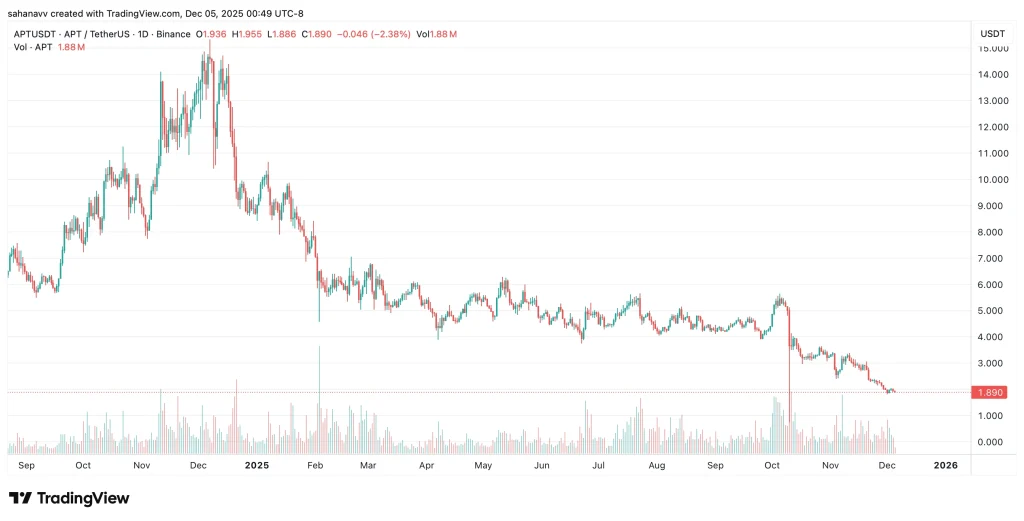
apt price

A Crisis Driven by Tokenomics, Not Technology

Aptos is not in trouble because its tech lags behind competitors. It’s struggling because its tokenomics worked against its own ecosystem.

A massive total supply of 1.18 billion APT and a circulating supply already crossing 733 million created a relentless supply overhang. Monthly unlocks of 11.3 million tokens continuously flood the market, generating steady sell pressure. November’s unlock—worth tens of millions—lined up with yet another sharp dump.

The unlock design was too aggressive for a young L1 still trying to build narrative momentum. Staking exacerbated the issue: almost 80% of the supply is staked at ~7% yield. This looks healthy on paper, but creates:

  • Continuous dilution
  • Locked liquidity
  • A shortage of new buyers whenever the unlocks hit

This combination crushed momentum long before the market did.

A Chain Without a Clear Identity in a Competitive Market

The ecosystem’s challenge isn’t inactivity—it’s direction. On-chain data shows stablecoin growth, RWA initiatives, and partnerships, yet no breakout consumer app to define Aptos.

Meanwhile:

  • Solana captured retail culture, DEX dominance, and meme velocity
  • Sui gained developer mindshare in the Move-language niche
  • Ethereum L2s pulled in real DeFi capital

Aptos ended up in the middle—good tech, but no narrative powerful enough to attract attention in a market where attention is oxygen.

So Why Haven’t Big Investors Left?

Despite the brutal year, Aptos still holds long-term value drivers that institutional backers care about:

  1. Genuine RWA Traction: Aptos is quietly becoming a serious player in real-world asset infrastructure, with Paxos, BlackRock-linked initiatives, and other enterprise players building rails on the network.
  1. Rising App Revenue: Even as the token bleeds, protocol revenue and user engagement have improved—suggesting that the ecosystem is maturing beneath the surface.
  1. Big Backers Play the Long Game: Major investors rarely abandon a project during drawdowns. As long as fundamentals hold—developer talent, scalability, and Move-based security—Aptos remains a long-term bet worth defending.

The Road to Recovery: A Necessary Reset

Aptos is not dead. It’s at a reset phase, and the next steps will determine its future. Critical fixes include:

  • Tokenomic restructuring: burns, reduced unlock velocity, sustainable staking
  • Introducing liquid staking to unlock liquidity without mass selling
  • Building at least one viral consumer app
  • Owning a strong identity: “Institutional-grade RWAs + AI tooling on Move.”

If Aptos can execute even half of this ahead of the next liquidity cycle, a recovery toward the $5–$6 range becomes realistic. Beyond that, new highs depend on one thing alone—delivery, not promises.

Disclaimer: The articles reposted on this site are sourced from public platforms and are provided for informational purposes only. They do not necessarily reflect the views of MEXC. All rights remain with the original authors. If you believe any content infringes on third-party rights, please contact service@support.mexc.com for removal. MEXC makes no guarantees regarding the accuracy, completeness, or timeliness of the content and is not responsible for any actions taken based on the information provided. The content does not constitute financial, legal, or other professional advice, nor should it be considered a recommendation or endorsement by MEXC.

You May Also Like

Short-Term Bitcoin Profits Dominate For The First Time Since 2023

Short-Term Bitcoin Profits Dominate For The First Time Since 2023

The post Short-Term Bitcoin Profits Dominate For The First Time Since 2023 appeared on BitcoinEthereumNews.com. Bitcoin is making another attempt to break the downtrend that has kept the crypto king capped since late October. Price is hovering near $91,000 as investors watch a rare shift in market structure unfold.  For the first time in more than two and a half years, short-term holders have surpassed long-term holders in realized profits, creating both opportunities and risks for BTC. Sponsored Sponsored Bitcoin Sees Some Shift The MVRV Long/Short Difference highlights a notable change in Bitcoin’s profit distribution. A positive reading usually signals long-term holders hold more unrealized gains, while a negative value indicates short-term holders are ahead. In Bitcoin’s case, the difference has dipped into negative territory for the first time since March 2023. This marks 30 months since short-term holders last led in profits. Such dominance raises concerns because short-term holders tend to sell aggressively when volatility increases. Their profit-taking behavior could add pressure on BTC’s price if the broader market weakens, especially during attempts to break the downtrend. Want more token insights like this? Sign up for Editor Harsh Notariya’s Daily Crypto Newsletter here. Bitcoin MVRV Long/Short Difference. Source: Santiment Sponsored Sponsored Despite this shift, Bitcoin’s broader momentum shows encouraging signs. Exchange net position change data confirms rising outflows across major platforms, signaling a shift in investor accumulation. BTC leaving exchanges is often treated as a bullish indicator, reflecting confidence in long-term appreciation. This trend suggests that many traders view the $90,000 range as a reasonable bottom zone and are preparing for a potential recovery. Sustained outflows support price stability and strengthen the probability of BTC breaking above immediate resistance levels. Bitcoin Exchange Net Position Change. Source: Glassnode BTC Price Is Trying Its Best Bitcoin is trading at $91,330 at the time of writing, positioned just below the $91,521 resistance. Reclaiming this level and flipping it into support…
Share
BitcoinEthereumNews2025/12/08 05:57
OKX founder responds to Moore Threads co-founder 1,500 BTC debt

OKX founder responds to Moore Threads co-founder 1,500 BTC debt

The post OKX founder responds to Moore Threads co-founder 1,500 BTC debt appeared on BitcoinEthereumNews.com. The successful stock market debut of Moore Threads, a company that’s being touted as China’s answer to Nvidia, has been overshadowed by resurfaced allegations that link one of its co-founders to an unpaid cryptocurrency debt that has been lingering for roughly a decade. Shares in the GPU maker skyrocketed to as much as 470% on Thursday following its initial public offering (IPO) on the Shanghai Stock Exchange, valuing the company at around RMB 282 billion ($39.9 billion). However, as the success was being celebrated online, a social media post revived claims that Moore Threads’ co-founder Li Feng borrowed 1,500 Bitcoins from Mingxing “Star” Xu, founder and CEO of cryptocurrency exchange OKX, and never repaid the loan. Crypto past with OKX founder resurfaces In an X post, AB Kuai.Dong referenced Feng’s involvement in a 2017 initial coin offering that raised 5,000 ETH alongside controversial angel investor Xue Manzi. Feng allegedly dismissed the Bitcoin loan, stating, “It was just that Xu Mingxing’s investment in me had failed.” Xu responded to the post with a conciliatory message, writing, “People cannot always remain in the shadow of negative history. Face the future and contribute more positive energy.” He added, “Let the legal system handle the debt issue,” and offered blessings to every entrepreneur. Feng reportedly partnered with Xue Manzi and Li Xiaolai in 2017 to launch Malego Coin, which was later renamed Alpaca Coin MGD. The project reportedly raised approximately 5,000 ETH, but it was around this period that China banned ICOs, allowing regulators to crack down on what they viewed as speculative excess and potential fraud in the cryptocurrency sector. The Bitcoin loan dispute appears separate from the ICO controversy. According to sources familiar with the matter, the original loan agreement was dated December 17, 2014, with an expiry of December 16, 2016.…
Share
BitcoinEthereumNews2025/12/08 06:13