Binance announces the delisting of four USDT perpetual contracts effective January 21, 2026, impacting BID, DMC, ZRC, and TANSSI.Binance announces the delisting of four USDT perpetual contracts effective January 21, 2026, impacting BID, DMC, ZRC, and TANSSI.

Binance to Delist Four USDT-Margined Perpetual Contracts
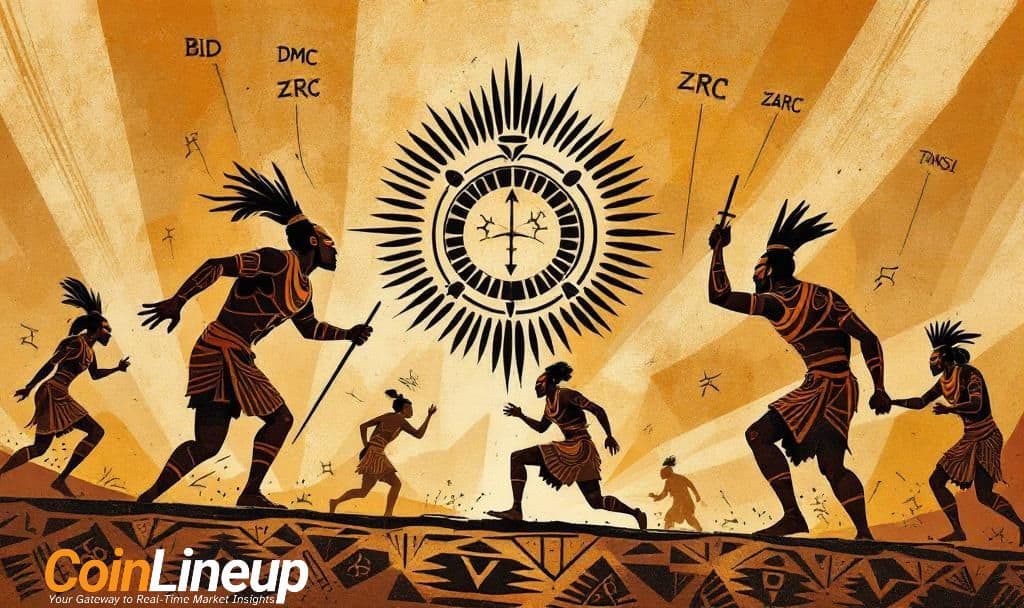
Binance to Delist Four USDT-Margined Perpetual Contracts
Key Takeaways:
  • Binance delists perpetual contracts impacting four cryptocurrencies.
  • Affected trading ends January 21, 2026.
  • Potential volatility and reduced liquidity anticipated.

Binance will delist four USDT-margined perpetual contracts, including BIDUSDT, DMCUSDT, ZRCUSDT, and TANSSIUSDT, on January 21, 2026. Users must close positions by 08:30 UTC to prevent forced settlement amid potential volatility.

Binance announced the removal of four USDT-margined perpetual contracts—BIDUSDT, DMCUSDT, ZRCUSDT, and TANSSIUSDT—effective January 21, 2026, post-settlement at 09:00 UTC.

The decision impacts traders by potentially increasing market volatility and liquidity challenges. Immediate impacts could influence existing positions, enforcing closure before the deadline.

Binance’s decision involves no cited leadership commentary. Delisting involves perpetual contracts exclusively, with spot markets unaffected. Market participants must be aware of the potential liquidity challenges as the deadline approaches.

Users face enforced settlement should they not close positions. Immediate financial consequences appear limited, yet traders could experience losses if positions remain unmanaged.

Long-term market monitoring is advisable for traders, ensuring strategic planning. Historical trends suggest minimal precedent for such delistings, creating an uncertain future for these contracts. Policy adjustments, technological advancements, or market trends could influence future outcomes, requiring vigilance from all stakeholders.


Market Opportunity
TANSSI Logo
TANSSI Price(TANSSI)
$0.004347
$0.004347$0.004347
-2.48%
USD
TANSSI (TANSSI) Live Price Chart
Disclaimer: The articles reposted on this site are sourced from public platforms and are provided for informational purposes only. They do not necessarily reflect the views of MEXC. All rights remain with the original authors. If you believe any content infringes on third-party rights, please contact service@support.mexc.com for removal. MEXC makes no guarantees regarding the accuracy, completeness, or timeliness of the content and is not responsible for any actions taken based on the information provided. The content does not constitute financial, legal, or other professional advice, nor should it be considered a recommendation or endorsement by MEXC.

You May Also Like

The Channel Factories We’ve Been Waiting For

The Channel Factories We’ve Been Waiting For

The post The Channel Factories We’ve Been Waiting For appeared on BitcoinEthereumNews.com. Visions of future technology are often prescient about the broad strokes while flubbing the details. The tablets in “2001: A Space Odyssey” do indeed look like iPads, but you never see the astronauts paying for subscriptions or wasting hours on Candy Crush.  Channel factories are one vision that arose early in the history of the Lightning Network to address some challenges that Lightning has faced from the beginning. Despite having grown to become Bitcoin’s most successful layer-2 scaling solution, with instant and low-fee payments, Lightning’s scale is limited by its reliance on payment channels. Although Lightning shifts most transactions off-chain, each payment channel still requires an on-chain transaction to open and (usually) another to close. As adoption grows, pressure on the blockchain grows with it. The need for a more scalable approach to managing channels is clear. Channel factories were supposed to meet this need, but where are they? In 2025, subnetworks are emerging that revive the impetus of channel factories with some new details that vastly increase their potential. They are natively interoperable with Lightning and achieve greater scale by allowing a group of participants to open a shared multisig UTXO and create multiple bilateral channels, which reduces the number of on-chain transactions and improves capital efficiency. Achieving greater scale by reducing complexity, Ark and Spark perform the same function as traditional channel factories with new designs and additional capabilities based on shared UTXOs.  Channel Factories 101 Channel factories have been around since the inception of Lightning. A factory is a multiparty contract where multiple users (not just two, as in a Dryja-Poon channel) cooperatively lock funds in a single multisig UTXO. They can open, close and update channels off-chain without updating the blockchain for each operation. Only when participants leave or the factory dissolves is an on-chain transaction…
Share
BitcoinEthereumNews2025/09/18 00:09
Superstate Raises Over $82 Million to Develop Onchain Capital Markets

Superstate Raises Over $82 Million to Develop Onchain Capital Markets

Superstate announced that it has raised $82.5 million in a Series B funding round. The capital will be used to develop infrastructure for issuing and trading shares
Share
Incrypted2026/01/23 00:13
Valicor Brings Financial Education to Second High School in Underserved Community

Valicor Brings Financial Education to Second High School in Underserved Community

Partnership with Ramsey Education expands from Cincinnati to Michigan, equipping students with essential money management skills. MONROE, Ohio., Jan. 22, 2026 /
Share
AI Journal2026/01/22 23:50