Chipper Cash, an African fintech that offers consumer payments, cross-border transfers, and US dollar virtual cards, stopped burning cash in the final quarter ofChipper Cash, an African fintech that offers consumer payments, cross-border transfers, and US dollar virtual cards, stopped burning cash in the final quarter of

Chipper Cash stops burning cash after restructuring business

Chipper Cash, an African fintech that offers consumer payments, cross-border transfers, and US dollar virtual cards, stopped burning cash in the final quarter of 2025, generating enough operating revenue to cover its day-to-day expenses.

The milestone comes after years of restructuring and a sharp reset in fintech funding, underscoring the growing importance of cash discipline for African consumer fintechs still chasing scale.

The turnaround leans on a handful of core markets. Nigeria and Uganda are among its leading revenue drivers, alongside demand for US dollar virtual cards, a highly-placed source close to Chipper’s operations told TechCabal. The cards became more relevant as consumers struggled to pay for global services with local bank cards.

Quarterly free cash flow rose steadily and edged above zero in the final quarter of 2025, according to co-founder and chief executive Ham Serunjogi, who shared the update in a LinkedIn post on Tuesday.
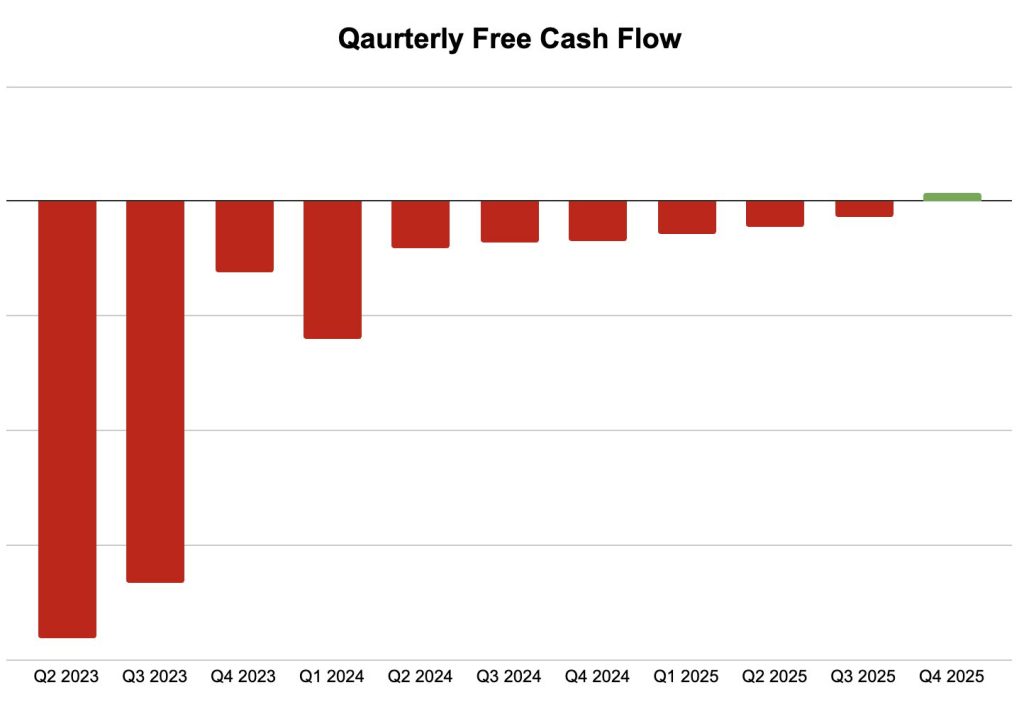
Image: Ham Serugonji on LinkedIn

“Achieving this as one of Africa’s few scaled fintechs – with hundreds of employees across the globe – is hard, especially considering the headwinds over the last few years,” Serunjogi said. 

Chipper Cash moved away from rapid expansion to tighter control of margins and cash flow. Serugonji said the results showed the business could endure and secure its long-term viability.   

“This is a direct result of their (employees’) dedication, proving that we can build a durable institution that will serve the continent for decades to come,” he said. 

Chipper did not disclose any figures.  Two former employees familiar with its finances told TechCabal the company is now profitable and has about 24 months of runway.

Chipper did not respond to a request for comments.

Nigeria’s foreign exchange reforms in 2023 reshaped demand for US dollar payments. After months of forex backlogs, the shift to a market-determined rate and looser pricing controls introduced sharp swings in spreads and fees. For fintechs, this volatility forced constant adjustments to pricing and product design.

“This achievement wasn’t easy and required some of the most difficult decisions in our history, including team restructurings over the last two years to ensure the company’s long-term viability,” Serunjogi added in this LinkedIn post. 

Founded in 2018, Chipper operates consumer payments, peer-to-peer transfers, and remittance corridors across Africa, the US, and the United Kingdom (UK). It also offers cards and application programming interfaces (APIs) for businesses moving money in and out of the continent.

The company rode the venture boom to a $2.2 billion valuation in 2021, before sliding to to $250 million to $500 million, according to Forbes, after the collapse of backers including FTX, the digital currency exchange which filed for bankruptcy in late 2022, and Silicon Valley Bank (SVB), the US lender that served venture-backed startups and technology funds, as global tech valuations fell.

Rivals are under similar pressure as venture funding slowed, investors shifted focus to cash generation, and regulators increased scrutiny of payments firms across Africa. At the same time, FX volatility raised costs and squeezed margins. Fintechs like Flutterwave have cut costs, slowed expansion, and pulled back to core markets.

Market Opportunity
CROSS Logo
CROSS Price(CROSS)
$0.12661
$0.12661$0.12661
-2.43%
USD
CROSS (CROSS) Live Price Chart
Disclaimer: The articles reposted on this site are sourced from public platforms and are provided for informational purposes only. They do not necessarily reflect the views of MEXC. All rights remain with the original authors. If you believe any content infringes on third-party rights, please contact service@support.mexc.com for removal. MEXC makes no guarantees regarding the accuracy, completeness, or timeliness of the content and is not responsible for any actions taken based on the information provided. The content does not constitute financial, legal, or other professional advice, nor should it be considered a recommendation or endorsement by MEXC.

You May Also Like

US Congress Proposes AI Export Oversight Bill

US Congress Proposes AI Export Oversight Bill

US Congress introduces bipartisan bill for AI chip export oversight, affecting Nvidia and Trump policies.
Share
bitcoininfonews2026/01/22 21:02
Ubisoft (UBI) Stock: Restructuring Efforts and Game Cancellations Prompt 33% Dip

Ubisoft (UBI) Stock: Restructuring Efforts and Game Cancellations Prompt 33% Dip

TLDR Ubisoft’s stock dropped 33% following organizational changes and the cancellation of six games. The company plans to shut down studios in Halifax and Stockholm
Share
Blockonomi2026/01/22 20:50
This U.S. politician’s suspicious stock trade just returned over 200% in weeks

This U.S. politician’s suspicious stock trade just returned over 200% in weeks

The post This U.S. politician’s suspicious stock trade just returned over 200% in weeks appeared on BitcoinEthereumNews.com. United States Representative Cloe Fields has seen his stake in Opendoor Technologies (NASDAQ: OPEN) stock return over 200% in just a matter of weeks. According to congressional trade filings, the lawmaker purchased a stake in the online real estate company on July 21, 2025, investing between $1,001 and $15,000. At the time, the stock was trading around $2 and had been largely stagnant for months. Receive Signals on US Congress Members’ Stock Trades Stocks Stay up-to-date on the trading activity of US Congress members. The signal triggers based on updates from the House disclosure reports, notifying you of their latest stock transactions. Enable signal The trade has since paid off, with Opendoor surging to $10, a gain of nearly 220% in under two months. By comparison, the broader S&P 500 index rose less than 5% during the same period. OPEN one-week stock price chart. Source: Finbold Assuming he invested a minimum of $1,001, the purchase would now be worth about $3,200, while a $15,000 stake would have grown to nearly $48,000, generating profits of roughly $2,200 and $33,000, respectively. OPEN’s stock rally Notably, Opendoor’s rally has been fueled by major corporate shifts and market speculation. For instance, in August, the company named former Shopify COO Kaz Nejatian as CEO, while co-founders Keith Rabois and Eric Wu rejoined the board, moves seen as a return to the company’s early innovative spirit.  Outgoing CEO Carrie Wheeler’s resignation and sale of millions in stock reinforced the sense of a new chapter. Beyond leadership changes, Opendoor’s surge has taken on meme-stock characteristics. In this case, retail investors piled in as shares climbed, while short sellers scrambled to cover, pushing prices higher.  However, the stock is still not without challenges, where its iBuying model is untested at scale, margins are thin, and debt tied to…
Share
BitcoinEthereumNews2025/09/18 04:02