Bitcoin Magazine Amboss Launches ‘RailsX,’ a Bitcoin-Native Exchange Built on Lightning Amboss launched RailsX, a peer-to-peer platform for trading Bitcoin andBitcoin Magazine Amboss Launches ‘RailsX,’ a Bitcoin-Native Exchange Built on Lightning Amboss launched RailsX, a peer-to-peer platform for trading Bitcoin and

Amboss Launches ‘RailsX,’ a Bitcoin-Native Exchange Built on Lightning

Bitcoin Magazine
Amboss Launches ‘RailsX,’ a Bitcoin-Native Exchange Built on Lightning

Amboss, a company best known for building tools and liquidity infrastructure for the Bitcoin Lightning Network, announced the launch of RailsX, a new peer-to-peer exchange designed to let users trade bitcoin and stablecoins directly with one another — without relying on centralized exchanges or giving up custody of their funds, the company shared with Bitcoin Magazine. 

The announcement was made today at the PlanB Forum in El Salvador.

At a high level, RailsX aims to solve a problem many Bitcoin users still face: moving between bitcoin, dollars, and other currencies usually requires trusting centralized platforms that can freeze accounts, charge high fees, or restrict access based on geography. 

RailsX instead uses Bitcoin’s Lightning Network to enable direct trades between users, keeping funds under users’ control at all times.

Unlike traditional crypto exchanges, RailsX does not hold customer assets or operate an order book in the conventional sense. Instead, it acts and facilitates peer-to-peer swaps using Lightning payment channels, allowing users to exchange bitcoin and Lightning-issued stablecoins instantly and at very low cost.

Amboss says the system is designed to support stablecoins issued on Bitcoin using Taproot Assets, a newer protocol that allows assets like dollar-pegged tokens to be created and transferred over Bitcoin’s Lightning Network. That means users can move between bitcoin and stablecoins without leaving Bitcoin’s infrastructure or touching another blockchain.

Amboss’ lightning-based stablecoins could democratize currency trading across Bitcoin 

Why does this matter? Today, the global foreign exchange market — where currencies like dollars, euros, and pesos are traded — moves roughly $9.5 trillion per day, but access to it is largely limited to banks, brokers, and large financial institutions. 

Amboss argues that Lightning-based stablecoins and peer-to-peer trading could open currency exchanges to anyone with an internet connection, a Lightning wallet, and self-custodied funds.

RailsX builds on Amboss’s existing product, Rails, which allows users to provide liquidity to Lightning channels and earn fees while maintaining custody of their bitcoin or stablecoins. Together, the two products aim to create a more liquid Lightning ecosystem, making it easier for payments and trades to route efficiently across the network.

To bridge the gap between Bitcoin and traditional finance, Amboss is also partnering with companies including Magnolia and Bringin to provide fiat on- and off-ramps in the U.S. and Europe. This would allow users to convert between bank money and Lightning-based assets without using a centralized crypto exchange.

The launch comes amid renewed interest in bringing stablecoins back to Bitcoin. Industry leaders, including Tether CEO Paolo Ardoino and Lightning Labs CEO Elizabeth Stark, have recently signaled support for issuing USDT and other stablecoins natively on Bitcoin using Taproot Assets.

“RailsX represents the next step in Bitcoin’s evolution,” said Amboss CEO Jesse Shrader in a statement, framing the product as a way to scale Bitcoin’s use beyond speculation and toward everyday financial activity.

This post Amboss Launches ‘RailsX,’ a Bitcoin-Native Exchange Built on Lightning first appeared on Bitcoin Magazine and is written by Micah Zimmerman.

Disclaimer: The articles reposted on this site are sourced from public platforms and are provided for informational purposes only. They do not necessarily reflect the views of MEXC. All rights remain with the original authors. If you believe any content infringes on third-party rights, please contact service@support.mexc.com for removal. MEXC makes no guarantees regarding the accuracy, completeness, or timeliness of the content and is not responsible for any actions taken based on the information provided. The content does not constitute financial, legal, or other professional advice, nor should it be considered a recommendation or endorsement by MEXC.

You May Also Like

Shocking OpenVPP Partnership Claim Draws Urgent Scrutiny

Shocking OpenVPP Partnership Claim Draws Urgent Scrutiny

The post Shocking OpenVPP Partnership Claim Draws Urgent Scrutiny appeared on BitcoinEthereumNews.com. The cryptocurrency world is buzzing with a recent controversy surrounding a bold OpenVPP partnership claim. This week, OpenVPP (OVPP) announced what it presented as a significant collaboration with the U.S. government in the innovative field of energy tokenization. However, this claim quickly drew the sharp eye of on-chain analyst ZachXBT, who highlighted a swift and official rebuttal that has sent ripples through the digital asset community. What Sparked the OpenVPP Partnership Claim Controversy? The core of the issue revolves around OpenVPP’s assertion of a U.S. government partnership. This kind of collaboration would typically be a monumental endorsement for any private cryptocurrency project, especially given the current regulatory climate. Such a partnership could signify a new era of mainstream adoption and legitimacy for energy tokenization initiatives. OpenVPP initially claimed cooperation with the U.S. government. This alleged partnership was said to be in the domain of energy tokenization. The announcement generated considerable interest and discussion online. ZachXBT, known for his diligent on-chain investigations, was quick to flag the development. He brought attention to the fact that U.S. Securities and Exchange Commission (SEC) Commissioner Hester Peirce had directly addressed the OpenVPP partnership claim. Her response, delivered within hours, was unequivocal and starkly contradicted OpenVPP’s narrative. How Did Regulatory Authorities Respond to the OpenVPP Partnership Claim? Commissioner Hester Peirce’s statement was a crucial turning point in this unfolding story. She clearly stated that the SEC, as an agency, does not engage in partnerships with private cryptocurrency projects. This response effectively dismantled the credibility of OpenVPP’s initial announcement regarding their supposed government collaboration. Peirce’s swift clarification underscores a fundamental principle of regulatory bodies: maintaining impartiality and avoiding endorsements of private entities. Her statement serves as a vital reminder to the crypto community about the official stance of government agencies concerning private ventures. Moreover, ZachXBT’s analysis…
Share
BitcoinEthereumNews2025/09/18 02:13
Telos Advisers Welcomes Stephen Gardner as a Strategic Advisory Board Member
Telos Advisers Welcomes Stephen Gardner as a Strategic Advisory Board Member

Former Amtrak CEO brings more than 25 years of leadership experience in rail, infrastructure delivery, and national transportation policy NEWARK, N.J.–(BUSINESS
Share
AI Journal2026/02/03 02:16
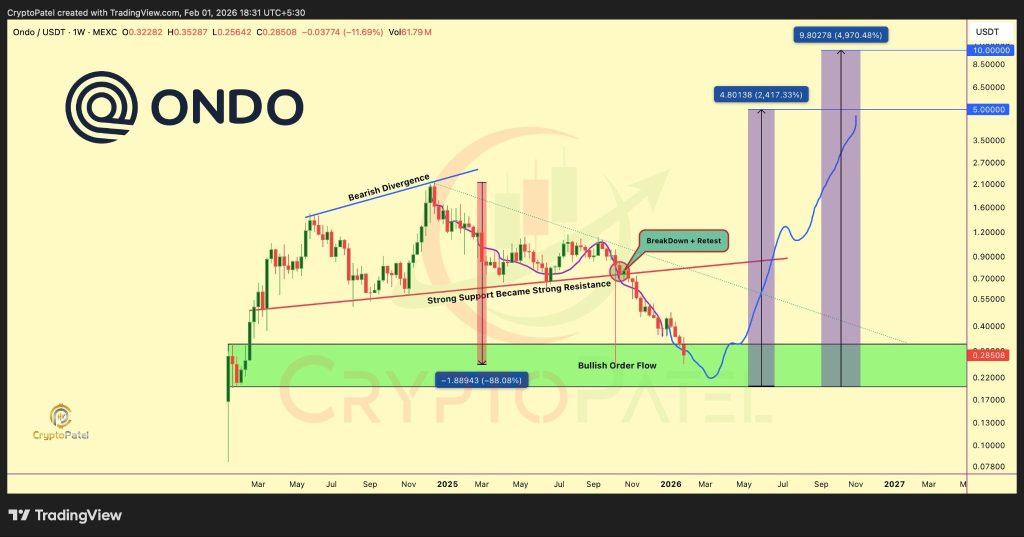
ONDO Price Crashes 88% From All-Time Highs, But Analyst Says ‘Last Hope’ Zone Is Here

ONDO Price Crashes 88% From All-Time Highs, But Analyst Says ‘Last Hope’ Zone Is Here

The ONDO price has drifted into a part of the chart that usually gets traders paying attention. After months of downside, the price is now sitting inside a zone
Share
Captainaltcoin2026/02/03 02:30
