Illuvium token price surged for the third consecutive day, reaching its highest point since February 14 as the Pro League started.  Illuvium (ILV) rose to a high of $23.65, up 160% from its lowest level this year. The surge came…Illuvium token price surged for the third consecutive day, reaching its highest point since February 14 as the Pro League started.  Illuvium (ILV) rose to a high of $23.65, up 160% from its lowest level this year. The surge came…

Here’s why the Illuvium’s ILV price is soaring

2025/08/05 23:37

Illuvium token price surged for the third consecutive day, reaching its highest point since February 14 as the Pro League started. 

Summary
  • Illuvium price jumped after the developers released details of the Pro League.
  • The event will run from August 3, with the main event ending in December.
  • Technicals point to more upside, with the potential price target being at $41.

Illuvium (ILV) rose to a high of $23.65, up 160% from its lowest level this year. The surge came alongside a 3,200% spike in daily volume to $344 million, well above its $124 million market capitalization.

Illuvium Pro League kicks off

The ILV price spiked after the developers launched the 2025 edition of the Illuvium Pro League. The league will include three tournaments: IPL 250, IPL 500, and IPL 1000, with various qualification paths to the main event.

A two-point system will be in play: IPL points, earned from tournaments, and RLP, accumulated through the ranked ladder. The season begins August 16 and culminates in a world event in December.

IPL 250 will feature 32 players and a $2,000 prize pool. IPL 500 will host 64 players and offer $5,000, while the IPL 1000 will be an invite-only event with 64 players. Additional “last call” and “last chance” events will provide final opportunities to qualify.

The main event in December will involve 64 players, with 32 earning a payout from the total $250,000 prize pool.

ILV’s rally was also fueled by on-chain data showing increased accumulation by smart money investors. According to Nansen, these investors now hold over 91,000 ILV tokens, a significant rise from a month ago. Meanwhile, the ILV supply on exchanges has dropped from 2.81 million to 2.74 million.

Meanwhile, the supply of ILV tokens in exchanges has dropped to 2.74 million from last month’s high of 2.81 million.

ILV price surged after forming a double-bottom pattern
ILV price

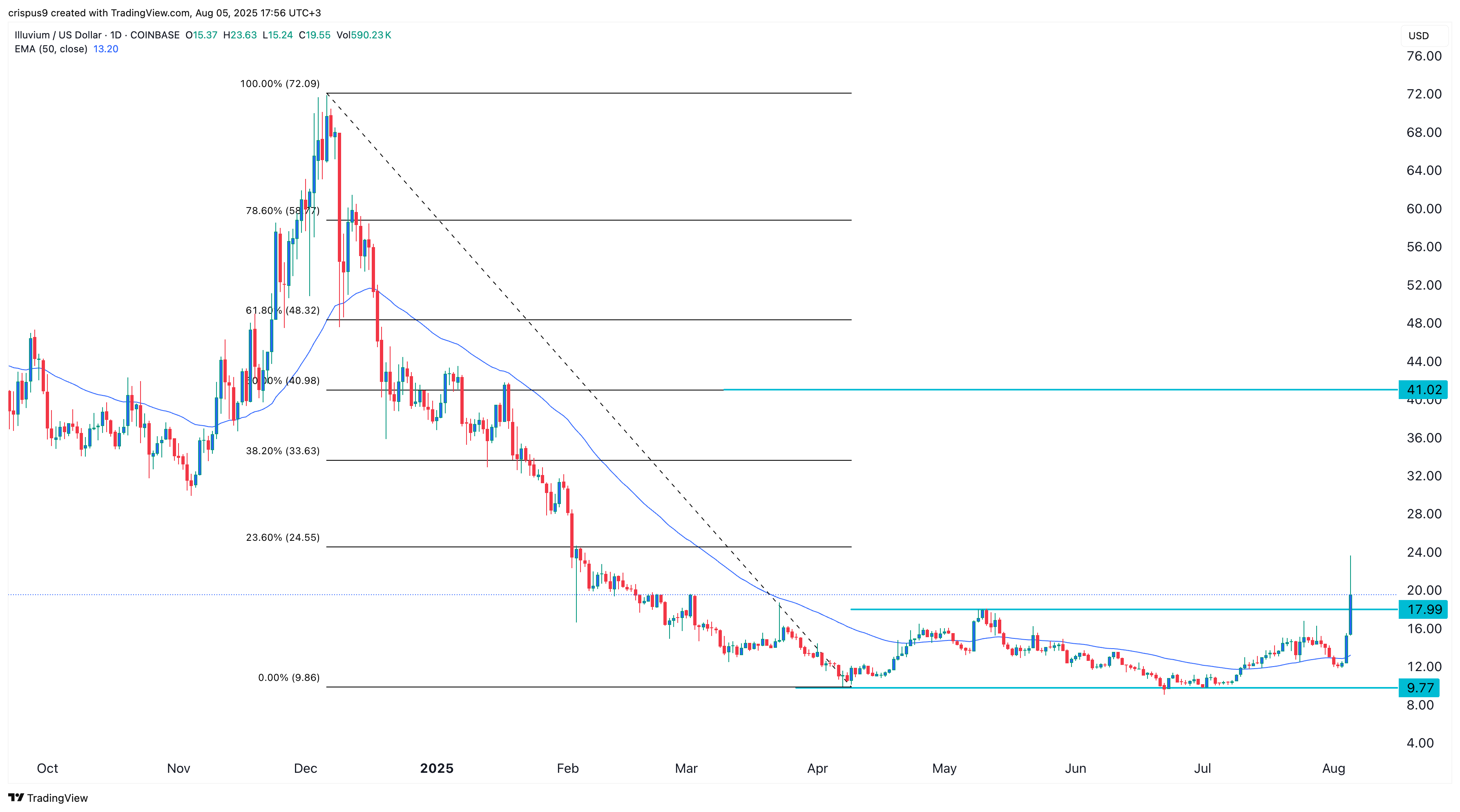
The daily chart shows that the ILV price dropped to a low of $9.7, where it formed a double-bottom pattern whose neckline was at $18, its highest point on May 10. 

The token has since moved above its 50-day moving average and briefly crossed the 23.6% Fibonacci retracement level. The most likely scenario is continued upside leading into the tournament’s start, followed by a potential pullback.


Disclaimer: The articles reposted on this site are sourced from public platforms and are provided for informational purposes only. They do not necessarily reflect the views of MEXC. All rights remain with the original authors. If you believe any content infringes on third-party rights, please contact service@support.mexc.com for removal. MEXC makes no guarantees regarding the accuracy, completeness, or timeliness of the content and is not responsible for any actions taken based on the information provided. The content does not constitute financial, legal, or other professional advice, nor should it be considered a recommendation or endorsement by MEXC.

You May Also Like

China Blocks Nvidia’s RTX Pro 6000D as Local Chips Rise

China Blocks Nvidia’s RTX Pro 6000D as Local Chips Rise

The post China Blocks Nvidia’s RTX Pro 6000D as Local Chips Rise appeared on BitcoinEthereumNews.com. China Blocks Nvidia’s RTX Pro 6000D as Local Chips Rise China’s internet regulator has ordered the country’s biggest technology firms, including Alibaba and ByteDance, to stop purchasing Nvidia’s RTX Pro 6000D GPUs. According to the Financial Times, the move shuts down the last major channel for mass supplies of American chips to the Chinese market. Why Beijing Halted Nvidia Purchases Chinese companies had planned to buy tens of thousands of RTX Pro 6000D accelerators and had already begun testing them in servers. But regulators intervened, halting the purchases and signaling stricter controls than earlier measures placed on Nvidia’s H20 chip. Image: Nvidia An audit compared Huawei and Cambricon processors, along with chips developed by Alibaba and Baidu, against Nvidia’s export-approved products. Regulators concluded that Chinese chips had reached performance levels comparable to the restricted U.S. models. This assessment pushed authorities to advise firms to rely more heavily on domestic processors, further tightening Nvidia’s already limited position in China. China’s Drive Toward Tech Independence The decision highlights Beijing’s focus on import substitution — developing self-sufficient chip production to reduce reliance on U.S. supplies. “The signal is now clear: all attention is focused on building a domestic ecosystem,” said a representative of a leading Chinese tech company. Nvidia had unveiled the RTX Pro 6000D in July 2025 during CEO Jensen Huang’s visit to Beijing, in an attempt to keep a foothold in China after Washington restricted exports of its most advanced chips. But momentum is shifting. Industry sources told the Financial Times that Chinese manufacturers plan to triple AI chip production next year to meet growing demand. They believe “domestic supply will now be sufficient without Nvidia.” What It Means for the Future With Huawei, Cambricon, Alibaba, and Baidu stepping up, China is positioning itself for long-term technological independence. Nvidia, meanwhile, faces…
Share
BitcoinEthereumNews2025/09/18 01:37