Open‑YOLO 3D replaces costly SAM/CLIP steps with 2D detection, LG label‑maps, and parallelized visibility, enabling fast and accurate 3D OV segmentation.Open‑YOLO 3D replaces costly SAM/CLIP steps with 2D detection, LG label‑maps, and parallelized visibility, enabling fast and accurate 3D OV segmentation.

Drop the Heavyweights: YOLO‑Based 3D Segmentation Outpaces SAM/CLIP

2025/08/26 16:20

Abstract and 1 Introduction

  1. Related works
  2. Preliminaries
  3. Method: Open-YOLO 3D
  4. Experiments
  5. Conclusion and References

A. Appendix

3 Preliminaries

Problem formulation: 3D instance segmentation aims at segmenting individual objects within a 3D scene and assigning one class label to each segmented object. In the open-vocabulary (OV) setting, the class label can belong to previously known classes in the training set as well as new class labels. To this end, let P denote a 3D reconstructed point cloud scene, where a sequence of RGB-D images was used for the reconstruction. We denote the RGB image frames as I along with their corresponding depth frames D. Similar to recent methods [35, 42, 34], we assume that the poses and camera parameters are available for the input 3D scene.

\

3.1 Baseline Open-Vocabulary 3D Instance Segmentation

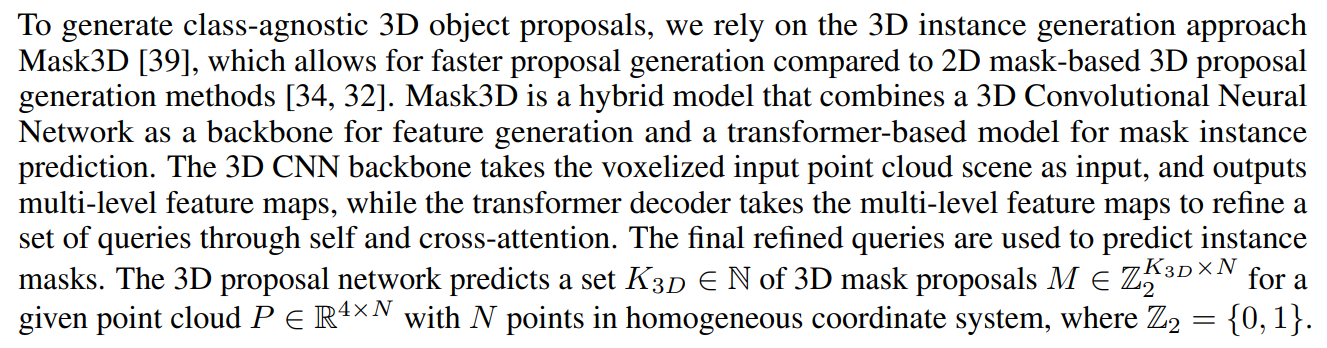
We base our approach on OpenMask3D [42], which is the first method that performs open-vocabulary 3D instance segmentation in a zero-shot manner. OpenMask3D has two main modules: a class-agnostic mask proposal head, and a mask-feature computation module. The class-agnostic mask proposal head uses a transformer-based pre-trained 3D instance segmentation model [39] to predict a binary mask for each object in the point cloud. The mask-feature computation module first generates 2D segmentation masks by projecting 3D masks into views in which the 3D instances are highly visible, and refines them using the SAM [23] model. A pre-trained CLIP vision-language model [55] is then used to generate image embeddings for the 2D segmentation masks. The embeddings are then aggregated across all the 2D frames to generate a 3D mask-feature representation.

\ Limitations: OpenMask3D makes use of the advancements in 2D segmentation (SAM) and vision-language models (CLIP) to generate and aggregate 2D feature representations, enabling the querying of instances according to open-vocabulary concepts. However, this approach suffers from a high computation burden leading to slow inference times, with a processing time of 5-10 minutes per scene. The computation burden mainly originates from two sub-tasks: the 2D segmentation of the large number of objects from the various 2D views, and the 3D feature aggregation based on the object visibility. We next introduce our proposed method which aims at reducing the computation burden and improving the task accuracy.

\

4 Method: Open-YOLO 3D

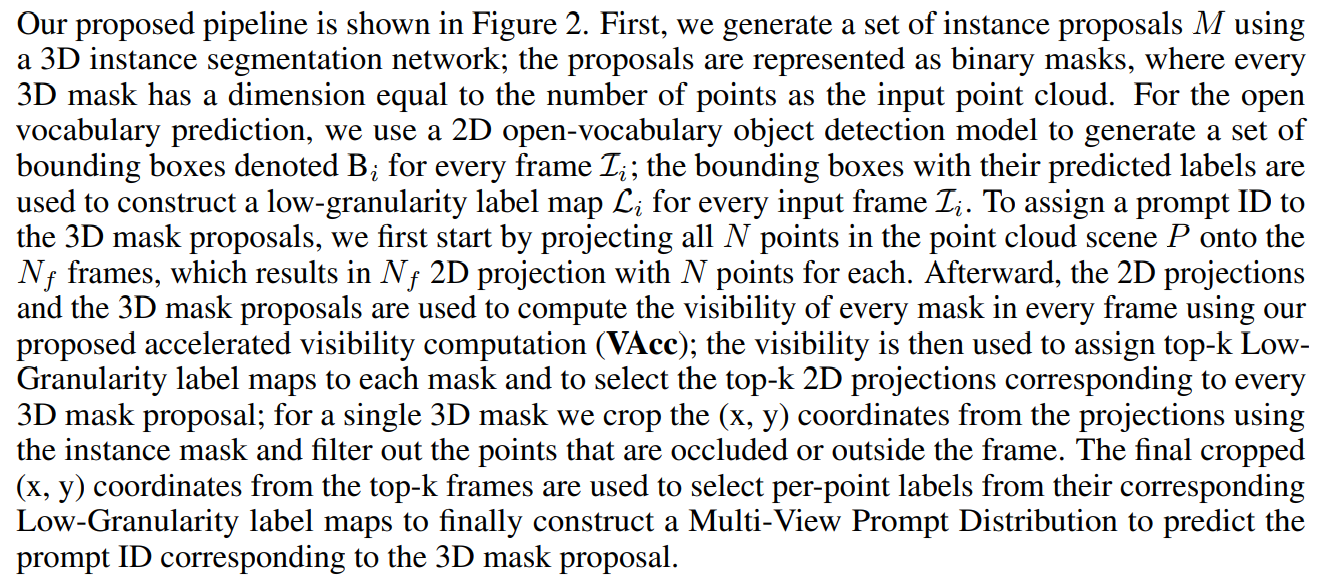
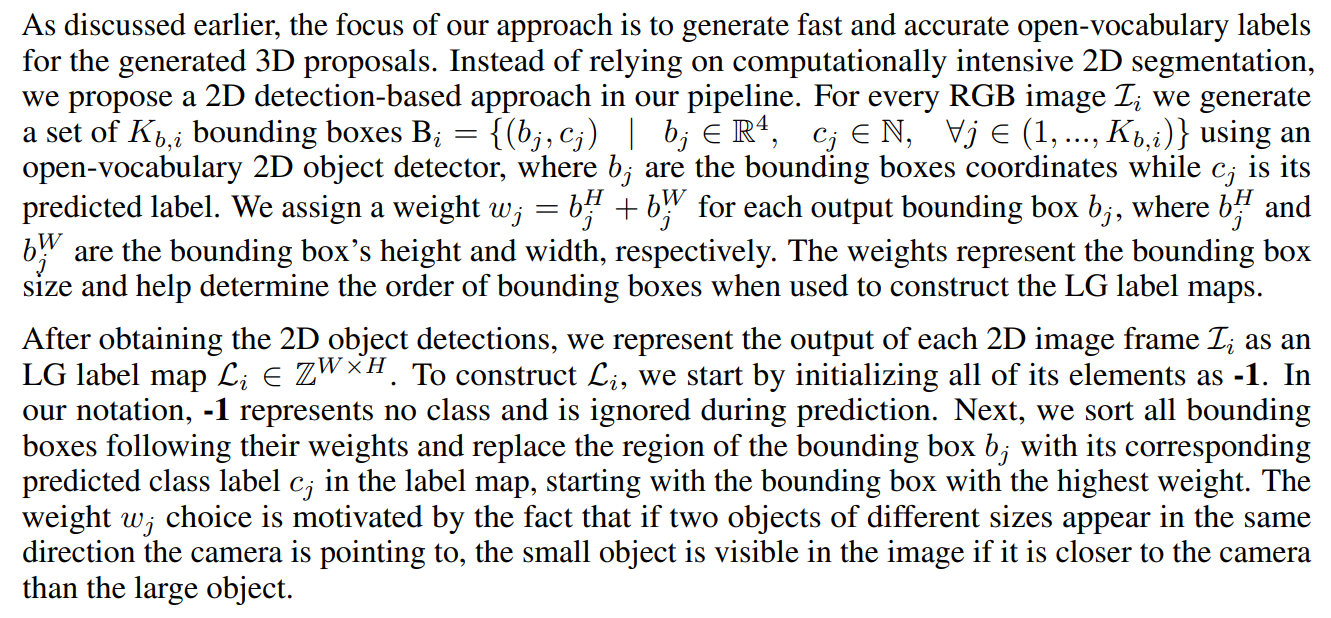
Motivation: We here present our proposed 3D open-vocabulary instance segmentation method, Open-YOLO 3D, which aims at generating 3D instance predictions in an efficient strategy. Our proposed method introduces efficient and improved modules at the task level as well as the data level. Task Level: Unlike OpenMask3D, which generates segmentations of the projected 3D masks, we pursue a more efficient approach by relying on 2D object detection. Since the end target is to generate labels for the 3D masks, the increased computation from the 2D segmentation task is not necessary. Data Level: OpenMask3D computes the 3D mask visibility in 2D frames by iteratively counting visible points for each mask across all frames. This approach is time-consuming, and we propose an alternative approach to compute the 3D mask visibility within all frames at once.

\

4.1 Overall Architecture
\

4.2 3D Object Proposal
\

4.3 Low Granularity (LG) Label-Maps
\

4.4 Accelerated Visibility Computation (VAcc)

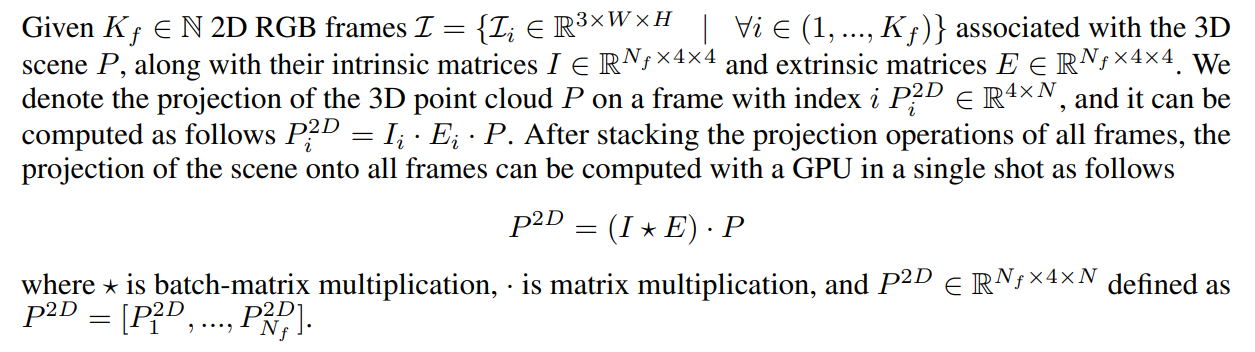
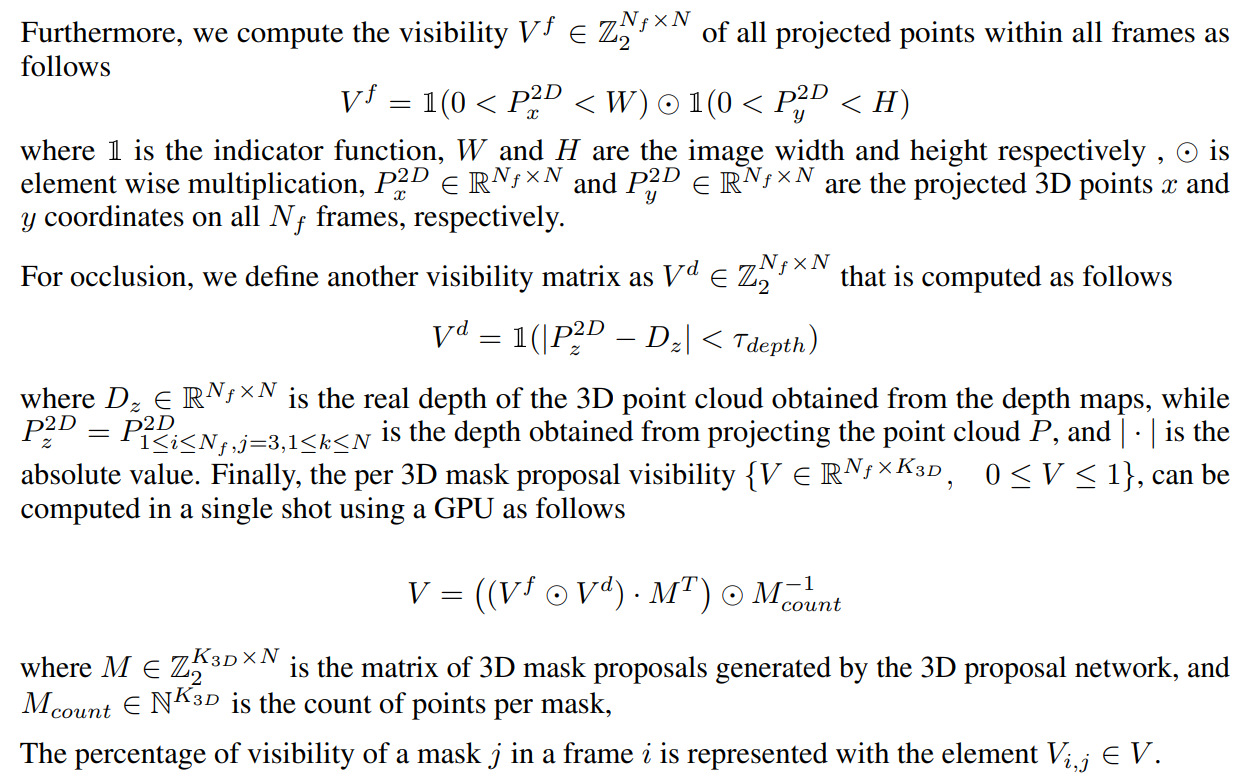
In order to associate 2D label maps with 3D proposals, we compute the visibility of each 3D mask. To this end, we propose a fast approach that is able to compute 3D mask visibility within frames via tensor operations which are highly parallelizable.

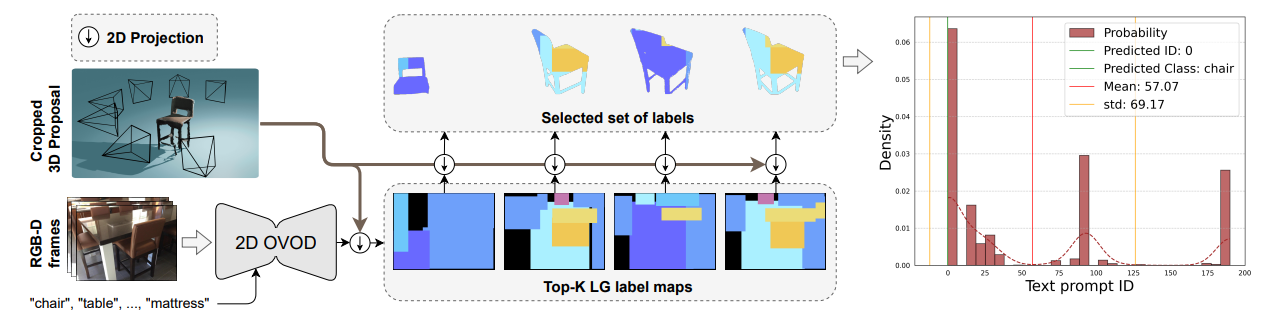
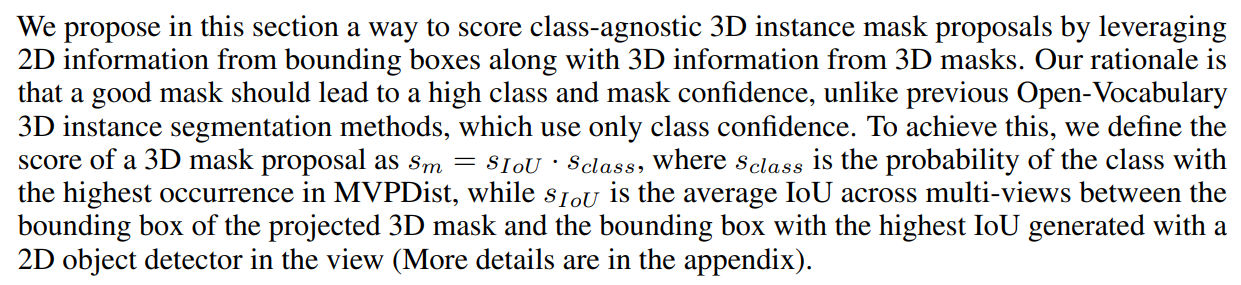
\ Figure 3: Multi-View Prompt Distribution (MVPDist). After creating the LG label maps for all frames, we select the top-k label maps based on the 2D projection of the 3D proposal. Using the (x, y) coordinates of the 2D projection, we choose the labels from the LG label maps to generate the MVPDist. This distribution predicts the ID of the text prompt with the highest probability.
\

\

\

4.5 Multi-View Prompt Distribution (MVPDist)
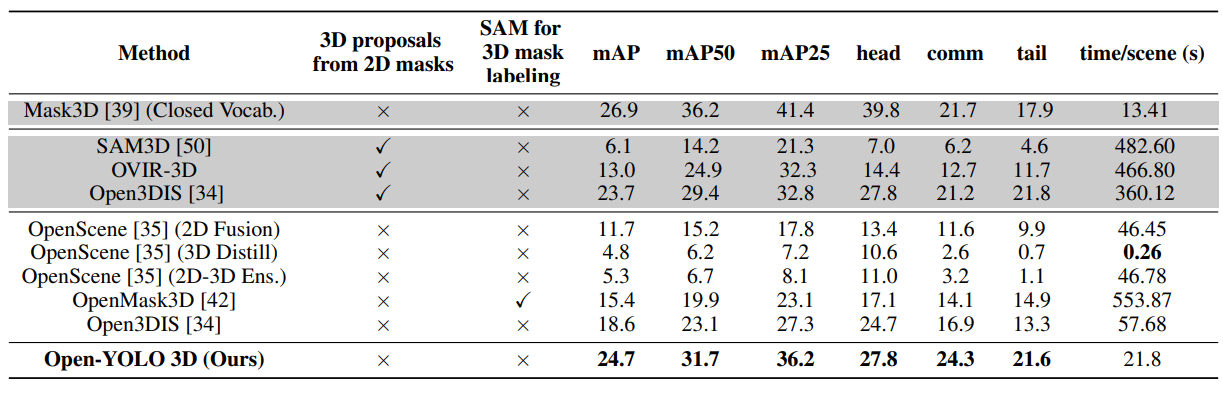
\ Table 1: State-of-the-art comparison on ScanNet200 validation set. We use Mask3D trained on the ScanNet200 training set to generate class-agnostic mask proposals. Our method demonstrates better performance compared to those that generate 3D proposals by fusing 2D masks and proposals from a 3D network (highlighted in gray in the table). It outperforms state-of-the-art methods by a wide margin under the same conditions using only proposals from a 3D network.
\

4.6 Instance Prediction Confidence Score
\

:::info Authors:

(1) Mohamed El Amine Boudjoghra, Mohamed Bin Zayed University of Artificial Intelligence (MBZUAI) (mohamed.boudjoghra@mbzuai.ac.ae);

(2) Angela Dai, Technical University of Munich (TUM) (angela.dai@tum.de);

(3) Jean Lahoud, Mohamed Bin Zayed University of Artificial Intelligence (MBZUAI) ( jean.lahoud@mbzuai.ac.ae);

(4) Hisham Cholakkal, Mohamed Bin Zayed University of Artificial Intelligence (MBZUAI) (hisham.cholakkal@mbzuai.ac.ae);

(5) Rao Muhammad Anwer, Mohamed Bin Zayed University of Artificial Intelligence (MBZUAI) and Aalto University (rao.anwer@mbzuai.ac.ae);

(6) Salman Khan, Mohamed Bin Zayed University of Artificial Intelligence (MBZUAI) and Australian National University (salman.khan@mbzuai.ac.ae);

(7) Fahad Shahbaz Khan, Mohamed Bin Zayed University of Artificial Intelligence (MBZUAI) and Australian National University (fahad.khan@mbzuai.ac.ae).

:::


:::info This paper is available on arxiv under CC BY-NC-SA 4.0 Deed (Attribution-Noncommercial-Sharelike 4.0 International) license.

:::

\

Disclaimer: The articles reposted on this site are sourced from public platforms and are provided for informational purposes only. They do not necessarily reflect the views of MEXC. All rights remain with the original authors. If you believe any content infringes on third-party rights, please contact service@support.mexc.com for removal. MEXC makes no guarantees regarding the accuracy, completeness, or timeliness of the content and is not responsible for any actions taken based on the information provided. The content does not constitute financial, legal, or other professional advice, nor should it be considered a recommendation or endorsement by MEXC.

You May Also Like

Canada Canadian Portfolio Investment in Foreign Securities rose from previous $9.04B to $17.41B in July

Canada Canadian Portfolio Investment in Foreign Securities rose from previous $9.04B to $17.41B in July

The post Canada Canadian Portfolio Investment in Foreign Securities rose from previous $9.04B to $17.41B in July appeared on BitcoinEthereumNews.com. Information on these pages contains forward-looking statements that involve risks and uncertainties. Markets and instruments profiled on this page are for informational purposes only and should not in any way come across as a recommendation to buy or sell in these assets. You should do your own thorough research before making any investment decisions. FXStreet does not in any way guarantee that this information is free from mistakes, errors, or material misstatements. It also does not guarantee that this information is of a timely nature. Investing in Open Markets involves a great deal of risk, including the loss of all or a portion of your investment, as well as emotional distress. All risks, losses and costs associated with investing, including total loss of principal, are your responsibility. The views and opinions expressed in this article are those of the authors and do not necessarily reflect the official policy or position of FXStreet nor its advertisers. The author will not be held responsible for information that is found at the end of links posted on this page. If not otherwise explicitly mentioned in the body of the article, at the time of writing, the author has no position in any stock mentioned in this article and no business relationship with any company mentioned. The author has not received compensation for writing this article, other than from FXStreet. FXStreet and the author do not provide personalized recommendations. The author makes no representations as to the accuracy, completeness, or suitability of this information. FXStreet and the author will not be liable for any errors, omissions or any losses, injuries or damages arising from this information and its display or use. Errors and omissions excepted. The author and FXStreet are not registered investment advisors and nothing in this article is intended…
Share
BitcoinEthereumNews2025/09/18 02:38
Why BONK’s weekly trend remains deeply bearish despite price rise

Why BONK’s weekly trend remains deeply bearish despite price rise

The post Why BONK’s weekly trend remains deeply bearish despite price rise appeared on BitcoinEthereumNews.com. Bonk saw a 5.55% rally in the past 24 hours, but CoinMarketCap data showed that its daily trading volume has fallen by nearly 10% at the time of writing. These gains could be driven partly due to the Solana [SOL] launchpad Bonk.fun news that 51% of the fees would be used to buy back BONK, up from the existing 10%. BONK sinks below long-term support Source: BONK/USDT on TradingView Bonk’s [BONK] weekly chart showed a strong downtrend in progress. The $0.0000096 support, which stretched back to early 2024, was being retested as resistance. Two weeks ago, a weekly trading session closed below this support. The OBV was also in a downtrend with the price, and the RSI’s reading of 36 showed strong bearish momentum. Overall, it was a place where the bulls needed to make a last stand. As things stand, the buyers lack the conviction to reverse the trend. Source: BONK/USDT on TradingView On the 4-hour chart, there seemed to be a bit of hope for BONK bulls. A range formation (purple) between $0.00000846 and $0.0000105 has halted the downtrend over the past three weeks. At the same time, the OBV trended higher, while the RSI oscillated between bullish and bearish momentum. It was a sign that there was buying pressure in recent days. Despite this hopeful development, it would be extremely difficult for the bulls to overturn the long-term downtrend. The loss of $0.0000096 as support, just below the psychological $0.00001 level, was a big blow to bullish sentiment. The bullish BONK case The rising OBV hinted at a potential, albeit unlikely, BONK trend reversal. A breakout past $0.0000105 and a retest of the range high as support would be a buy signal. To the north, the next target would be $0.0000135. Traders call to action — Respect…
Share
BitcoinEthereumNews2025/12/08 05:02