SOLID isn’t academic fluff - it’s your insurance against rage-quitting your own codebase. This article breaks down all five principles (SRP, OCP, LSP, ISP, DIP) with Python + UML, showing bad vs good examples. If you want cleaner design, fewer bugs, and teammates who don’t hate you, read this.SOLID isn’t academic fluff - it’s your insurance against rage-quitting your own codebase. This article breaks down all five principles (SRP, OCP, LSP, ISP, DIP) with Python + UML, showing bad vs good examples. If you want cleaner design, fewer bugs, and teammates who don’t hate you, read this.

SOLID Principles In Practice With Python And UML Examples in 2025

2025/08/28 14:22

\ Let’s be real: most developers nod politely when SOLID comes up, then continue writing 500-line classes that smell worse than week-old fried eggs.

Here’s the thing: SOLID isn’t about pleasing your CS professor. It’s about writing code that your future self won’t want to rage-quit from after a single bugfix. Bad code means frustration, late nights, and way too much coffee.

SOLID is a language that senior devs use to communicate across years of maintenance. When you see it in a project, you don’t need to crawl line by line like some code archaeologist digging through ruins. Instead, you can predict the system’s behavior, understand responsibilities, and trust that classes aren’t hiding surprises like a clown in a sewer drain. Follow it, and you can read code like a map. Ignore it, and you're wandering blind through spaghetti caves.

What is SOLID (for the two people who missed the party)?

SOLID is an acronym for five object-oriented design principles coined by Uncle Bob Martin back when 2000s were still a thing:

  • S — Single Responsibility Principle (SRP)
  • O — Open–Closed Principle (OCP)
  • L — Liskov Substitution Principle (LSP)
  • I — Interface Segregation Principle (ISP)
  • D — Dependency Inversion Principle (DIP)

Each principle is simple in words, but game-changing in practice. Let’s walk through them with Python and UML examples, and see why your future code reviewers will thank you.

\


🪓 Single Responsibility Principle (SRP)

One job, one class. Don’t be that developer who mixes logging, DB writes, and business logic in one method.

Why it matters

If a class does too many things, every change risks breaking unrelated behavior. It’s like wiring your home’s electricity, plumbing, and gas through the same pipe - one adjustment and the whole house either floods, burns, or explodes.

Bad Example

Here’s a FileManager class that thinks it’s Batman: reads files, writes them, compresses them, and even appends greetings:
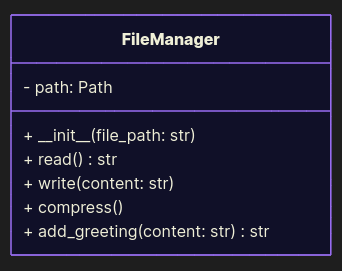
UML

from pathlib import Path from zipfile import ZipFile   class FileManager:     def __init__(self, file_path: str):         self.path = Path(file_path)      def read(self) -> str:         return self.path.read_text('utf-8')      def write(self, content: str):         self.path.write_text(content, 'utf-8')      def compress(self):         with ZipFile(self.path.with_suffix('.zip'), mode='w') as file:             file.write(self.path)      def add_greeting(self, content: str) -> str:         return content + '\nHello world!'   if __name__ == '__main__':     file_path = 'data.txt'     file_manager = FileManager(file_path)     content = file_manager.add_greeting(file_manager.read())     file_manager.write(content)     file_manager.compress() 
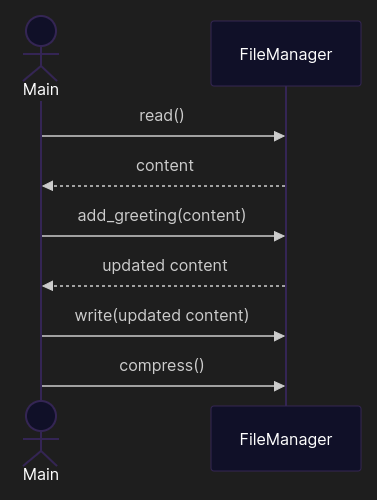
Call diagram

What’s wrong?

Although the usage looks easy, every time you need to tweak compression, you risk breaking file writing. Change greetings? Oops, now compression fails.

Good Example

Split responsibilities. Each class does one job, cleanly.
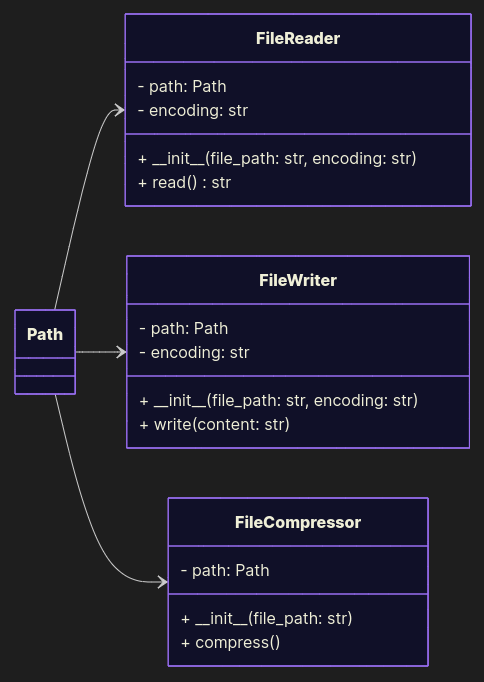
UML

from pathlib import Path from zipfile import ZipFile  DEFAULT_ENCODING = 'utf-8'   class FileReader:     def __init__(self, file_path: Path, encoding: str = DEFAULT_ENCODING):         self.path = file_path         self.encoding = encoding      def read(self) -> str:         return self.path.read_text(self.encoding)   class FileWriter:     def __init__(self, file_path: Path, encoding: str = DEFAULT_ENCODING):         self.path = file_path         self.encoding = encoding      def write(self, content: str):         self.path.write_text(content, self.encoding)   class FileCompressor:     def __init__(self, file_path: Path):         self.path = file_path      def compress(self):         with ZipFile(self.path.with_suffix('.zip'), mode='w') as file:             file.write(self.path)   def add_greeting(self, content: str) -> str:     return content + '\nHello world!'   if __name__ == '__main__':     file_path = Path('data.txt')     content = FileReader(file_path).read()     FileWriter(file_path).write(add_greeting(content))     FileCompressor(file_path).compress() 
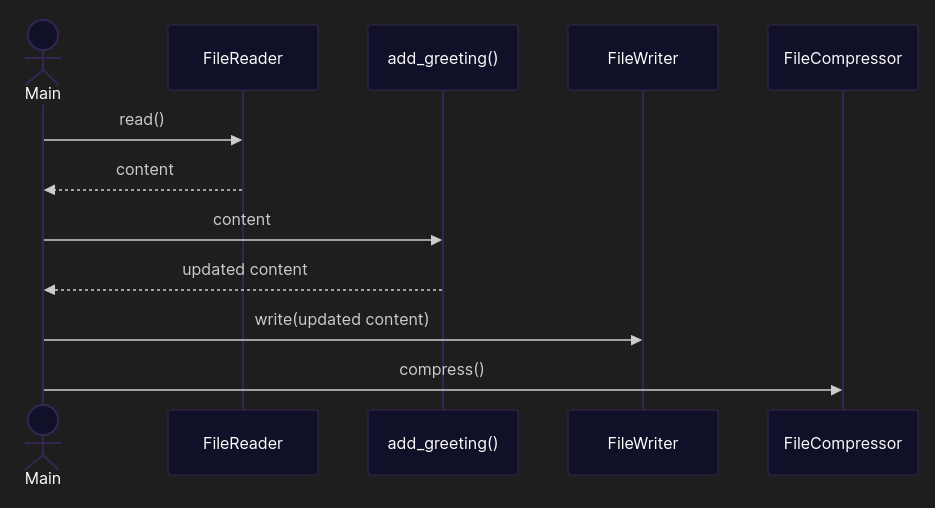
Call diagram

Although the call diagram looks a little trickier, now you can modify compression without touching greetings. Future you approves.

\


🧩 Open–Closed Principle (OCP)

Code should be open for extension, closed for modification. Like Netflix - adding new shows without rewriting the entire app.

Why it matters

If every new feature forces you to edit the same class, your code becomes a fragile Jenga tower. Add one more method, and boom - production outage.

Bad Example

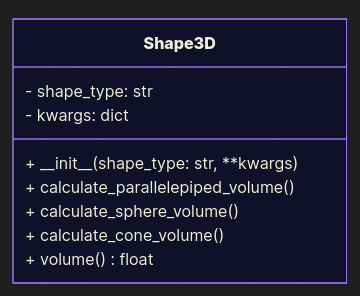
The classic “God class of geometry”:
UML

from math import pi   class Shape3D:     def __init__(self, shape_type: str, **kwargs):         self.shape_type = shape_type         self.kwargs = kwargs      def calculate_parallelepiped_volume(self):         return self.kwargs['w'] * self.kwargs['h'] * self.kwargs['l']      def calculate_sphere_volume(self):         return 3 / 4 * pi * self.kwargs['r'] ** 3      def calculate_cone_volume(self):         return 1 / 3 * pi * self.kwargs['r'] ** 2 * self.kwargs['h']      def volume(self) -> float:         if self.shape_type == 'parallelepiped':             return self.calculate_parallelepiped_volume()         if self.shape_type == 'sphere':             return self.calculate_sphere_volume()         if self.shape_type == 'cone':             return self.calculate_cone_volume()         # Add more ifs forever         raise ValueError   if __name__ == '__main__':     print(Shape3D('parallelepiped', w=1.0, h=2.0, l=3.0).volume())     print(Shape3D('sphere', r=3.5).volume())     print(Shape3D('cone', r=3.5, h=2.0).volume()) 

Every time you add a new shape, you hack this class. Here, we are not extending; we are modifying. This violates OCP.

Good Example

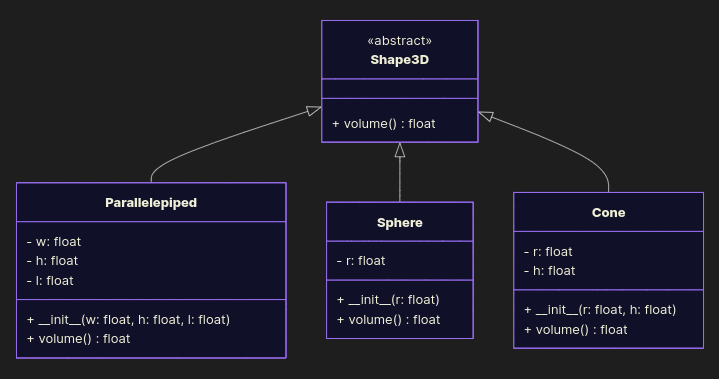
Make a common base class, extend it with new shapes.
UML

from abc import ABC, abstractmethod from math import pi   class Shape3D(ABC):     @abstractmethod     def volume(self) -> float:         raise NotImplementedError   class Parallelepiped(Shape3D):     def __init__(self, w: float, h: float, l: float):         self.w, self.h, self.l = w, h, l      def volume(self):         return self.w * self.h * self.l   class Sphere(Shape3D):     def __init__(self, r: float):         self.r = r      def volume(self):         return 3 / 4 * pi * self.r ** 3   class Cone(Shape3D):     def __init__(self, r: float, h: float):         self.r, self.h = r, h      def volume(self):         return 1 / 3 * pi * self.r ** 2 * self.h   if __name__ == '__main__':     print(Parallelepiped(w=1.0, h=2.0, l=3.0).volume())     print(Sphere(r=3.5).volume())     print(Cone(r=3.5, h=2.0).volume()) 

Want a Torus? Just new subclass. No if-hell required, no edits of old code. Clean. Extensible. Chef’s kiss.

\

🤔 Another Discussable Example of OCP Violation

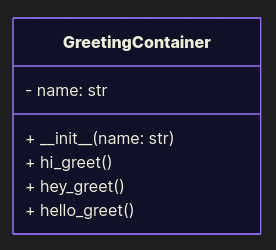
Here’s a class that offers multiple hard-coded greeting methods:
UML

class GreetingContainer:     def __init__(self, name: str):         self.name = name      def hi_greet(self):         print("Hi, " + self.name)      def hey_greet(self):         print("Hey, " + self.name)      def hello_greet(self):         print("Hello, " + self.name) 

At first glance this looks fine: we’re not deleting or altering existing methods, we’re just adding new ones. Technically, we’re extending the class. But here’s the catch: clients using this class must know exactly which method to call, and the interface keeps bloating. This design is brittle - new greetings mean more methods and more places in the code that have to be aware of them. You can argue it’s not a direct OCP violation, but it drifts into LSP territory: instances of GreetingContainer can’t be treated uniformly, since behavior depends on which method you pick (we will discuss it a little later).

\


🦆 Liskov Substitution Principle (LSP)

If code expects an object of some type, any subclass should be usable without nasty surprises. A subclass that breaks this promise isn’t an extension - it’s a landmine disguised as a feature.

Why it matters

Subclasses must be replaceable with their children without breaking stuff. Violate this, and you’ll create runtime landmines.

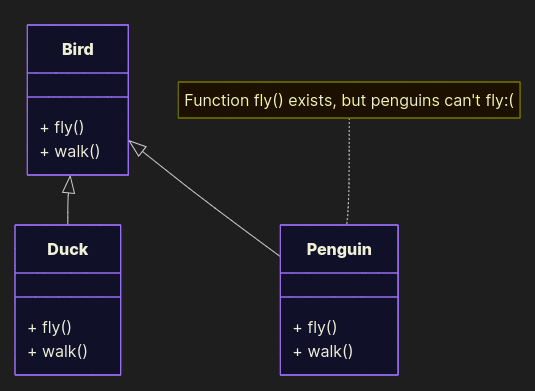
Bad example
UML

class Bird:     def fly(self):         return "The bird is flying"      def walk(self):         return "The bird is walking"   class Duck(Bird):     def fly(self):         return "The duck is flying"      def walk(self):         return "The duck is walking"   class Penguin(Bird):     def fly(self):         raise AttributeError("Penguins cannot fly:(")      def walk(self):         return "The penguin is walking" 

Penguins do exist, but they break LSP here. Anywhere you expect a Bird, the substitution fails and the design no longer guarantees consistent behavior.

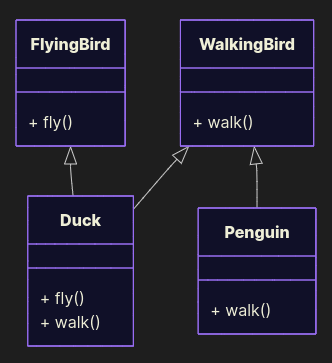
Good example

Split behaviors:
UML

class FlyingBird:     def fly(self):         return "The bird is flying"   class WalkingBird:     def walk(self):         return "The bird is walking"   class Duck(FlyingBird, WalkingBird):     def fly(self):         return "The duck is flying"      def walk(self):         return "The duck is walking"   class Penguin(WalkingBird):     def walk(self):         return "The penguin is walking" 

Now penguins waddle safely. Ducks still fly. Everyone’s happy. No runtime betrayals.

\

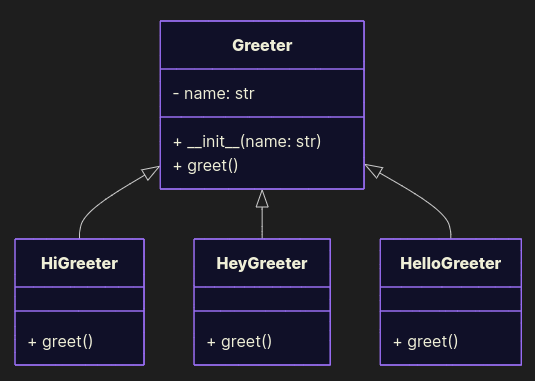
Good Example of a greeter from the OCP topic

Define a base Greeter and extend it with new variants:
UML

class Greeter:     def __init__(self, name: str):         self.name = name      def greet(self):         raise NotImplementedError   class HiGreeter(Greeter):     def greet(self):         print("Hi, " + self.name)   class HeyGreeter(Greeter):     def greet(self):         print("Hey, " + self.name)   class HelloGreeter(Greeter):     def greet(self):         print("Hello, " + self.name) 

This design is cleaner: the interface stays stable (greet()), new greetings are real extensions, and polymorphism works. Clients don’t care how the greeting is produced - they just call greet(). And the real benefit: we can swap one Greeter for another and remain confident the code behaves as expected, without digging into implementation details - because we followed OCP and LSP. That’s the spirit of predictable, maintainable design.

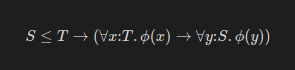
For the nerds, the formal definition of this principle is:
en.wikipedia.org/wiki/Liskov_substitution_principle

\


🔌 Interface Segregation Principle (ISP)

Don’t force a class to implement methods it doesn’t need. Otherwise you’re just padding the code with dead weight.

Why it matters

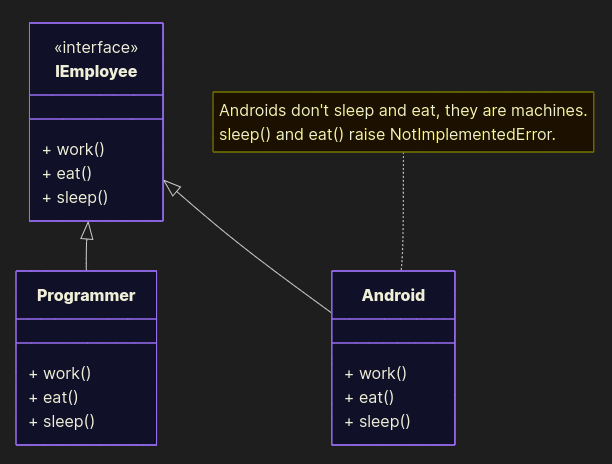
Clients shouldn’t be forced to implement methods they don’t need. If your interface has eat() and sleep(), but a robot only needs charge(), you’re designing like it’s 1999. Formally: many small, focused interfaces are always better than one bloated interface that forces irrelevant obligations.

Bad example
UML

from abc import ABC, abstractmethod   class IEmployee(ABC):     @abstractmethod     def work(self):         pass      @abstractmethod     def eat(self):         pass      @abstractmethod     def sleep(self):         pass   class Programmer(IEmployee):     def work(self):         print("Programmer programs programs")      def eat(self):         print("Programmer eats pizza")      def sleep(self):         print("Programmer falls asleep at 2 AM")   class Android(IEmployee):     def work(self):         print("Android moves boxes")      def eat(self):         raise NotImplementedError("Android doesn't eat, it's a machine")      def sleep(self):         raise NotImplementedError("Android doesn't sleep, it's a machine") 

Good example

Split interfaces:
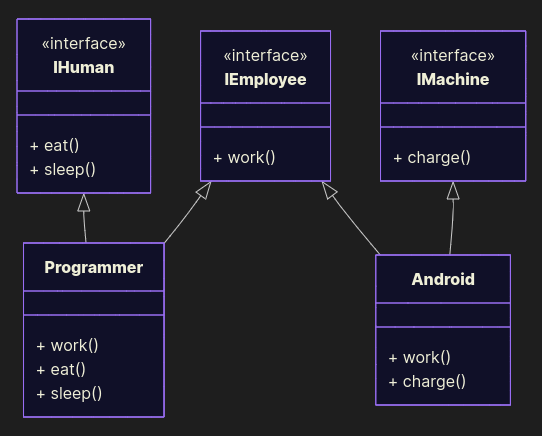
UML

from abc import ABC, abstractmethod   class IEmployee(ABC):     @abstractmethod     def work(self):         pass   class IHuman(ABC):     @abstractmethod     def eat(self):         pass      @abstractmethod     def sleep(self):         pass   class IMachine:     @abstractmethod     def charge(self):         pass   class Programmer(IEmployee, IHuman):     def work(self):         print("Programmer programs programs")      def eat(self):         print("Programmer eats pizza")      def sleep(self):         print("Programmer falls asleep at 2 AM")   class Android(IEmployee, IMachine):     def work(self):         print("Android moves boxes")      def charge(self):         print("Android charges, wait for 3 hours") 

Now humans eat, robots charge. No unnecessary code. Interfaces are lean, not bloated.

\

\


🏗 Dependency Inversion Principle (DIP)

Depend on abstractions, not concrete implementations. Otherwise, your code is welded to a single library or vendor like shackles you’ll never escape from.

Why it matters

If your service directly imports boto3, good luck swapping S3 for HDFS, GCS, or even MinIO. From a formal perspective, this creates a tight coupling to a specific implementation rather than an abstraction, which severely limits extensibility and portability. Vendor lock-in = pain, and even a simple architectural decision - like supporting both on-prem HDFS and cloud object storage - suddenly requires massive rewrites.

Bad example
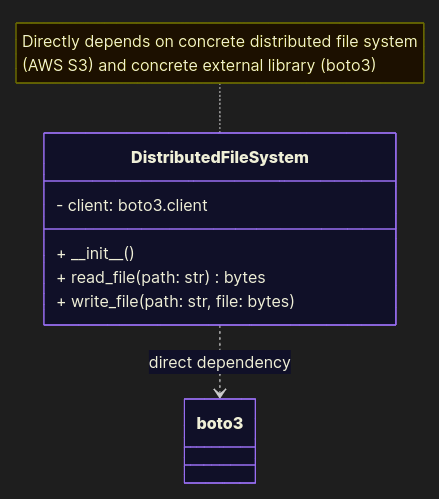
UML

import boto3   class DistributedFileSystem:     def __init__(self):         self.client = boto3.client('s3')      def read_file(path: str) -> bytes:         data = self.client.get_object(Key=path)         return data['Body'].read()      def write_file(path: str, file: bytes):         self.client.put_object(Body=file, Key=path) 

Direct AWS dependency. Migrating to another cloud = rewrite.

Good example

Abstract it:
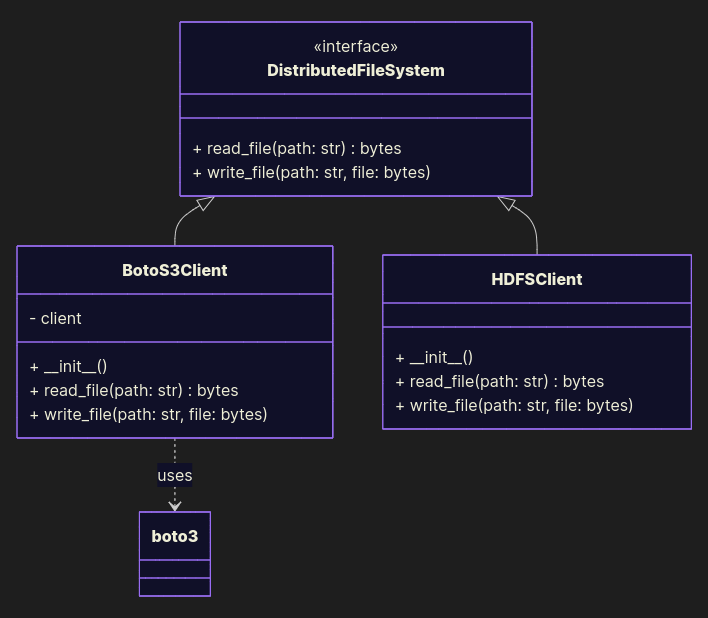
UML

from abc import ABC, abstractmethod  import boto3   class DistributedFileSystem(ABC):     @abstractmethod     def read_file(path: str) -> bytes:         pass      @abstractmethod     def write_file(path: str, file: bytes):         pass   class BotoS3Client(DistributedFileSystem):     def __init__(self):         self.client = boto3.client('s3')      def read_file(path: str) -> bytes:         data = self.client.get_object(Key=path)         return data['Body'].read()      def write_file(path: str, file: bytes):         self.client.put_object(Body=file, Key=path)   class HDFSClient(DistributedFileSystem): ... 

Now you can switch storage backends without rewriting business logic. Future-proof and vendor-agnostic.

\


Final Thoughts: SOLID ≠ Religion, But It Saves Your Sanity

In 2025, frameworks evolve, clouds change, AI tools promise to “replace us”, but the pain of bad code is eternal.

SOLID isn’t dogma - it’s the difference between code that scales with your project and code nobody wants to work with.

Use SOLID not because Uncle Bob said so, but because your future self (and your team) will actually enjoy working with you.

\


👉 What do you think - are SOLID principles still relevant today, or do you prefer chaos-driven development?

Disclaimer: The articles reposted on this site are sourced from public platforms and are provided for informational purposes only. They do not necessarily reflect the views of MEXC. All rights remain with the original authors. If you believe any content infringes on third-party rights, please contact service@support.mexc.com for removal. MEXC makes no guarantees regarding the accuracy, completeness, or timeliness of the content and is not responsible for any actions taken based on the information provided. The content does not constitute financial, legal, or other professional advice, nor should it be considered a recommendation or endorsement by MEXC.

You May Also Like

The Urgency Index: BullZilla “Sell-Out Clock” Is the Hottest Metric in Best Crypto to Buy Now as XRP and Cardano Stable

The Urgency Index: BullZilla “Sell-Out Clock” Is the Hottest Metric in Best Crypto to Buy Now as XRP and Cardano Stable

What if the best crypto to buy right now wasn’t a top-20 coin, but a presale project exploding so fast that stages flip every 48 hours, or sooner if $100,000 pours in? That’s exactly what’s happening with the BullZilla presale, now considered one of the most explosive launches of 2025. While the broader market gains momentum, BullZilla crypto is moving at an unmatched speed, triggering intense FOMO and attracting early investors seeking massive upside. The BZIL presale is built on a unique stage progression system that rewards early buyers with massive ROI. BullZilla coin buyers in Stage 13 have already seen ROI boosts exceeding 1,500% against its listing price. This performance alone secures BullZilla’s status among the best crypto to buy right now, combining scarcity, narrative-driven branding, and deflationary mechanics that mimic the success arcs of previous 1000x meme tokens. Even as XRP jumps and Cardano holds firm, BullZilla price action continues to dominate investor conversations. The presale tally has crossed $1 million, over 3,600 holders, and more than 32 billion BZIL tokens sold. Meanwhile, staged increases, such as the jump from $0.00032572 to $0.00033238, demonstrate that early buyers benefit instantly. It’s no surprise that traders repeatedly call BullZilla the best crypto to buy right now, driven by its high-energy presale momentum. BullZilla Presale: The New Gold Standard for Early-Stage ROI The BullZilla presale is engineered to reward urgency. With price increases locked every 48 hours or once each stage hits $100,000, investors find themselves in a high-adrenaline race to secure tokens before the next price bump. This structure alone elevates BZIL into the category of the best crypto to buy right now, particularly for anyone who understands how early-stage tokenomics create exponential returns. The Urgency Index: BullZilla "Sell-Out Clock" Is the Hottest Metric in Best Crypto to Buy Now as XRP and Cardano Stable 4 BullZilla price has been rising with precision and consistency. From earlier phases to Stage 13, early supporters witnessed 5,564.69% ROI, proving that entry timing is everything. Beyond ROI, scarcity ensures long-term value. Token burns are hard-coded into supply mechanics, with each burn tightening the supply and increasing token desirability. Combined with active staking, referral bonuses, and cinematic branding, BullZilla crypto surpasses traditional presales and justifies its title as the best crypto to buy right now for high-growth seekers. As bullish sentiment rises across the market, BZIL presale stands out as the project moving with the greatest velocity. Its ability to generate organic hype without relying on artificial inflation or paid influencer campaigns further solidifies its reputation as the best crypto to buy right now. Scarcity, Burns & Stage 13B: BullZilla’s Formula for Explosive Gains One of BullZilla’s most powerful catalysts is the scarcity baked into its tokenomics. Stage 13B, priced at $0.00033238 is witnessing rapid depletion, with less than 90,000 tokens remaining. Over 666,666 tokens have already been burned, proving that BullZilla’s deflationary mechanics are not theoretical, they are actively shaping supply and investor expectations. As supply shrinks and demand accelerates, BullZilla coin naturally strengthens its position as the best crypto to buy right now, especially for investors seeking tokens with built-in scarcity. Historically, meme coins with aggressive burn structures have outperformed expectations (e.g., SHIB’s early surge), and BullZilla crypto mirrors this pattern with even tighter presale controls. The storytelling aspect of BullZilla also amplifies its appeal. Unlike generic meme coins, BZIL introduces stage names like Zilla Sideways Smash, a branding strategy that enhances memorability and community engagement. This narrative construction makes investors feel connected to the project’s progression, increasing loyalty and enthusiasm. With each price surge, burned token event, and presale milestone, BullZilla adds another layer to its identity, strengthening its claim as the best crypto to buy right now. XRP ($XRP): Strong Momentum, But Still Overshadowed by BullZilla’s Presale Pace XRP has recorded a 7% jump, reaching $2.19 in the last 24 hours. Momentum is strong, fueled by positive sentiment and increased inflows of liquidity. For traditional crypto traders, this is encouraging, but compared to the explosive movement in the BullZilla presale, XRP’s pace appears more stable than aggressive. XRP remains a reliable asset backed by institutional interest and large-scale adoption. It has strong fundamentals, a resilient community, and long-term relevance in the payments sector. However, XRP’s growth curve is steady rather than exponential. When compared to BullZilla coin’s rapid-staging price increases, XRP doesn’t deliver the immediate high-risk, high-reward opportunity that traders seeking the best crypto to buy right now often chase. XRP is strong, but it is not multiplying investor capital at the same speed as BZIL presale. The difference is simple: XRP grows with utility and market cycles, while BullZilla grows through staged presale mechanics designed to maximize early ROI. Cardano (ADA): Stability, Expansion, and Slow-Building Growth Cardano trades with consistent performance, driven by ongoing ecosystem development and staking participation. Its layered blockchain architecture and research-focused roadmap keep it positioned as a dependable long-term investment. ADA remains one of the most academically respected blockchains in the world. But the challenge for Cardano is time. Its growth is slow, steady, and fundamentally driven, not explosive. For investors prioritizing immediate gains or early-stage risk plays, ADA cannot compete with the energy, scarcity mechanics, and stage-based ROI of the BullZilla presale. While ADA is excellent for holding, staking, and long-term stability, it lacks the rapid movement that makes BullZilla the best crypto to buy right now. Cardano is a backbone asset in any diversified portfolio. But for traders looking for a high-octane opportunity where small capital can generate exponential growth, BullZilla price action remains unmatched. How to Join BullZilla Before Stage 13C Hits For investors ready to enter one of the best crypto to buy right now, the steps are simple: Visit the official BullZilla presale portal.Connect your Web3 wallet.Purchase BZIL using ETH, USDT, or card. Stake immediately to earn rewards. Use referral codes for up to 10% bonuses. With stages progressing rapidly, timing is crucial. Each delay risks entering at a higher BullZilla price, reducing overall token allocation and potential ROI. The Urgency Index: BullZilla "Sell-Out Clock" Is the Hottest Metric in Best Crypto to Buy Now as XRP and Cardano Stable 5 Conclusion: BullZilla Dominates the Market Conversation The crypto market is gaining momentum, but no project is generating more excitement than the BZIL presale. With explosive early-stage ROI, rapid stage progression, token burns, scarcity mechanics, and narrative-driven hype, BullZilla crypto stands alone as the best crypto to buy right now for investors seeking exponential returns. XRP is climbing, Cardano remains fundamentally strong, but neither matches BullZilla’s presale velocity. With a price of $0.00033238, over 32 billion tokens sold, 3,600+ holders, and millions raised, the BullZilla presale is quickly becoming the most-watched meme coin launch of 2025. If you’re looking for the best crypto to buy right now, the window to enter BullZilla before Stage 13C is closing fast. The Urgency Index: BullZilla "Sell-Out Clock" Is the Hottest Metric in Best Crypto to Buy Now as XRP and Cardano Stable 6 For More Information:  BZIL Official Website Join BZIL Telegram Channel Follow BZIL on X  (Formerly Twitter) Summary The article spotlights BullZilla as the breakout opportunity in the crypto market, emphasizing the explosive momentum of the BZIL presale, which is already accelerating through stages that shift every 48 hours or once $100,000 is raised. Investors are urged to join the earliest round to secure the highest possible gains before prices increase. Alongside BullZilla, the article compares XRP and Cardano, but reinforces that BullZilla’s early–stage mechanics create a uniquely powerful setup for rapid growth. Throughout the piece, the phrase “best crypto to buy right now” is repeatedly positioned to establish BZIL as the top contender in the current market, supported by hype-driven analysis of BullZilla price potential, BullZilla crypto appeal, and the expanding excitement around the BZIL presale Read More: The Urgency Index: BullZilla “Sell-Out Clock” Is the Hottest Metric in Best Crypto to Buy Now as XRP and Cardano Stable">The Urgency Index: BullZilla “Sell-Out Clock” Is the Hottest Metric in Best Crypto to Buy Now as XRP and Cardano Stable
Share
Coinstats2025/12/08 02:15
Exploring Market Buzz: Unique Opportunities in Cryptocurrencies

Exploring Market Buzz: Unique Opportunities in Cryptocurrencies

In the ever-evolving world of cryptocurrencies, recent developments have sparked significant interest. A closer look at pricing forecasts for Cardano (ADA) and rumors surrounding a Solana (SOL) ETF, coupled with the emergence of a promising new entrant, Layer Brett, reveals a complex market dynamic. Cardano's Prospects: A Closer Look Cardano, a stalwart in the blockchain space, continues to hold its ground with its research-driven development strategy. The latest price predictions for ADA suggest potential gains, predicting a double or even quadruple increase in its valuation. Despite these optimistic forecasts, the allure of exponential gains drives traders toward more speculative ventures. The Buzz Around Solana ETF The potential introduction of a Solana ETF has the crypto community abuzz, potentially catapulting SOL prices to new heights. As investors await regulatory decisions, the impact of such an ETF on Solana's value could be substantial, potentially reaching up to $300. However, as with Cardano, the substantial market capitalization of Solana may temper its growth potential. Why Layer Brett is Gaining Traction Amidst established names, a new contender, Layer Brett, has started to capture the market's attention with its early presale stages. Offering a low entry price of just $0.0058 and promising over 700% in staking rewards, Layer Brett presents a tempting proposition for those looking to maximize returns. Comparative Analysis: ADA, SOL, and $LBRETT While both ADA and SOL offer stable investment choices with reliable growth, Layer Brett emerges as a high-risk, high-reward option that could potentially offer significantly higher returns due to its nascent market position and aggressive economic model. Initial presale pricing lets investors get in on the ground floor. Staking rewards currently exceed 690%, a persuasive incentive for early adopters. Backed by Ethereum's Layer 2 for enhanced transaction speed and reduced costs. A community-focused $1 million giveaway to further drive engagement and investor interest. Predicted by some analysts to offer up to 50x returns in coming years. Shifting Sands: Investor Movements As the crypto market landscape shifts, many investors, including those traditionally holding ADA and SOL, are beginning to diversify their portfolios by turning to high-potential opportunities like Layer Brett. The combination of strategic presale pricing and significant staking rewards is creating a momentum of its own. Act Fast: Time-Sensitive Opportunities As September progresses, opportunities to capitalize on these low entry points and high yield offerings from Layer Brett are likely to diminish. With increasing attention and funds being directed towards this new asset, the window to act is closing quickly. Invest in Layer Brett now to secure your position before the next price hike and staking rewards reduction. For more information, visit the Layer Brett website, join their Telegram group, or follow them on X by clicking the following links: Website Telegram X Disclaimer: This is a sponsored press release and is for informational purposes only. It does not reflect the views of Bitzo, nor is it intended to be used as legal, tax, investment, or financial advice.
Share
Coinstats2025/09/18 18:39
XRP’s Potential Surge Above $15 Amid Technical Patterns and Regulatory Clarity

XRP’s Potential Surge Above $15 Amid Technical Patterns and Regulatory Clarity

The post XRP’s Potential Surge Above $15 Amid Technical Patterns and Regulatory Clarity appeared on BitcoinEthereumNews.com. XRP is poised for a potential surge above $15 in the coming years, driven by historical technical patterns mirroring 2017 breakouts, spiking on-chain velocity in 2025, and emerging U.S. regulatory clarity that could classify it as a commodity, boosting investor confidence and institutional inflows. XRP technical patterns suggest a 600%+ gain, targeting $15 or higher based on multi-year chart analysis since 2014. On-chain velocity has reached record highs in 2025, indicating accelerated transaction activity and sustained price momentum. A proposed U.S. Senate bill could reclassify XRP as a commodity under CFTC oversight, potentially unlocking billions in institutional investment, according to regulatory experts. Discover XRP’s breakout potential with technical signals and regulatory tailwinds driving massive gains in 2025. Stay ahead of the crypto surge—explore key insights and predictions now. What Is Driving XRP’s Potential Price Surge in 2025? XRP’s potential price surge in 2025 stems from a confluence of technical chart patterns, surging on-chain metrics, and favorable regulatory developments in the U.S. Historical analysis shows XRP forming identical breakout structures to its 2017 rally, which could propel the price from current levels around $2.10 to over $15. This momentum is amplified by record transaction velocity and the prospect of commodity status, attracting institutional capital previously sidelined by uncertainty. How Do Historical Technical Patterns Support XRP’s Breakout? XRP’s price history reveals a series of descending triangles and consolidation phases that have preceded explosive rallies, providing a strong foundation for current predictions. From 2014, XRP formed its first major descending triangle over 1,209 days, followed by a sharp decline and subsequent reversal marked by false breakdowns below support levels. This pattern led to a dramatic surge from 2020 lows to nearly $2.00 in 2021, demonstrating XRP’s resilience. Entering 2022 and 2023, the asset consolidated between $0.40 and $0.50, building pressure for the next…
Share
BitcoinEthereumNews2025/12/08 02:54