

Stellar Price Prediction 2026, 2027 and 2030: Can XLM Touch $1?

Stellar (XLM) has always been the quiet infrastructure play in crypto — no meme community, no celebrity backing, no explosive viral narrative. What it has instead is a decade of institutional partnerships, the deepest cross-border payment network in blockchain, ISO 20022 compliance that makes it natively interoperable with SWIFT and central bank systems, and a smart contract platform — Soroban — that launched on mainnet in 2024 and has been scaling ever since.
As of late March 2026, XLM trades around $0.15–$0.16 — down roughly 83% from its all-time high of $0.938 set in January 2018. But 2026 has delivered two genuinely significant catalysts. On March 17, the SEC and CFTC jointly designated XLM as a digital commodity — removing the regulatory uncertainty that had been one of the primary barriers to institutional participation. And on the same day, Amundi — Europe’s largest asset manager — announced the launch of a $100 million tokenized fund built on Stellar, validating the network’s RWA utility at institutional scale.
So — can XLM touch $1? This article gives you the full analysis: current fundamentals, the complete analyst forecast table for 2026, 2027, and 2030, the technical levels that matter, and a clear-eyed assessment of whether the $1 target is realistic.
Stellar XLM — At a Glance (March 2026)
| Metric | Value |
|---|---|
| Current Price | ~$0.15–$0.16 |
| All-Time High | $0.938 (January 2018) |
| Decline from ATH | ~83% |
| 2025 High | ~$0.48 (January 2025) |
| 2026 YTD | Down from ~$0.21 (Jan 2026) |
| Market Cap | ~$5.2 billion |
| Circulating Supply | ~33 billion XLM |
| Total Supply | ~50 billion XLM (fixed) |
| Consensus | Stellar Consensus Protocol (SCP) |
| Settlement Speed | Under 5 seconds |
| Transaction Fee | ~$0.00001 |
| RWA TVL on Stellar | $1.2 billion+ |
| Soroban Smart Contracts | Live since February 2024 |
| SEC/CFTC Commodity Status | March 17, 2026 |
| ISO 20022 Compliant | Yes |
Source: CoinGecko
What Happened to Stellar in 2025–2026?
2025 was a year of institutional milestones that failed to move the price — and 2026 has delivered a regulatory breakthrough that the market has not yet fully priced in.
Through 2025, Stellar’s network hit the Stellar Development Foundation’s $3 billion RWA tokenization target, surpassed 1 billion network operations in Q3, and saw Soroban smart contracts mature from early experimentation into production-grade deployments with live dApps, stablecoins (USDC monthly volume hit $500 million), and tokenized treasuries. The DTCC named XLM a designated settlement token — a signal of how seriously traditional financial infrastructure is evaluating Stellar. Wirex, a principal Visa member, launched dual-stablecoin settlement using USDC and EURC on Stellar. Ondo Finance launched USDY (institutional-grade tokenised US yield) on Stellar. Mercado Bitcoin, Latin America’s largest digital asset platform, began issuing tokenized assets on Stellar.
XLM opened 2025 at approximately $0.48, then sold off progressively as macro fears and altcoin fatigue set in — closing 2025 near $0.21. The broader bitcoin crash that erased over half the crypto market’s value in late 2025 and early 2026 dragged XLM to its current ~$0.15 level, a price the market had already visited in 2023.
The March 17, 2026 commodity classification is the most structurally significant development for XLM since its 2018 ATH. SEC and CFTC oversight removes the security risk that kept institutional custody providers and asset managers from building on Stellar at scale. It follows the same path that preceded ETF approval for Bitcoin and Ethereum — and no XLM spot ETF yet exists, meaning that runway remains entirely ahead.
Stellar Price Prediction 2026
2026 forecasts for XLM span a wider range than almost any other mid-cap crypto — reflecting genuine uncertainty about whether the commodity classification and institutional momentum translates into price appreciation in the current macro environment.
Analyst Forecasts — 2026
| Source | 2026 Target | Basis |
|---|---|---|
| Coinpedia (bull) | $1.20–$2.50 | Institutional adoption velocity, RWA growth |
| CoinLore (bull) | $0.50–$1.69 | Historical price cycle analysis |
| Crypto Officiel | $0.30–$0.75 | Macro recovery + Soroban growth |
| Changelly | $0.17–$0.35 | Technical model |
| CoinCodex | $0.17–$0.25 | Algorithm, halving cycle model |
| Cryptopolitan | $0.13–$0.19 | Conservative fundamental model |
| DigitalCoinPrice | $0.17–$0.32 | Technical trend model |
| CryptoPredictions | $0.16–$0.26 | Monthly forecast model |
| Bear case | $0.10–$0.14 | Continued bear market |
The base case consensus from most technical models places XLM in the $0.20–$0.35 range by year-end 2026 — a 30–120% gain from current levels under conditions where Bitcoin stabilises and macro risk-off sentiment eases. The bull case from Coinpedia and CoinLore targeting $1.00–$2.50 requires Stellar to see significant institutional capital flow following the commodity classification, Soroban DeFi adoption accelerating, and a broader crypto recovery. The bear case is XLM drifting toward $0.10–$0.14 if the crypto bear market extends.
Bull Case 2026: $0.50–$1.69
The bull case rests on the commodity classification unlocking institutional demand at scale. Bitcoin and Ethereum required commodity status before their ETF products launched — XLM now has that prerequisite cleared. If a major ETF issuer files for an XLM spot product in 2026, the market would likely reprice XLM significantly in anticipation of the institutional inflows that followed BTC and ETH ETF launches. The Amundi $100M tokenized fund launch is the first concrete proof point of post-commodity-classification institutional adoption. Coinpedia’s bull scenario places XLM at $1.20–$2.50 if resistance above $0.50 and $1.00 is reclaimed.
Base Case 2026: $0.20–$0.50
The base case reflects Stellar recovering alongside the broader crypto market, with its own institutional catalysts providing modest outperformance relative to most altcoins. The $0.30–$0.50 range represents a return to late 2024 / early 2025 price levels — achievable if Bitcoin recovers toward $80,000–$100,000 and Soroban DeFi activity continues growing.
Bear Case 2026: $0.10–$0.15
The bear case is the current price range persisting or declining further if the macro environment does not improve. XLM at $0.10–$0.15 represents a continuation of the 2026 bear market with no macro catalyst to reverse the downtrend. Key support at the $0.14 level — where XLM bounced in March 2026 — is the critical floor to watch.
Stellar Price Prediction 2027
For 2027, the consensus shifts more bullish across most models — reflecting expectations that a new crypto cycle begins and Stellar’s institutional infrastructure begins generating measurable price impact.
| Source | 2027 Target |
|---|---|
| Coinpedia | $1.80–$3.20 |
| Crypto Officiel | $0.30–$0.75 |
| FlitPay / ZKP | $0.45–$1.30 |
| CoinCodex | $0.17–$0.31 |
| Changelly | $0.17–$0.37 |
| DigitalCoinPrice | $0.20–$0.37 |
The $0.45–$1.30 range from FlitPay and ZKP reflects a scenario where Soroban DeFi adoption begins to show measurable on-chain metrics, enabling XLM to trade more on its own utility fundamentals and less as a pure Bitcoin beta play. Coinpedia’s $1.80–$3.20 2027 target is the most aggressive, requiring Stellar to capture a meaningful share of CBDC settlement infrastructure and DeFi TVL expansion.
Stellar Price Prediction 2030
By 2030, the analyst picture for XLM splits sharply between a conservative infrastructure model and a utility-driven bull scenario.
| Source | 2030 Target |
|---|---|
| Coinpedia | $5.50–$7.00 |
| Crypto Officiel (bull) | $1.00–$2.50 |
| Crypto Officiel (moderate) | $0.70–$2.20 |
| Crypto Officiel (bear) | $0.30–$0.70 |
| CoinLore | $3.26 |
| Changelly | $0.31–$0.37 |
| CoinCodex | $0.28–$0.39 |
| DigitalCoinPrice | $0.29–$0.42 |
The $1.00 by 2030 target — the original question posed in this article’s URL — falls within the moderate-to-bull scenario for most credible models. Crypto Officiel’s realistic bull case places XLM between $1.00 and $2.50 by 2030 if Stellar becomes a niche leader in humanitarian and emerging market finance. Coinpedia’s $7.00 target requires Stellar to win meaningful CBDC settlement share and significant DeFi TVL through Soroban — an ambitious but not structurally impossible outcome given the network’s existing partnerships.
The cross-border payment market is projected to exceed $250 trillion annually by 2030. Even capturing a fraction of that volume as XLM transaction fees and bridge asset demand would produce price appreciation that current models do not fully reflect. The honest ceiling, however, is that CoinCodex — consistently the most disciplined algorithm model — estimates XLM will not reach $1 until roughly 2049 at its current adoption trajectory, capping its model maximum at $0.9906 by then.
Why XLM Has a Genuine Utility Case
Most altcoins ask you to speculate on future adoption. Stellar asks you to evaluate present adoption. The distinction matters for price prediction.
Stellar already processes cross-border payments in over 170 countries through the MoneyGram integration. Franklin Templeton tokenized US Treasury funds on Stellar. Ondo Finance’s USDY, WisdomTree, and Paxos all have active Stellar deployments. The DTCC — the US securities settlement institution that processes quadrillions of dollars annually — designated XLM as a settlement token. Amundi’s $100 million fund, announced the same day as the commodity classification, represents Europe’s largest asset manager committing real capital to Stellar infrastructure. The tokenised RWA market is projected to reach $18.9 trillion by 2033, and Stellar is already one of the primary settlement layers for this market with $1.2 billion in current TVL.
Stellar also holds a structural advantage its competitors often lack: ISO 20022 compliance. This global messaging standard is being adopted by SWIFT and major central banks worldwide. XLM is one of the very few crypto assets natively compatible with ISO 20022 — meaning when traditional banking infrastructure upgrades to this standard, Stellar’s interoperability becomes a built-in competitive advantage rather than something that needs to be engineered from scratch.
The Soroban smart contract platform — backed by a $100 million SDF adoption fund — is expanding this utility beyond payments into DeFi and RWA tokenization, targeting 5,000 TPS throughput and 2.5-second ledger close times in upcoming upgrades. The Protocol 24 “Privacy & ZK” integration planned for 2026 adds zero-knowledge proof capability for private compliant transactions — addressing a key requirement for institutional users who need both privacy and regulatory auditability simultaneously. These are exactly the capabilities that Chainlink’s oracle network and Ethereum’s RWA ecosystem are building toward — putting Stellar in direct competition for institutional DeFi market share for the first time.
The Bear Case for XLM
Despite the compelling utility narrative, the persistent gap between Stellar’s fundamentals and its price deserves honest examination.
XLM has been an “institutional milestone” asset since 2017 — announcing major partnerships and upgrades that generate press releases without generating sustained price appreciation. The pattern of impressive announcements followed by price decline has repeated across multiple cycles. The commodity classification is genuinely new, but the market has seen many Stellar milestones not move the price meaningfully. XLM also competes directly with XRP/Ripple for the cross-border payment narrative — and XRP has consistently maintained a larger market cap, deeper liquidity, and more institutional exchange support despite their similar use cases. The $5.2 billion market cap for XLM at $0.15 is not particularly cheap relative to its on-chain activity metrics — suggesting the institutional premium is already partially priced in.
The SDF holding approximately 30 billion of the 50 billion total XLM supply for ecosystem development and grants also represents a structural overhang — while managed transparently, gradual market entry of treasury funds creates persistent sell pressure that appreciation must continuously absorb. And XLM spot ETFs do not yet exist. The commodity classification opens the door, but ETF issuers may not prioritise a $5 billion market cap asset when Bitcoin and Ethereum ETF products still have room to grow.
Technical Analysis: Key Levels
Support levels:
- $0.14 — current key support, March 2026 bounce level
- $0.10 — major psychological support
- $0.085 — extended bear case floor
Resistance levels:
- $0.18–$0.20 — immediate resistance, conversion to support needed for bull case
- $0.23 — next supply cluster
- $0.30 — key level, aligns with 200-day moving average
- $0.515 — November 2024 high (election-driven peak)
- $0.938 — all-time high (January 2018)
Coinpedia specifically notes that a break above $0.20 and conversion to support opens the path to $0.30. Acceptance above $0.30 would signal a structural shift rather than a temporary relief bounce. The 50-day moving average is above the current price and falling — resistance rather than support — while the 200-day moving average has been rising since September 2025, providing a long-term structural floor.
Can Stellar Lumens Reach $1?
The honest answer is: yes, but it requires conditions that are not yet in place.
At $1, XLM’s market cap would be approximately $33 billion — roughly six times current levels. That would place Stellar in the top 10 cryptocurrencies by market cap, larger than Solana has been at various points in its history. It is not a structurally impossible number. The path runs through institutional ETF approval following the commodity classification (likely 2026–2027), continued Soroban DeFi TVL growth that creates measurable fee demand for XLM beyond payments, and a Bitcoin bull market recovery that lifts the entire altcoin market and gives institutional-grade assets like XLM the benefit of capital rotation. The $1 target is more realistic for 2027–2028 under base case conditions than it is for 2026. The commodity classification is the catalyst the Stellar community has been waiting for — but catalysts in crypto take time to fully price in, and the current macro environment is suppressing the initial response.
You May Also Like

Senator Demands Commerce Department Explain National Security Review of Bitmain
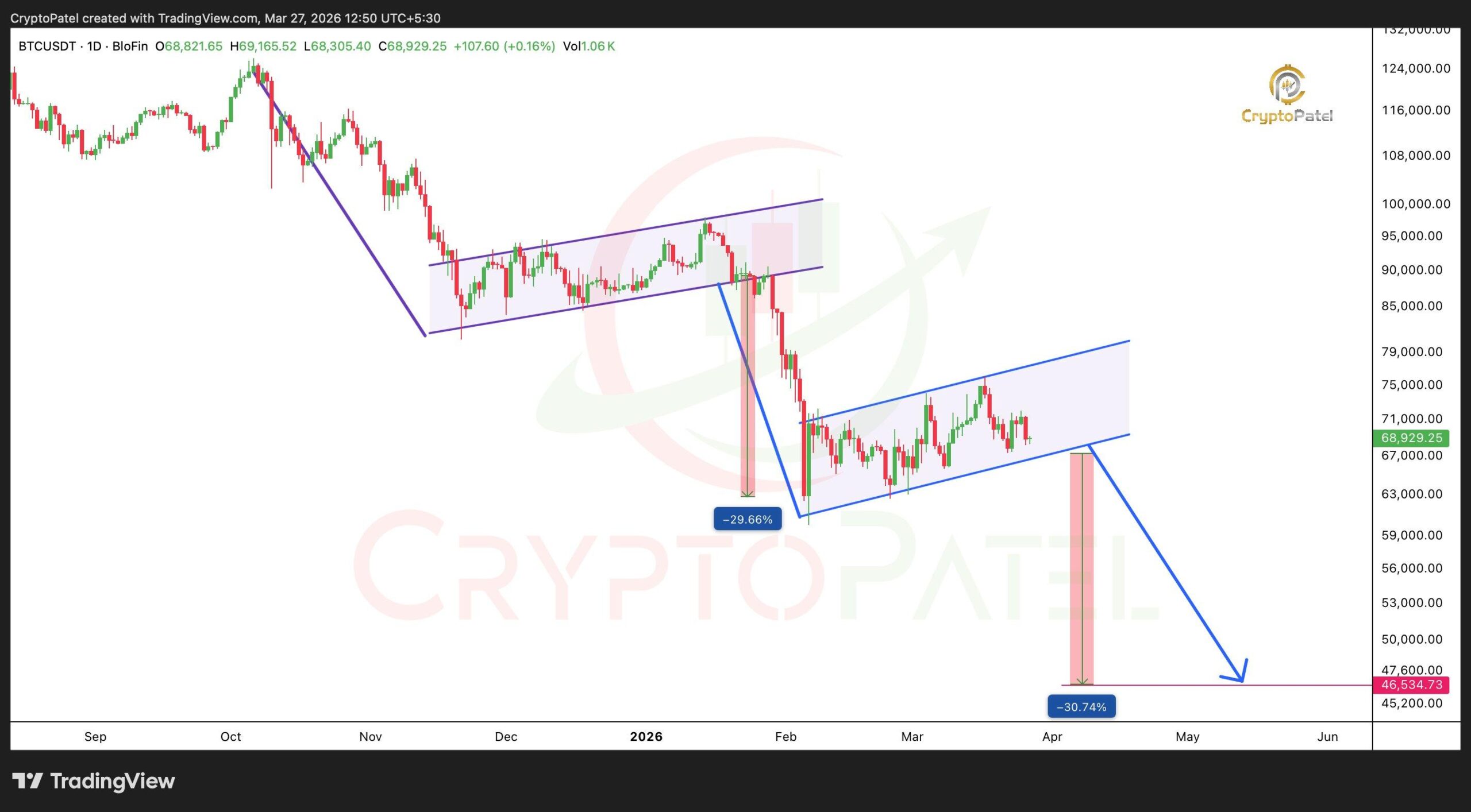
Veteran Analyst Predicts Bitcoin Price Crash to $49,000, Here’s Why


