1. What is the Lightning Network? The Lightning Network is a scalability solution built on top of Bitcoin, allowing users to quickly send and receive small amounts of Bitcoin with minimal fees. In1. What is the Lightning Network? The Lightning Network is a scalability solution built on top of Bitcoin, allowing users to quickly send and receive small amounts of Bitcoin with minimal fees. In
Apprentissage/Cryptocurrency Knowledge/Hot Concepts/What is the...ng Network?

What is the Lightning Network?

Jul 16, 2025MEXC
0m
4
4$0.008531-3.04%
Suilend
SEND$0.05034+1.10%

1. What is the Lightning Network?


The Lightning Network is a scalability solution built on top of Bitcoin, allowing users to quickly send and receive small amounts of Bitcoin with minimal fees. In simple terms, the Lightning Network functions as a second-layer solution for the Bitcoin network.

The Lightning Network conducts transaction processing off-chain, with only the final transaction result confirmed on the blockchain. This enhances the transaction efficiency of the Bitcoin network, enabling users to complete payments at reduced costs and faster speeds.

2. Why is the Lightning Network Necessary?


2.1 Enhanced Transaction Speed


Bitcoin's native network can process only about 7 transactions per second, while everyday electronic payment systems can handle tens of thousands of transactions per second. This results in a subpar payment experience within Bitcoin's native network. The Lightning Network, on the other hand, conducts transactions off-chain and confirms the final results on the blockchain, significantly boosting transaction speed.

2.2 Reduced Transaction Fees


Bitcoin transaction fees follow a competitive bidding model. Users must pay a certain fee for each transaction, and miners prioritize and process transactions based on the fees offered. Transactions with higher fees take precedence, while those with lower fees are processed later. This means that during congested periods on the Bitcoin network, users may need to pay higher fees for their transactions to be executed promptly. In the past, average transaction fees on the Bitcoin network have reached as high as $60, and this year, due to the popularity of BRC-20 tokens, average fees briefly surpassed $30.

Due to the slow transaction speed and high transaction fees on Bitcoin's native network, using Bitcoin for everyday payments is not cost-effective. However, the Lightning Network has changed that. On the Lightning Network, transaction fees for a $100 transaction will not exceed 1 cent, greatly reducing transaction costs and making Bitcoin a feasible option for everyday payments.

2.3 Lowering Transaction Barriers


Everyday payments often involve small, frequent transactions. Over the past three months, the average transaction fee on the Bitcoin network has hovered around $2. When the cost of fees may exceed the price of the item you are purchasing, Bitcoin becomes an impractical choice for payment.

The Lightning Network significantly reduces transaction fees, rendering the impact of fees on the price of your purchases negligible. This lowers the threshold for using Bitcoin in transactions.

3. How the Lightning Network Works


The Lightning Network operates through payment channels, where users establish peer-to-peer payment channels to form the Lightning Network.

To conduct transactions, both parties establish a payment channel between themselves by sending funds from the initial transaction to a multi-signature address. This multi-signature address is managed using private keys from both parties and requires their signatures to create new transactions.

This multi-signature wallet serves as a duplicate record of the assets. Transactions generated by both parties are recorded in this duplicate. When the channel is closed, the results recorded in the duplicate are broadcast to the blockchain for final settlement, and the remaining balance is recorded on the blockchain.

Let's illustrate this with a simple example:

A and B want to transact via the Lightning Network. To do this, they must first establish a payment channel and store funds in the wallet for this payment channel. The wallet is jointly managed using the private keys of both A and B, and it can only be opened upon confirmation from both parties.

As mentioned earlier, the multi-signature wallet serves as a duplicate record of the assets. Transaction records between A and B are stored in this duplicate. When A and B no longer engage in transactions and choose to close the payment channel between them, the final transaction result between A and B is sent back to the Bitcoin network for confirmation.

Now, let's introduce a slightly more complex scenario by introducing a new participant, C.

A and B want to transact via the Lightning Network, but in this case, they do not have Lightning Network established between them. However, C has separate payment channels with both A and B.

In this situation, A and B can route their transaction from A to C and then from C to B, with C acting as an intermediary. While A and B cannot transact directly, C eliminates the need for them to establish a new payment channel between themselves.

The transaction ultimately occurs between A and B, but it is facilitated with the assistance of C, allowing C to set and collect a certain routing fee for facilitating the transaction between A and B.

4. Disadvantages of the Lightning Network


4.1 Entry Costs: There are costs associated with entering the Lightning Network, making the process of transferring funds onto the Lightning Network relatively expensive.

4.2 Liquidity Issues: If your counterparty has no balance in the channel, you will not be able to receive or make payments. While specialized Lightning Network service providers now address this liquidity problem, it introduces potential centralization issues.

4.3 Vulnerability to Hacks: Payment channels, wallets, and application programming interfaces (APIs) are all susceptible to hacking attacks.

5. The Future of the Lightning Network


Despite its existing shortcomings, the Lightning Network continues to develop rapidly. As of now, there are over 16,000 Lightning Network nodes, and its promotion and popularization have made significant contributions to payments and social domains.

Social project Damus supports Lightning Network payment and tipping features. Digital payment platform Strike, in collaboration with Shopify, Blackhawk Network, and NCR, has established a Bitcoin payment system that allows merchants to swiftly receive USD after customers pay with cryptocurrencies. Following El Salvador's recognition of Bitcoin as legal tender, the Lightning Network has been promoted for use within the country.

The emergence of the Lightning Network represents a significant step toward enabling Bitcoin for everyday payments. Current issues are actively being addressed by Bitcoin community developers to further enhance the Lightning Network.

In conclusion, when we discuss second-layer networks, we often refer to Layer 2 networks on Ethereum. If you are interested in learning more about Ethereum Layer 2 networks, feel free to give "Understand Ethereum Layer 2 in One Easy Example" a read.
Opportunité de marché
Logo de 4
Cours 4(4)
$0.008531
$0.008531$0.008531
-3.26%
USD
Graphique du prix de 4 (4) en temps réel

Articles populaires

Voir plus
Indicateur Mayer Multiple Bitcoin : définition, formule et valeurs clés

Indicateur Mayer Multiple Bitcoin : définition, formule et valeurs clés

La plupart des indicateurs Bitcoin nécessitent des heures d'étude pour être déchiffrés. Le Mayer Multiple simplifie cette complexité en un seul chiffre — et il est utilisé depuis des années pour suivr

Rapport hebdomadaire de recherche Trader Alpha de MEXC | Inflation PCE persistante, risques budgétaires non résolus et pression vendeuse continue sur les ETF

Rapport hebdomadaire de recherche Trader Alpha de MEXC | Inflation PCE persistante, risques budgétaires non résolus et pression vendeuse continue sur les ETF

Semaine 1 de juin 2026 Période de référence : 27 mai – 2 juin 2026 Date limite des données : 2 juin 2026 Narratif clé Au cours de la semaine écoulée, les données macroéconomiques et les flux de capita
Qu'est-ce que les Actions ?

Qu'est-ce que les Actions ?

1. Qu'est-ce que les Actions MEXC ? Actions MEXC est un produit de trading Cross-chain innovant lancé par MEXC en collaboration avec des courtiers réglementés pour les utilisateurs crypto mondiaux. Il
Qu'est-ce que les Actions ?

Qu'est-ce que les Actions ?

1. Qu'est-ce que les Actions MEXC ? Actions MEXC est un produit de trading Cross-chain innovant lancé par MEXC en collaboration avec des courtiers réglementés pour les utilisateurs crypto mondiaux. Il

Actualités tendance

Voir plus
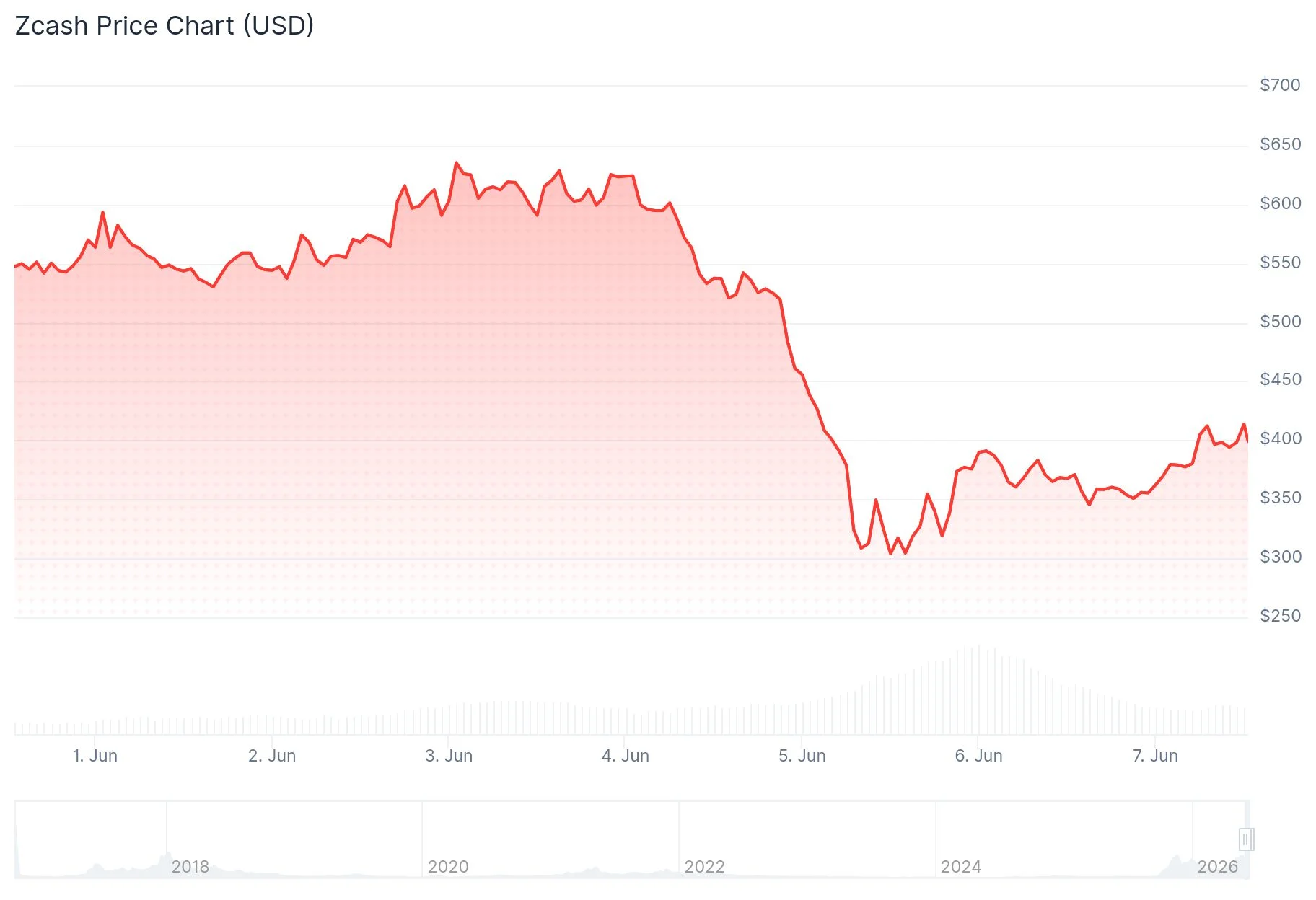
Zcash (ZEC) chute de 40 % après la révélation d'une vulnérabilité critique du Pool Orchard après 4 ans

Zcash (ZEC) chute de 40 % après la révélation d'une vulnérabilité critique du Pool Orchard après 4 ans

Zcash (ZEC) a chuté de 40 % après qu'un bug critique du pool Orchard a été révélé et corrigé en juin 2026. L'IA a découvert la faille. Aucune exploitation détectée. Analyse complète. The post

L'action Realty Income (O) est-elle toujours le meilleur choix de dividende mensuel en ce moment ?

L'action Realty Income (O) est-elle toujours le meilleur choix de dividende mensuel en ce moment ?

TLDR Realty Income a relevé ses prévisions d'AFFO pour l'ensemble de l'année 2026 à 4,41–4,44 $ par action après de solides résultats au T1 La société a porté son objectif d'investissement 2026 à 9,5

L'action Fluence Energy (FLNC) vaut-elle encore la peine d'être achetée après une année à +385 % ?

L'action Fluence Energy (FLNC) vaut-elle encore la peine d'être achetée après une année à +385 % ?

TLDR Le titre Fluence Energy a ouvert à 22,91 $, en hausse de 69 % au cours des 30 derniers jours et de 385,4 % au cours de l'année écoulée. Les analystes ont une note consensuelle « Conserver » de 21

La semaine à venir : les marchés face aux craintes de hausse des taux, l'IPO de SpaceX et les données clés sur l'inflation

La semaine à venir : les marchés face aux craintes de hausse des taux, l'IPO de SpaceX et les données clés sur l'inflation

TLDR Le S&P 500 a chuté de 2,6 % la semaine dernière et le Nasdaq a baissé de 4,7 % alors que les marchés anticipaient une hausse des taux. Les données IPC de mai tombent mercredi, avec une inflation

Articles connexes

Voir plus
Le carnet d'ordres Bitcoin expliqué : profondeur BTC, Spread et Analyse par heatmap

Le carnet d'ordres Bitcoin expliqué : profondeur BTC, Spread et Analyse par heatmap

La plupart des traders Bitcoin passent tout leur temps sur les graphiques de prix — mais le carnet d'ordres BTC raconte une histoire différente.Il vous montre où se trouve le vrai argent, en attente d
Le tableau d'affichage Bitcoin expliqué : forums, communautés et comment les traders les utilisent

Le tableau d'affichage Bitcoin expliqué : forums, communautés et comment les traders les utilisent

La plupart des investisseurs en Bitcoin ne se contentent pas de surveiller les graphiques — ils suivent aussi les discussions.Un forum BTC est l'endroit où ces discussions prennent vie : opinions brut
Bitcoin Iran : comment les sanctions, l'énergie bon marché et les conflits influencent le prix du BTC

Bitcoin Iran : comment les sanctions, l'énergie bon marché et les conflits influencent le prix du BTC

L'Iran et le Bitcoin ont développé l'une des relations les plus singulières dans le monde de la crypto — motivée non seulement par l'innovation, mais par la survie économique.Les sanctions ont coupé l

Google Finance Bitcoin : Suivez le prix BTC-USD, les tendances et le sentiment gratuitement

Google Finance Bitcoin : Suivez le prix BTC-USD, les tendances et le sentiment gratuitement

Des millions de personnes recherchent « Bitcoin » sur Google chaque jour — et ce qu'elles trouvent va bien au-delà d'une simple définition.Google propose désormais deux outils gratuits puissants : un

S'inscrire sur MEXC
Inscrivez-vous et recevez jusqu'à 10,000 USDT en bonus
BTC sous 70 K $, sorties des ETF
BTC sous 70 K $, sorties des ETFBTC sous 70 K $, sorties des ETF
PCE en hausse, Strategy réduit le BTC. À lire.