Exploring how biases in the peer-review system impact researchers' choices, showing how principles of fairness relate to the production of scientific knowledge based on topic importance and hardness.Exploring how biases in the peer-review system impact researchers' choices, showing how principles of fairness relate to the production of scientific knowledge based on topic importance and hardness.

Academic Publishing and Fairness: A Game-Theoretic Model of Peer-Review Bias

2025/09/17 23:15

Abstract and 1. Introduction

  1. A free and fair economy: definition, existence and uniqueness

    2.1 A free economy

    2.2 A free and fair economy

  2. Equilibrium existence in a free and fair economy

    3.1 A free and fair economy as a strategic form game

    3.2 Existence of an equilibrium

  3. Equilibrium efficiency in a free and fair economy

  4. A free economy with social justice and inclusion

    5.1 Equilibrium existence and efficiency in a free economy with social justice

    5.2 Choosing a reference point to achieve equilibrium efficiency

  5. Some applications

    6.1 Teamwork: surplus distribution in a firm

    6.2 Contagion and self-enforcing lockdown in a networked economy

    6.3 Bias in academic publishing

    6.4 Exchange economies

  6. Contributions to the closely related literature

  7. Conclusion and References

Appendix

6.3 Bias in academic publishing

\
\
\
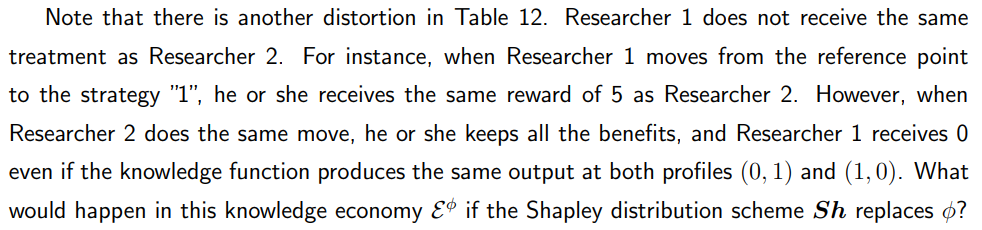
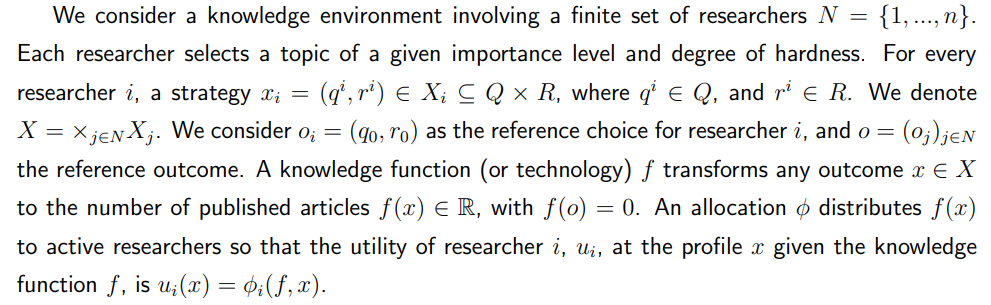
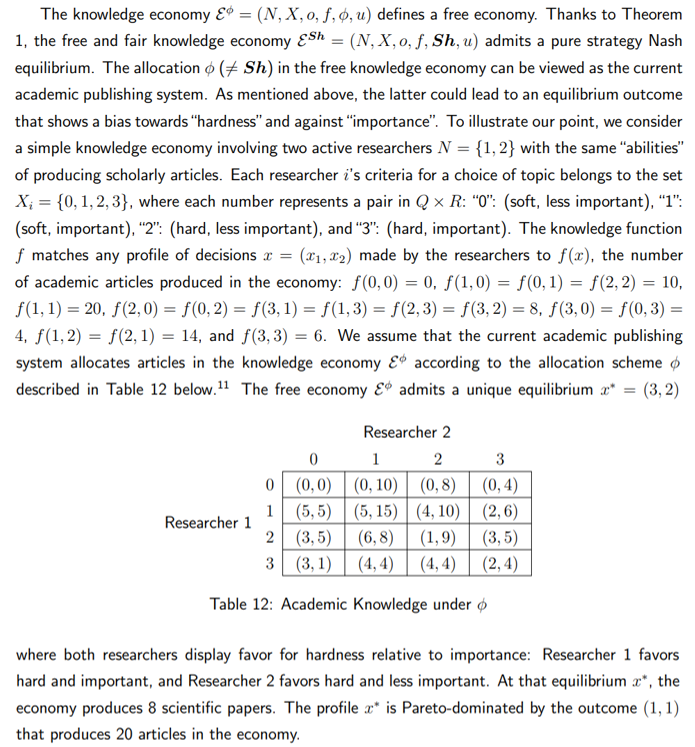
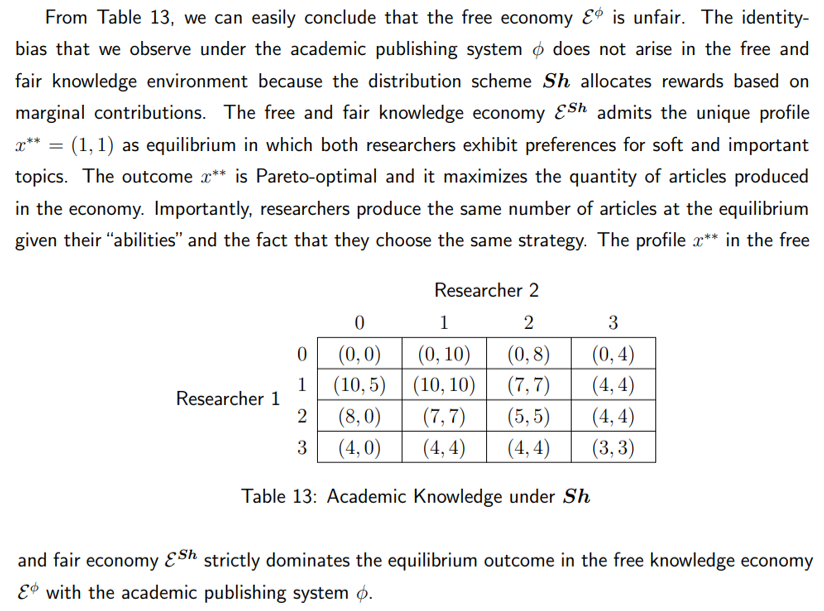
\ Well, it is straightforward to show that the researchers are symmetric under the knowledge function f. Using Anonymity and the other principles of merit-based justice, Table 13 below describes the allocation of academic articles under the allocation Sh.

\
\

:::info Authors:

(1) Ghislain H. Demeze-Jouatsa, Center for Mathematical Economics, University of Bielefeld (demeze jouatsa@uni-bielefeld.de);

(2) Roland Pongou, Department of Economics, University of Ottawa (rpongou@uottawa.ca);

(3) Jean-Baptiste Tondji, Department of Economics and Finance, The University of Texas Rio Grande Valley (jeanbaptiste.tondji@utrgv.edu).

:::


:::info This paper is available on arxiv under CC BY 4.0 DEED license.

:::

[10] Tough the trade-off between the two quality dimensions can be viewed as a rational decision, the consequences can be detrimental to economics, as a discipline and profession. For instance, some general interest journals suffer from the “incest factor” [Heckman et al., 2017], and Akerlof [2020] shows that the tendency of rewarding “hard” topics versus“ soft ”topics in economics results in “sins of omissions” where issues that are relevant to the literature and can not be approached in a “hard” way are ignored.

\

Disclaimer: The articles reposted on this site are sourced from public platforms and are provided for informational purposes only. They do not necessarily reflect the views of MEXC. All rights remain with the original authors. If you believe any content infringes on third-party rights, please contact service@support.mexc.com for removal. MEXC makes no guarantees regarding the accuracy, completeness, or timeliness of the content and is not responsible for any actions taken based on the information provided. The content does not constitute financial, legal, or other professional advice, nor should it be considered a recommendation or endorsement by MEXC.

You May Also Like

OCC Confirms Banks Can Facilitate No-Risk Crypto Transactions

OCC Confirms Banks Can Facilitate No-Risk Crypto Transactions

The post OCC Confirms Banks Can Facilitate No-Risk Crypto Transactions appeared on BitcoinEthereumNews.com. U.S. national banks have been passed by the Office of the Comptroller of the Currency (OCC) to enable their customers perform instant crypto trades with no risk. This decision has cleared a significant obstacle in the way of banks that desire to be part of the expanding digital assets market. Banks Receive Clarity on Crypto Trading Authority  Interpretive Letter 1188 states that a bank can be an intermediary in crypto transactions without having digital assets in its possession. The OCC clarified that one client may sell a crypto asset to one bank and that bank will sell the asset to the other client at the same time. Since the two trades take place virtually at the same time the bank does not have an exposure to the market. The license provides banks with a regulated structure to provide crypto trading services. This is in line with preceding actions like enabling banks to hold major crypto assets. Another explanation that OCC provides is that the role of the bank is not to trade digital assets. Instead, the only responsibility of the bank is linking the sellers and the buyers. OCC Reinforces Bank’s Crypto Oversight The regulator mentioned that such transactions carry a limited amount of settlement risk. The decision is an update of a previous guidance that permitted crypto custody and some stablecoin transactions. The latest clarification strengthens the same allowances but indicates continued regulation of responsible crypto services in the banking space. With this, the banks are now enabled to provide customers with a secure means of accessing digital assets in compliance with federal regulations. The OCC stressed that institutions need to continue having robust risk controls, such as cybersecurity controls and compliance programs. Hence, all their operations can be safe and in line with current rules. How Institutions Might…
Share
BitcoinEthereumNews2025/12/10 07:46