Exploring how the costs of a pandemic can lead to a self-enforcing lockdown in a networked economy, analyzing the resulting changes in network structure and the existence of stable equilibria.Exploring how the costs of a pandemic can lead to a self-enforcing lockdown in a networked economy, analyzing the resulting changes in network structure and the existence of stable equilibria.

The Economics of Self-Isolation: A Game-Theoretic Analysis of Contagion in a Free Economy

2025/09/17 23:00

Abstract and 1. Introduction

  1. A free and fair economy: definition, existence and uniqueness

    2.1 A free economy

    2.2 A free and fair economy

  2. Equilibrium existence in a free and fair economy

    3.1 A free and fair economy as a strategic form game

    3.2 Existence of an equilibrium

  3. Equilibrium efficiency in a free and fair economy

  4. A free economy with social justice and inclusion

    5.1 Equilibrium existence and efficiency in a free economy with social justice

    5.2 Choosing a reference point to achieve equilibrium efficiency

  5. Some applications

    6.1 Teamwork: surplus distribution in a firm

    6.2 Contagion and self-enforcing lockdown in a networked economy

    6.3 Bias in academic publishing

    6.4 Exchange economies

  6. Contributions to the closely related literature

  7. Conclusion and References

Appendix

6.2 Contagion and self-enforcing lockdown in a networked economy

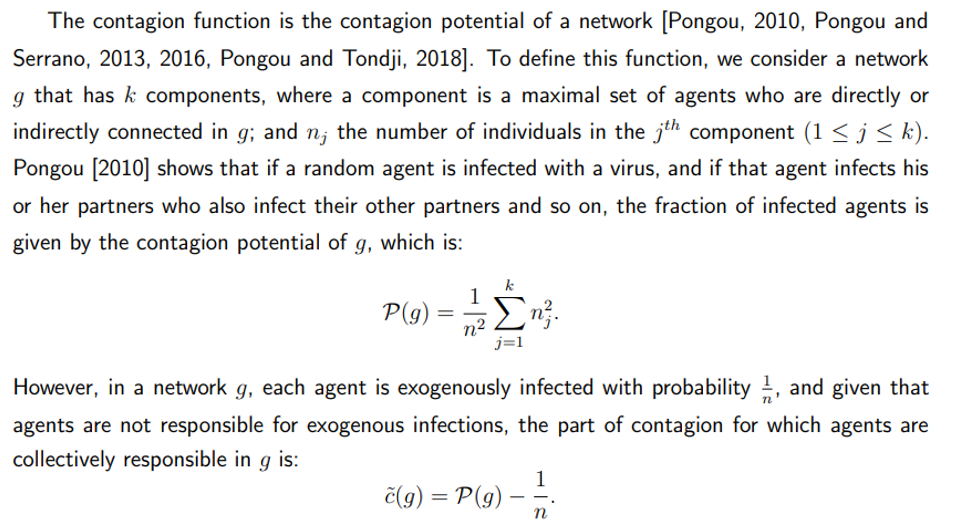
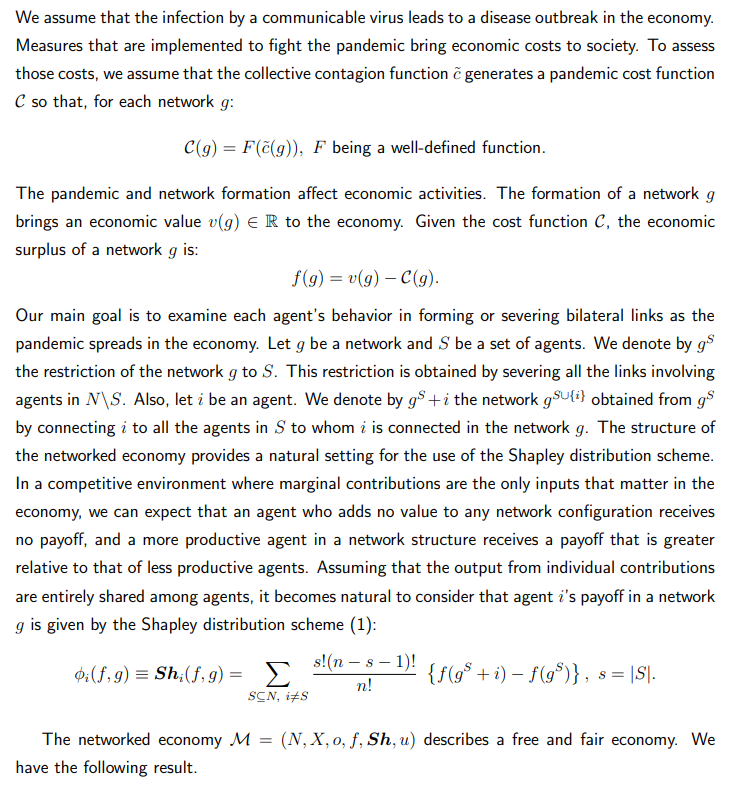
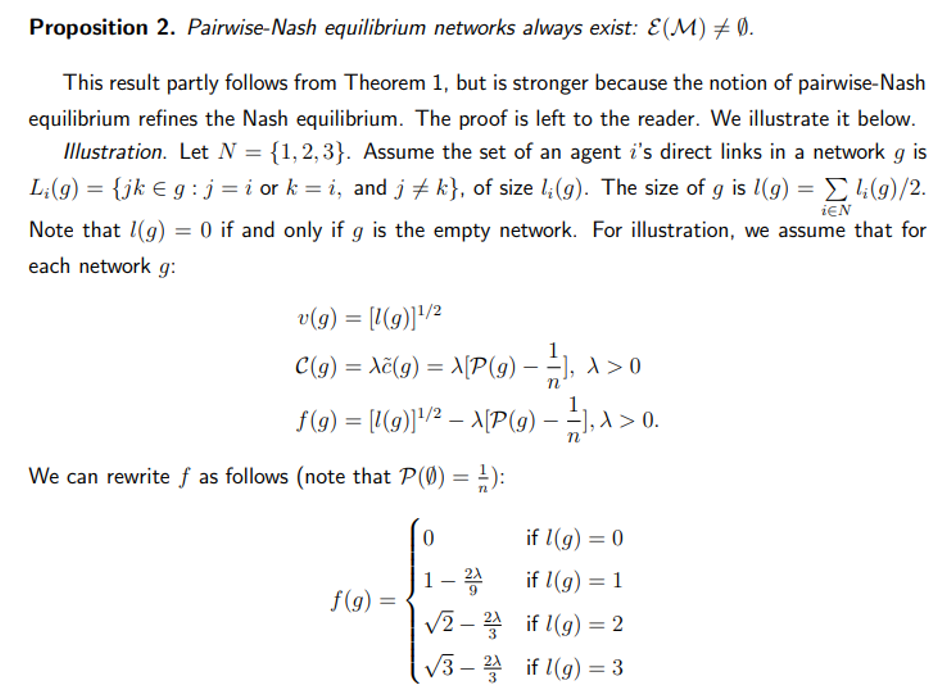
In this section, we provide an application of a free and fair economy to contagion and selfenforcing lockdown in a networked economy. We show how the costs of a pandemic from a virus outbreak can affect agents’ decisions to form and sever bilateral relationships in the economy. Specifically, we illustrate this application by using the contagion potential of a network [Pongou, 2010, Pongou and Serrano, 2013, 2016, Pongou and Tondji, 2018].

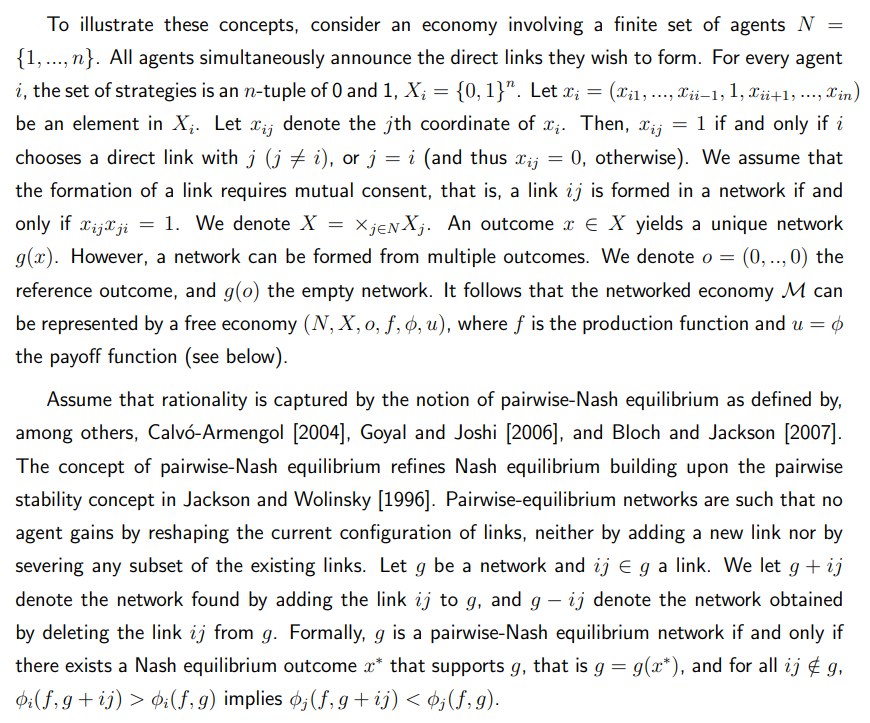
\ Consider an economy M involving agents who freely form and sever bilateral links according to their preferences. Agents’ choices lead to a network, defined as a set of bilateral links. Assume that rational behavior is captured by a certain equilibrium notion (for example, Nash equilibrium, pairwise-Nash equilibrium, etc.). Such an economy may have multiple equilibria. Denote by E(M) the set of its equilibria. Our main goal is to assess agent’s decisions in response to the spread of a random infection (for example, COVID-19) that might hit the economy. As the pandemic evolves in the economy, will some agents decide to sever existing links and self-isolate themselves? How does network structure depend on the infection cost?

\
\
\
\
\
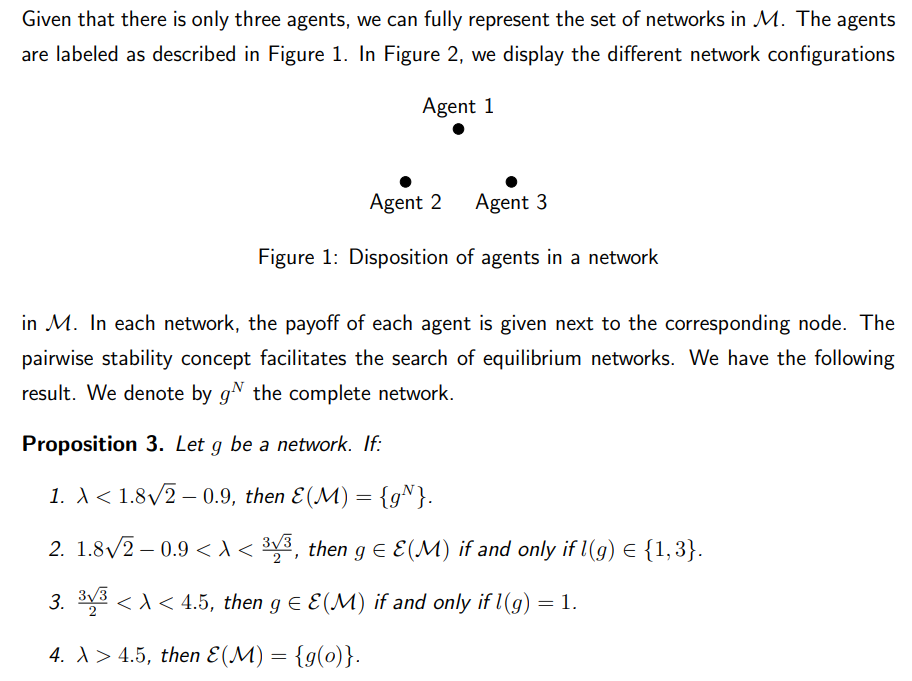
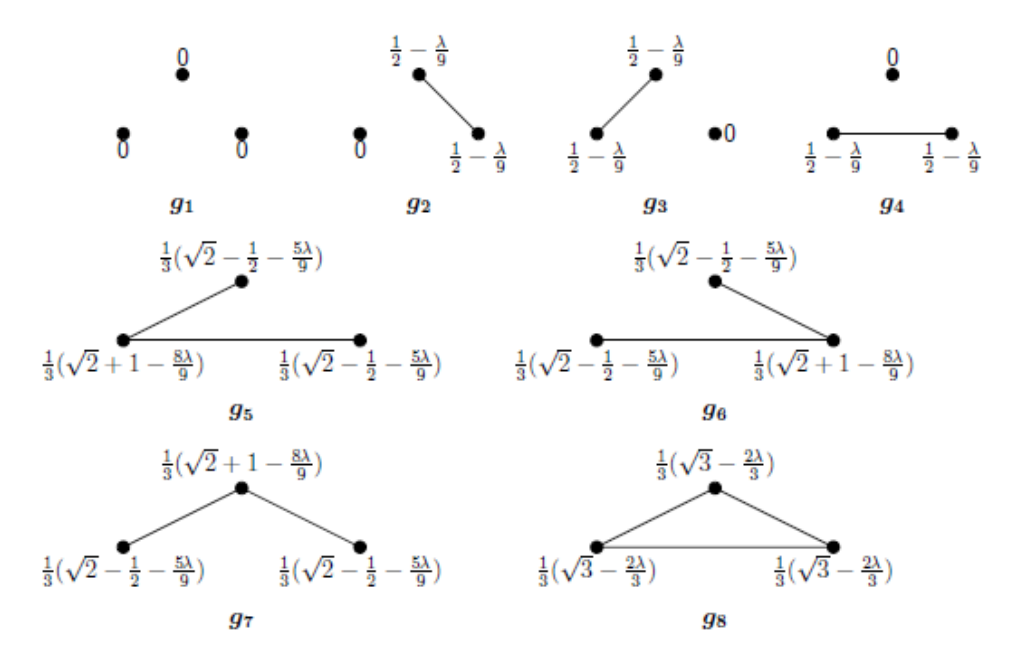
\ Figure 2: Possible network formation in M
\

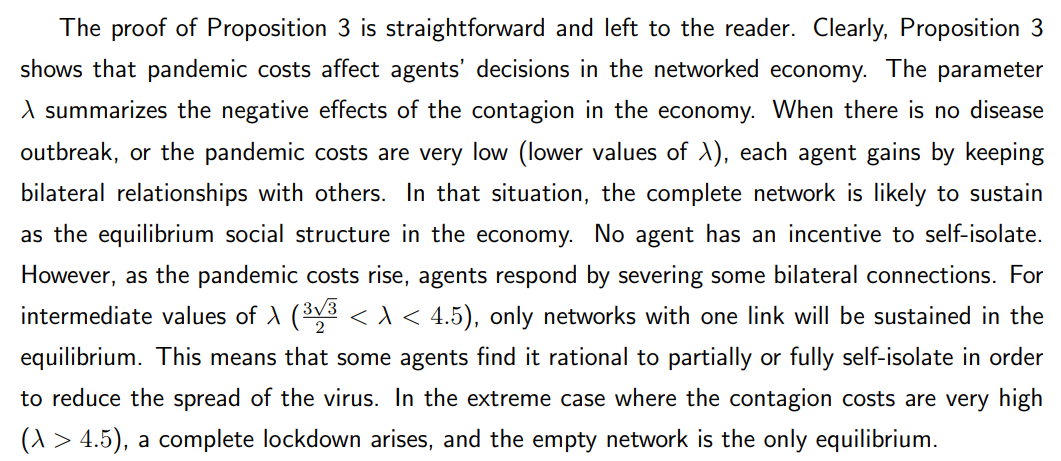
\ Interestingly, the value of λ depends on the nature of the virus. Viruses induce different severity levels. For example, COVID-19 and the flu virus have different values, inducing different network configurations in equilibrium. The different network configurations in Figure 2 can therefore be interpreted as the networks that will arise in different scenarios regarding the nature of the virus.

\

:::info Authors:

(1) Ghislain H. Demeze-Jouatsa, Center for Mathematical Economics, University of Bielefeld (demeze jouatsa@uni-bielefeld.de);

(2) Roland Pongou, Department of Economics, University of Ottawa (rpongou@uottawa.ca);

(3) Jean-Baptiste Tondji, Department of Economics and Finance, The University of Texas Rio Grande Valley (jeanbaptiste.tondji@utrgv.edu).

:::


:::info This paper is available on arxiv under CC BY 4.0 DEED license.

:::

\

Disclaimer: The articles reposted on this site are sourced from public platforms and are provided for informational purposes only. They do not necessarily reflect the views of MEXC. All rights remain with the original authors. If you believe any content infringes on third-party rights, please contact service@support.mexc.com for removal. MEXC makes no guarantees regarding the accuracy, completeness, or timeliness of the content and is not responsible for any actions taken based on the information provided. The content does not constitute financial, legal, or other professional advice, nor should it be considered a recommendation or endorsement by MEXC.

You May Also Like

Soluna Holdings Announces $32 Million Equity Offering

Soluna Holdings Announces $32 Million Equity Offering

The post Soluna Holdings Announces $32 Million Equity Offering appeared on BitcoinEthereumNews.com. Key Points: Soluna Holdings initiates $32 million offering for Bitcoin and AI projects. Funds targeted at expanding Bitcoin mining infrastructure. Soluna positions itself at the intersection of renewable energy and computing power. Soluna Holdings announced a $32 million registered direct offering, involving the issuance of 18,079,144 shares and Series C warrants at $1.77 each, as per Nasdaq regulations. This funding supports Bitcoin mining and AI infrastructure, potentially impacting related markets by expanding Soluna’s renewable energy-driven computing capacity. Equity Offering Fuels Bitcoin and AI Growth Soluna Holdings has entered into definitive agreements to issue 18,079,144 shares and Series C warrants at $1.77 per share. The $32 million raised will be directed at enhancing Bitcoin mining capabilities and advancing artificial intelligence initiatives, emphasizing Soluna’s strategic positioning in green energy sectors. “We strategically co-locate our data centers with renewable power sources to support Bitcoin mining, generative AI, and other compute-intensive applications.” – Soluna Press Release Bitcoin Market Faces Volatility Amid Funding News Did you know? Soluna’s funding strategy mirrors trends seen in other data-center companies supporting cryptos and AI, highlighting a shift towards sustainable tech infrastructure. Bitcoin (BTC) currently trades at $89,257.47 with a market cap of approximately $1.78 trillion. Recent declines include a -2.79% drop over the past 24 hours, according to CoinMarketCap. Bitcoin(BTC), daily chart, screenshot on CoinMarketCap at 00:01 UTC on December 7, 2025. Source: CoinMarketCap Insights from the Coincu research team suggest that Soluna’s strategy may catalyze further investments in technology that thrives on renewable energy, reinforcing its practical application in cryptocurrency and AI sectors. DISCLAIMER: The information on this website is provided as general market commentary and does not constitute investment advice. We encourage you to do your own research before investing. Source: https://coincu.com/bitcoin/soluna-holdings-raises-32-million/
Share
BitcoinEthereumNews2025/12/07 08:08
The Psychology Behind Why People Stay, Leave, Or Tune Out At Work

The Psychology Behind Why People Stay, Leave, Or Tune Out At Work

The post The Psychology Behind Why People Stay, Leave, Or Tune Out At Work appeared on BitcoinEthereumNews.com. The Psychology Behind Why People Stay, Leave, Or Tune Out At Work getty Leaders spend a lot of time wondering why some employees stay loyal, why others leave quickly, and why so many slip into disengagement long before they walk out the door. People often assume the main reason employees leave is pay or promotion. Those things matter, but they only scratch the surface. The bigger explanation is based in psychology. Employees make decisions based on how they feel, what they fear, what they assume, and whether their daily experiences reinforce a sense of meaning and connection. That is the part leaders overlook. The clues are always there, but they are often hidden in everyday interactions that seem small and routine. What Does The Psychology Of Daily Work Reveal About Why People Stay? getty What Does The Psychology Of Daily Work Reveal About Why People Stay? People stay in workplaces where they feel understood. Any organization can offer flexibility or better benefits, but those are not what keep people committed long term. Employees stay when they believe their voice matters, when support feels steady instead of controlling, and when their manager shows genuine interest in how they experience the workday. Microsoft’s Satya Nadella has talked about this often. He highlights how people perform at a higher level when leaders approach conversations with a learning mindset instead of an answer mindset. That shift changes the tone of the relationship. When employees sense curiosity from leaders, it lowers defensiveness, builds trust, and strengthens commitment. Curiosity also signals interest, and interest signals value. When people feel valued, they stay. When they do not, they begin to explore other options. This is why the tone of daily interactions matters so much. A single moment where someone feels dismissed can outweigh months of positive intentions.…
Share
BitcoinEthereumNews2025/12/07 07:45