Ethereum (ETH) saw a 7% decline on Monday amid BitMine boosting its holdings to 2.4 million ETH over the past week.Ethereum (ETH) saw a 7% decline on Monday amid BitMine boosting its holdings to 2.4 million ETH over the past week.

Ethereum Price Forecast: ETH drops 7% despite BitMine's $1.1 billion purchase

3 min read

Ethereum price today: $4,140

  • Ethereum treasury company BitMine purchased 264,378 ETH, worth about $1.1 billion, last week.
  • The company entered a $365 million purchase agreement and issued a $913 million stock warrant.
  • ETH has declined below its 50-day SMA for the first time in two months and is eyeing a bounce off $4,000.

Ethereum (ETH) saw a 7% decline on Monday amid BitMine boosting its holdings to 2.4 million ETH over the past week.

BitMine scoops 264K ETH, plans $1.28 billion stock sale

Ethereum treasury firm BitMine Immersion (BMNR) said that its Ether holdings have reached 2.4 million ETH, valued at over $10.13 billion, according to a statement on Monday.

That is, it added 264,378 ETH, worth about $1.1 billion, since its last announcement on September 15.

The Nevada-based firm has total holdings of $11.4 billion, which also comprises 192 Bitcoin (BTC), a $175 million stake in Worldcoin treasury company Eightco Holdings, and $345 million in unencumbered cash.

BitMine also revealed on Monday that it had entered into a purchase agreement with an unnamed institutional investor to sell 5,217,715 shares of its common stock at $70 per share, expecting gross proceeds of $365.2 million.

"BitMine has raised $365.24 million by selling our stock at a 14% premium to Friday's close. By selling shares at $70 per share, compared to our $61.29 closing price, this is materially accretive to existing shareholders as the primary use of proceeds is to add to our ETH holdings," said Thomas Lee, BitMine's Chairman.

The deal also involved a warrant to purchase 10,435,430 shares at a strike price of $87.50 in a direct offering. With $913 million in cash expected if the warrant is exercised in full before or on its March 22 expiry, BitMine could receive total proceeds of $1.28 billion when combined with expected proceeds from its common offering.

Following the announcement, BitMine shares fell nearly 10%, trading around $55 at the time of publication on Monday. The move aligns with a broader decline in the cryptocurrency market and related stocks.

BitMine pivoted to an Ethereum treasury strategy in June, after initially raising $250 million in a private placement involving Peter Thiel's Founders Fund, Galaxy Digital, and Pantera Capital, among others.

BitMine is the largest among several publicly-traded Ethereum treasuries, which hold a combined 4.15 million ETH, according to data from the Strategic ETH Reserve website.

Ethereum Price Forecast: ETH declines below 50-day SMA, eyes a bounce off $4,000

Ethereum experienced $516.3 million in futures liquidations over the past 24 hours, with $489.6 million attributed to long liquidations.

ETH saw a 7% decline over the past 24 hours, plunging below the 50-day Simple Moving Average (SMA) for the first time in over two months. The top altcoin is testing the support around $4,000, a level that bulls defended following a similar decline in mid-August.
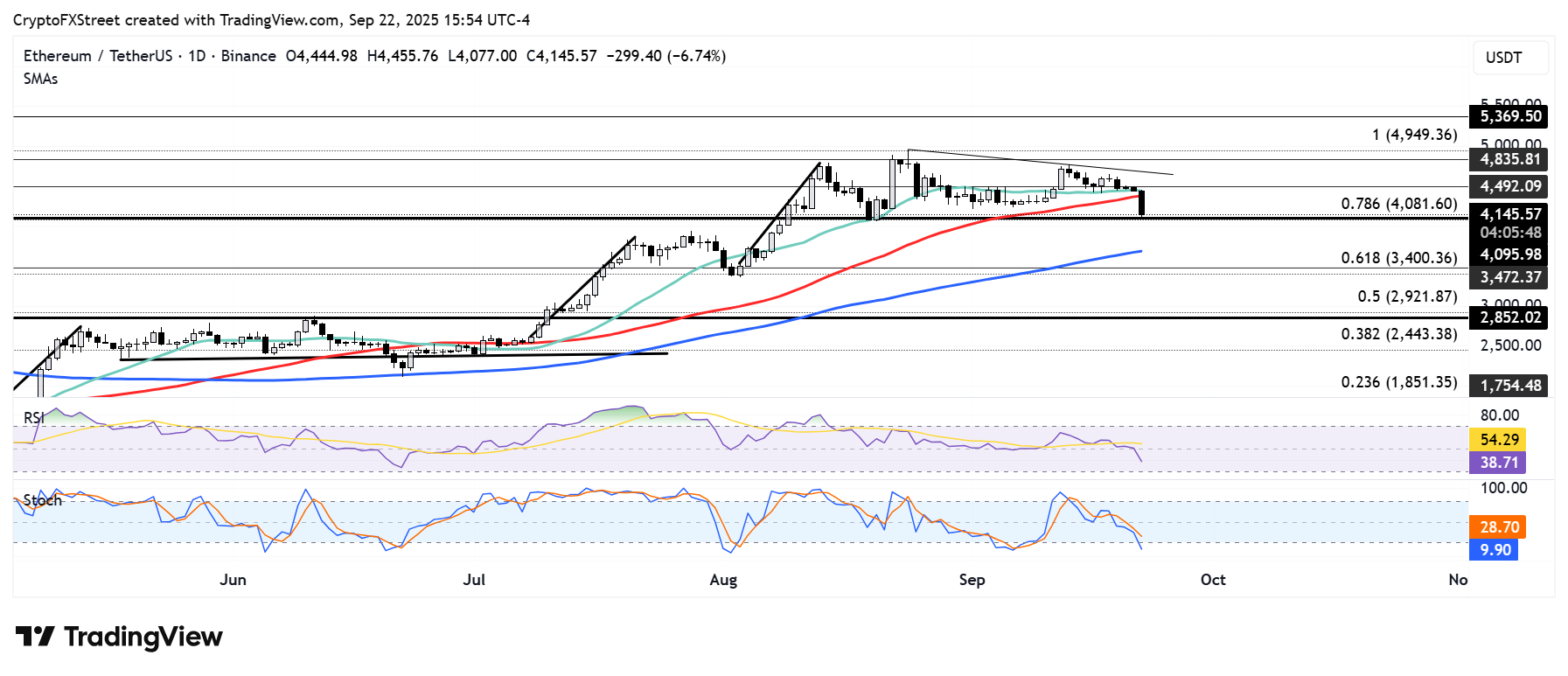
ETH/USDT daily chart

A further drop below $4,000 could send ETH to find support near the 100-day SMA.

The Relative Strength Index (RSI) has declined below its neutral level, and the Stochastic Oscillator (Stoch) has entered its oversold region. While the indicators suggest a dominant bearish momentum, oversold conditions in the Stoch could lead to a potential bearish exhaustion.


Market Opportunity
Ethereum Logo
Ethereum Price(ETH)
$1,910.81
$1,910.81$1,910.81
-2.57%
USD
Ethereum (ETH) Live Price Chart
Disclaimer: The articles reposted on this site are sourced from public platforms and are provided for informational purposes only. They do not necessarily reflect the views of MEXC. All rights remain with the original authors. If you believe any content infringes on third-party rights, please contact service@support.mexc.com for removal. MEXC makes no guarantees regarding the accuracy, completeness, or timeliness of the content and is not responsible for any actions taken based on the information provided. The content does not constitute financial, legal, or other professional advice, nor should it be considered a recommendation or endorsement by MEXC.

You May Also Like

Cashing In On University Patents Means Giving Up On Our Innovation Future

Cashing In On University Patents Means Giving Up On Our Innovation Future

The post Cashing In On University Patents Means Giving Up On Our Innovation Future appeared on BitcoinEthereumNews.com. “It’s a raid on American innovation that would deliver pennies to the Treasury while kneecapping the very engine of our economic and medical progress,” writes Pipes. Getty Images Washington is addicted to taxing success. Now, Commerce Secretary Howard Lutnick is floating a plan to skim half the patent earnings from inventions developed at universities with federal funding. It’s being sold as a way to shore up programs like Social Security. In reality, it’s a raid on American innovation that would deliver pennies to the Treasury while kneecapping the very engine of our economic and medical progress. Yes, taxpayer dollars support early-stage research. But the real payoff comes later—in the jobs created, cures discovered, and industries launched when universities and private industry turn those discoveries into real products. By comparison, the sums at stake in patent licensing are trivial. Universities collectively earn only about $3.6 billion annually in patent income—less than the federal government spends on Social Security in a single day. Even confiscating half would barely register against a $6 trillion federal budget. And yet the damage from such a policy would be anything but trivial. The true return on taxpayer investment isn’t in licensing checks sent to Washington, but in the downstream economic activity that federally supported research unleashes. Thanks to the bipartisan Bayh-Dole Act of 1980, universities and private industry have powerful incentives to translate early-stage discoveries into real-world products. Before Bayh-Dole, the government hoarded patents from federally funded research, and fewer than 5% were ever licensed. Once universities could own and license their own inventions, innovation exploded. The result has been one of the best returns on investment in government history. Since 1996, university research has added nearly $2 trillion to U.S. industrial output, supported 6.5 million jobs, and launched more than 19,000 startups. Those companies pay…
Share
BitcoinEthereumNews2025/09/18 03:26
XRP Ledger Unlocks Permissioned Domains With 91% Validator Backing

XRP Ledger Unlocks Permissioned Domains With 91% Validator Backing

XRP Ledger activated XLS-80 after 91% validator approval, enabling permissioned domains for credential-gated use on the public XRPL. The XRP Ledger has activated
Share
LiveBitcoinNews2026/02/06 13:00
TrendX Taps Trusta AI to Develop Safer and Smarter Web3 Network

TrendX Taps Trusta AI to Develop Safer and Smarter Web3 Network

The purpose of collaboration is to advance the Web3 landscape by combining the decentralized infrastructure of TrendX with AI-led capabilities of Trusta AI.
Share
Blockchainreporter2025/09/18 01:07