

Everything On Cardano Depends On This, IOG Warns
Input Output Group has put Cardano’s maintenance layer at the center of its latest governance pitch, arguing that the network’s future upgrades, applications and daily operations all depend on sustained funding for core infrastructure work.
In a post on X, IOG said the effort is led by Michael Karg and covers “Rigorous Testing/QA and Performance tuning,” “Bug fixes & security patches,” and “Node, network and community support.” The message was deliberately blunt: “Everything on Cardano depends on this.”
Why This Proposal Is Crucial For Cardano
The proposal, published on the Momentum Cardano site, frames maintenance as the baseline condition for the rest of the ecosystem. It describes the initiative as “core platform maintenance, support, and operational infrastructure for the Cardano network,” with a scope that runs from Q3 2026 through Q1 2027. The proposal’s treasury ask is ₳62,134,630.
The central argument is not that maintenance is a new feature, but that it is the layer that makes feature delivery possible. The proposal states: “Every proposal in this portfolio depends on one thing: a stable, reliable, operational Cardano network. Maintenance is the foundation everything else is built on.” It adds that Cardano “powers billions of dollars in value and thousands of applications across a global user base,” making continued codebase upkeep, security work and predictable releases a matter of operational stewardship rather than optional spending.
The proposal says the programme covers disaster recovery, knowledge sharing through the Cardano Blueprint, security reviews, monitoring data and performance metrics, all of which are to be published transparently. The underlying message is clear: new capabilities can only ship safely if the base layer remains stable.
The funded work is broad. According to the proposal, the maintenance envelope includes node bugfixing and architecture, DevOps and infrastructure, monitoring, documentation, open-source support, performance, quality assurance, release support and security, and component maintenance. That translates into work on CI/CD systems, compiler and platform compatibility, testnets, mainnet monitoring, global mempool data, GitHub issue triage, ledger performance, benchmarking, incident management, Plutus Core updates, DB-Sync consistency and Cardano API/CLI upkeep.
IOG also emphasizes that these deliverables are not staged as a conventional roadmap. The proposal says all deliverables are continuous and “run for the full duration of the funded period,” with no sequential phasing or quarterly gating. In other words, the request is structured around parallel operational coverage rather than discrete milestone releases.
The proposal includes a direct defense of the size of the line item. “People ask why Maintenance is the biggest line item. The answer is simple: everything else depends on it. Every stake pool operator, every DApp, every transaction on Cardano runs on the work this team does every day.”
A second quote from Christos Palaskas, the operator of the Skepsis Pool, makes the same point from a stake-pool perspective. “I’ve been running my stake pool Skepsis for 5+ years now. There have been numerous occasions where improvements to the node were welcomed with relief. There have been memory footprint improvements, security fixes, new features.” He warned that Cardano must keep maintaining the node “or we will not survive the next storm.”
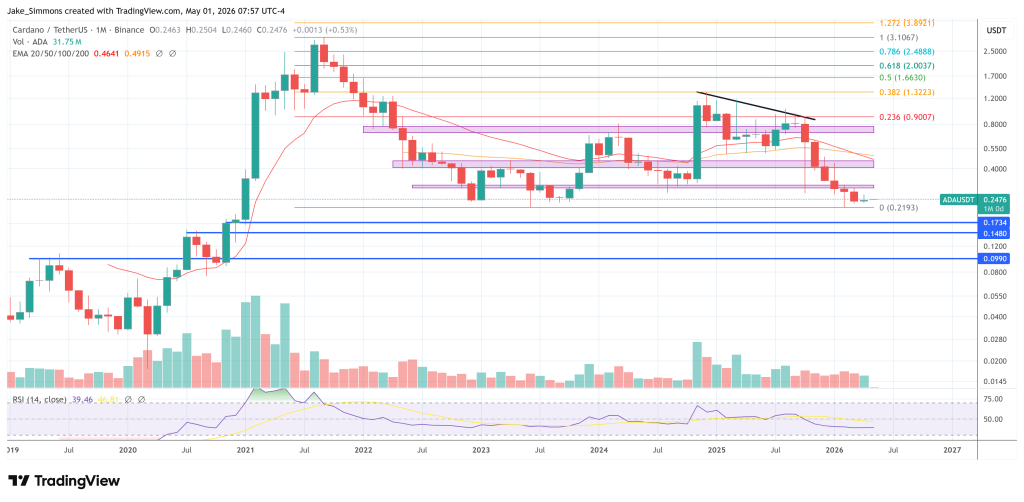
At press time, ADA traded at $0.2476.


You May Also Like

The week in photos: April 25 to May 1, 2026
OranjeBTC Moves To Raise $42M For Bitcoin Expansion




