US President Donald Trump has called on the House of Representatives to swiftly pass the GENIUS Act without making any amendments, urging lawmakers to deliver the bill to his desk “ASAP.” In a post on Truth Social Thursday, Trump celebrated the Senate’s approval of the bill and warned against any attempts to delay or tweak it. “The Senate just passed an incredible Bill that is going to make America the UNDISPUTED Leader in Digital Assets,” he wrote. “Get it to my desk, ASAP — NO DELAYS, NO ADD ONS.” The push comes a day after the Senate passed the GENIUS Act in a 68 to 30 vote , with 18 Democrats joining most Republicans in support. Formally known as the Guiding and Establishing National Innovation for US Stablecoins Act, the bill represents Congress’s first major attempt to regulate stablecoins, which are crypto tokens pegged to the US dollar. Source: Truth Social/@realDonaldTrump GENIUS Act Faces Scrutiny Over Trump’s Crypto Gains Ahead of House Debate Next, the House is expected to take up the measure, with Republicans holding a narrow majority. While GOP leadership is likely to support the bill, partisan tensions remain. The GENIUS Act failed its initial Senate vote in May. This was largely due to concerns about Trump’s ties to the crypto industry. Sen. Elizabeth Warren, one of the bill’s strongest critics, raised serious objections. She accused the president and his family of standing to make “hundreds of millions” if the bill becomes law. Trump’s USD1 stablecoin reportedly brought in $57m last year. Despite the controversy, several Democrats say the need to regulate the growing stablecoin sector is urgent. Sen. Mark Warner, who also raised concerns about Trump’s crypto ventures, argued that the US cannot afford to remain on the sidelines while other countries move forward with digital asset policy. With Backing from Industry, Stablecoin Bill Moves Ahead Despite Regulatory Gaps If the House passes the GENIUS Act, it would create a federal licensing system for stablecoin issuers. Each token would be required to maintain full 1:1 backing with US dollars. In addition, the bill would restrict how reserves are used, limiting them to redemptions and low-risk investments such as Treasury repos. It also mandates anti-money laundering checks and basic consumer protections. Once cleared by the House, the bill would head to President Trump for his final signature. Large crypto firms have largely welcomed the legislation. Many have spent millions lobbying in Washington to shape digital asset rules. However, critics say the bill leaves important gaps. While it prohibits members of Congress and their families from profiting off stablecoins, it does not apply the same rule to the president or first family. As a result, Trump could continue issuing stablecoins even as he signs the regulations governing them into law. Other provisions in the bill have also drawn criticism. It prohibits yield-bearing stablecoins, a move some say protects traditional banks but stifles innovation. Additionally, the bill’s strict compliance rules could increase costs. This may push out smaller issuers and concentrate power among a few large players. Even so, momentum appears to favor the bill. Trump’s allies see his urgency as a strategy to lock in digital asset policy. They hope to avoid delays from drawn-out Congressional negotiations or the risk of the bill being bundled with more contentious crypto legislation.US President Donald Trump has called on the House of Representatives to swiftly pass the GENIUS Act without making any amendments, urging lawmakers to deliver the bill to his desk “ASAP.” In a post on Truth Social Thursday, Trump celebrated the Senate’s approval of the bill and warned against any attempts to delay or tweak it. “The Senate just passed an incredible Bill that is going to make America the UNDISPUTED Leader in Digital Assets,” he wrote. “Get it to my desk, ASAP — NO DELAYS, NO ADD ONS.” The push comes a day after the Senate passed the GENIUS Act in a 68 to 30 vote , with 18 Democrats joining most Republicans in support. Formally known as the Guiding and Establishing National Innovation for US Stablecoins Act, the bill represents Congress’s first major attempt to regulate stablecoins, which are crypto tokens pegged to the US dollar. Source: Truth Social/@realDonaldTrump GENIUS Act Faces Scrutiny Over Trump’s Crypto Gains Ahead of House Debate Next, the House is expected to take up the measure, with Republicans holding a narrow majority. While GOP leadership is likely to support the bill, partisan tensions remain. The GENIUS Act failed its initial Senate vote in May. This was largely due to concerns about Trump’s ties to the crypto industry. Sen. Elizabeth Warren, one of the bill’s strongest critics, raised serious objections. She accused the president and his family of standing to make “hundreds of millions” if the bill becomes law. Trump’s USD1 stablecoin reportedly brought in $57m last year. Despite the controversy, several Democrats say the need to regulate the growing stablecoin sector is urgent. Sen. Mark Warner, who also raised concerns about Trump’s crypto ventures, argued that the US cannot afford to remain on the sidelines while other countries move forward with digital asset policy. With Backing from Industry, Stablecoin Bill Moves Ahead Despite Regulatory Gaps If the House passes the GENIUS Act, it would create a federal licensing system for stablecoin issuers. Each token would be required to maintain full 1:1 backing with US dollars. In addition, the bill would restrict how reserves are used, limiting them to redemptions and low-risk investments such as Treasury repos. It also mandates anti-money laundering checks and basic consumer protections. Once cleared by the House, the bill would head to President Trump for his final signature. Large crypto firms have largely welcomed the legislation. Many have spent millions lobbying in Washington to shape digital asset rules. However, critics say the bill leaves important gaps. While it prohibits members of Congress and their families from profiting off stablecoins, it does not apply the same rule to the president or first family. As a result, Trump could continue issuing stablecoins even as he signs the regulations governing them into law. Other provisions in the bill have also drawn criticism. It prohibits yield-bearing stablecoins, a move some say protects traditional banks but stifles innovation. Additionally, the bill’s strict compliance rules could increase costs. This may push out smaller issuers and concentrate power among a few large players. Even so, momentum appears to favor the bill. Trump’s allies see his urgency as a strategy to lock in digital asset policy. They hope to avoid delays from drawn-out Congressional negotiations or the risk of the bill being bundled with more contentious crypto legislation.

Trump Wants GENIUS Bill Sent Straight to His Desk, Without Congressional Tweaks

3 min read

US President Donald Trump has called on the House of Representatives to swiftly pass the GENIUS Act without making any amendments, urging lawmakers to deliver the bill to his desk “ASAP.”

In a post on Truth Social Thursday, Trump celebrated the Senate’s approval of the bill and warned against any attempts to delay or tweak it.

“The Senate just passed an incredible Bill that is going to make America the UNDISPUTED Leader in Digital Assets,” he wrote. “Get it to my desk, ASAP — NO DELAYS, NO ADD ONS.”

The push comes a day after the Senate passed the GENIUS Act in a 68 to 30 vote, with 18 Democrats joining most Republicans in support.

Formally known as the Guiding and Establishing National Innovation for US Stablecoins Act, the bill represents Congress’s first major attempt to regulate stablecoins, which are crypto tokens pegged to the US dollar.
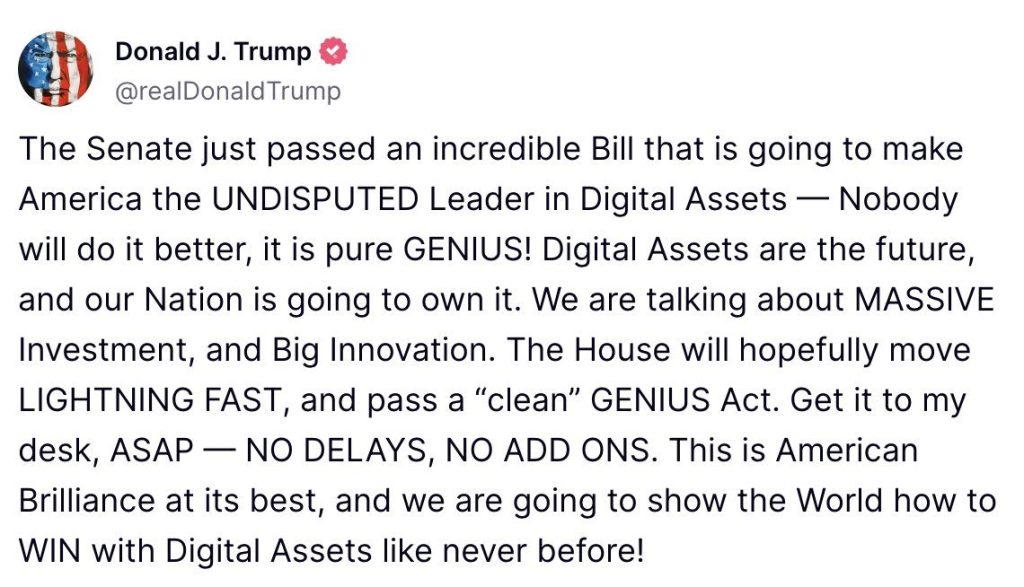
Source: Truth Social/@realDonaldTrump

GENIUS Act Faces Scrutiny Over Trump’s Crypto Gains Ahead of House Debate

Next, the House is expected to take up the measure, with Republicans holding a narrow majority. While GOP leadership is likely to support the bill, partisan tensions remain.

The GENIUS Act failed its initial Senate vote in May. This was largely due to concerns about Trump’s ties to the crypto industry. Sen. Elizabeth Warren, one of the bill’s strongest critics, raised serious objections. She accused the president and his family of standing to make “hundreds of millions” if the bill becomes law.

Trump’s USD1 stablecoin reportedly brought in $57m last year. Despite the controversy, several Democrats say the need to regulate the growing stablecoin sector is urgent. Sen. Mark Warner, who also raised concerns about Trump’s crypto ventures, argued that the US cannot afford to remain on the sidelines while other countries move forward with digital asset policy.

With Backing from Industry, Stablecoin Bill Moves Ahead Despite Regulatory Gaps

If the House passes the GENIUS Act, it would create a federal licensing system for stablecoin issuers. Each token would be required to maintain full 1:1 backing with US dollars.

In addition, the bill would restrict how reserves are used, limiting them to redemptions and low-risk investments such as Treasury repos. It also mandates anti-money laundering checks and basic consumer protections.

Once cleared by the House, the bill would head to President Trump for his final signature.

Large crypto firms have largely welcomed the legislation. Many have spent millions lobbying in Washington to shape digital asset rules. However, critics say the bill leaves important gaps.

While it prohibits members of Congress and their families from profiting off stablecoins, it does not apply the same rule to the president or first family. As a result, Trump could continue issuing stablecoins even as he signs the regulations governing them into law.

Other provisions in the bill have also drawn criticism. It prohibits yield-bearing stablecoins, a move some say protects traditional banks but stifles innovation. Additionally, the bill’s strict compliance rules could increase costs. This may push out smaller issuers and concentrate power among a few large players.

Even so, momentum appears to favor the bill. Trump’s allies see his urgency as a strategy to lock in digital asset policy. They hope to avoid delays from drawn-out Congressional negotiations or the risk of the bill being bundled with more contentious crypto legislation.

Disclaimer: The articles reposted on this site are sourced from public platforms and are provided for informational purposes only. They do not necessarily reflect the views of MEXC. All rights remain with the original authors. If you believe any content infringes on third-party rights, please contact service@support.mexc.com for removal. MEXC makes no guarantees regarding the accuracy, completeness, or timeliness of the content and is not responsible for any actions taken based on the information provided. The content does not constitute financial, legal, or other professional advice, nor should it be considered a recommendation or endorsement by MEXC.

You May Also Like

Bitcoin ETFs Outpace Ethereum With $2.9B Weekly Surge

Bitcoin ETFs Outpace Ethereum With $2.9B Weekly Surge

The surge follows a difficult August, when investors pulled out more than $750 million while rotating capital into Ethereum-focused funds. […] The post Bitcoin ETFs Outpace Ethereum With $2.9B Weekly Surge appeared first on Coindoo.
Share
Coindoo2025/09/18 01:15
CME Group to launch options on XRP and SOL futures

CME Group to launch options on XRP and SOL futures

The post CME Group to launch options on XRP and SOL futures appeared on BitcoinEthereumNews.com. CME Group will offer options based on the derivative markets on Solana (SOL) and XRP. The new markets will open on October 13, after regulatory approval.  CME Group will expand its crypto products with options on the futures markets of Solana (SOL) and XRP. The futures market will start on October 13, after regulatory review and approval.  The options will allow the trading of MicroSol, XRP, and MicroXRP futures, with expiry dates available every business day, monthly, and quarterly. The new products will be added to the existing BTC and ETH options markets. ‘The launch of these options contracts builds on the significant growth and increasing liquidity we have seen across our suite of Solana and XRP futures,’ said Giovanni Vicioso, CME Group Global Head of Cryptocurrency Products. The options contracts will have two main sizes, tracking the futures contracts. The new market will be suitable for sophisticated institutional traders, as well as active individual traders. The addition of options markets singles out XRP and SOL as liquid enough to offer the potential to bet on a market direction.  The options on futures arrive a few months after the launch of SOL futures. Both SOL and XRP had peak volumes in August, though XRP activity has slowed down in September. XRP and SOL options to tap both institutions and active traders Crypto options are one of the indicators of market attitudes, with XRP and SOL receiving a new way to gauge sentiment. The contracts will be supported by the Cumberland team.  ‘As one of the biggest liquidity providers in the ecosystem, the Cumberland team is excited to support CME Group’s continued expansion of crypto offerings,’ said Roman Makarov, Head of Cumberland Options Trading at DRW. ‘The launch of options on Solana and XRP futures is the latest example of the…
Share
BitcoinEthereumNews2025/09/18 00:56
Vitalik Buterin Questions the Continued Relevance of Ethereum’s Layer 2 Solutions

Vitalik Buterin Questions the Continued Relevance of Ethereum’s Layer 2 Solutions

The post Vitalik Buterin Questions the Continued Relevance of Ethereum’s Layer 2 Solutions appeared on BitcoinEthereumNews.com. Vitalik Buterin, a prominent voice
Share
BitcoinEthereumNews2026/02/04 05:30