

Why a16z-backed Syndicate Labs is shutting down after 5 years
Syndicate Labs, the high-profile blockchain infrastructure entity backed by Silicon Valley venture capital giant Andreessen Horowitz (a16z), has announced it will wind down its development operations after five years in the market. The company revealed its decision on Thursday in a series of social media statements, citing a fundamental and permanent shift in the Ethereum layer-2 rollup ecosystem. The firm stated that a dramatic contraction across the broader scaling sector has made it impossible to sustain its business model or wait out the current market conditions.
“Unfortunately, the rollup market has shrunk dramatically,” Syndicate Labs stated on X. “For every new rollup spinning up, several more are quietly shutting down.”
Founded during the previous crypto boom, Syndicate Labs initially achieved prominence by developing framework infrastructure for Decentralised Autonomous Organisations (DAOs). The startup captured global industry attention when it provided the foundational tools to support ConstitutionDAO’s high-profile attempt to purchase a rare copy of the US Constitution at Sotheby’s.
As the market evolved, Syndicate shifted its focus toward institutional-grade blockchain infrastructure, creating highly customisable Ethereum appchains and smart rollups utilising Arbitrum Orbit technology. Backed by a $20 million Series A funding round led by a16z in 2021, the firm aimed to provide modular, reusable framework infrastructure and shared sequencing tools, allowing developers to spin up decentralised applications (dApps) without building entire networks from scratch.
However, the company’s leadership noted that the technology landscape has moved sharply away from its shared infrastructure model over the past year. Instead of adopting generic, modular primitives, blockchain developers and enterprise projects are increasingly leaning toward bespoke, highly customised execution environments built completely from the ground up by internal development and consulting teams.
Will Papper, co-founder of Syndicate Labs, explained that the firm explored shifting into a consulting framework, offering rollup-as-a-service advisory, but concluded that its core product could not easily adapt to what the market now demands.
“The projects that have thrived are highly customised, with their execution environments built entirely from scratch,” Papper stated. “Our framework does not fall into either category. It is too specific to be used as a generic component, and it is not close enough to the execution client to be extended to specific applications.”
The real reason behind Syndicate Labs’ painful dead
Industry data highlights the challenging environment that mid-tier and smaller infrastructure providers face. According to data from L2Beat, the total value secured across the layer-2 rollup ecosystem has fallen roughly 36% from its peak of over $50 billion in October. Furthermore, the market has undergone extreme consolidation. Three dominant platforms, Arbitrum One, Base, and OP Mainnet, now command a combined 75% market share, holding nearly $30 billion in total value secured.
This heavy concentration of capital and liquidity has squeezed out smaller modular infrastructure networks. Research published by digital asset manager 21Shares reported that layer-2 transaction activity had dropped 61% since mid-2025, leaving dozens of smaller scaling networks operating as underutilised zombie chains with minimal transactional volume or user adoption.
Following the announcement, Syndicate’s native utility token, SYND, plummeted to a new all-time low of $0.01061, as investors reacted to the development division’s closure.
Syndicate Labs clarified that the decision to wind down operations was entirely unrelated to a security breach that occurred in late April. During that incident, an attacker exploited a leaked private key to upgrade bridge contracts across two networks, draining approximately 18.5 million SYND tokens and roughly $50,000 in user assets. Syndicate Labs stated that its treasury reserves have fully reimbursed all affected asset holders, covering approximately $330,000 in lost value.
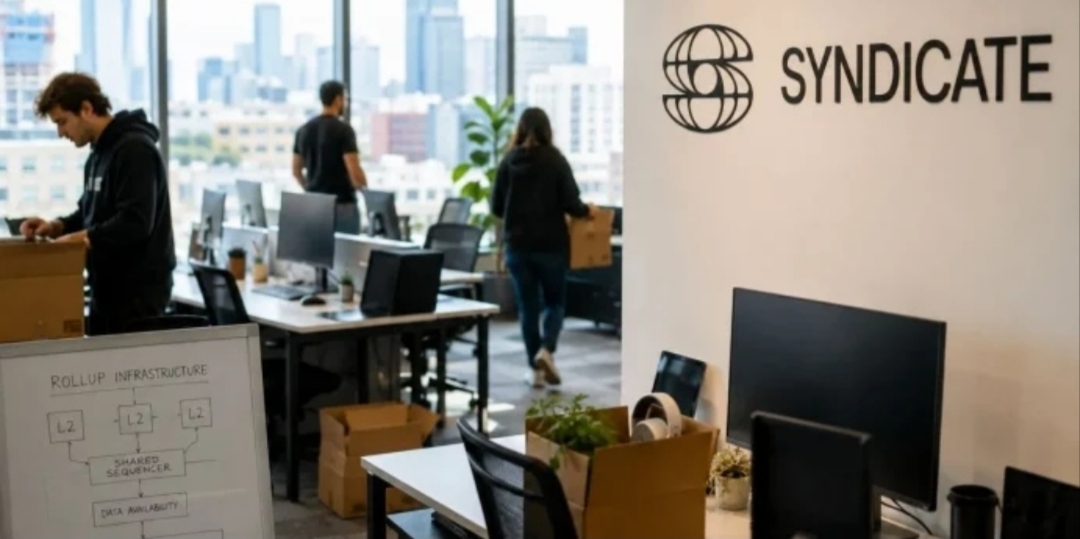
The firm emphasised that its wind-down will be managed via an orderly process to fulfil outstanding client obligations. Furthermore, the closure of the development division will not immediately impact the independent governance of the network.
Syndicate operates under a two-tiered structure: the development arm, Syndicate Labs, and the Syndicate Network Collective, a decentralised non-profit organisation registered as a Decentralised Unincorporated Non-profit Association (DUNA) in Wyoming. The Collective will remain operational to oversee SYND token governance. Management confirmed that team and investor token allocations will remain locked to ensure an equitable distribution of capital during the structural transition.
Also read: PayPal expands PYUSD stablecoin to 70 markets, including Africa


You May Also Like

Covéa Chooses Shift Technology as Strategic Partner for Fraud and Risk Management

One Of Frank Sinatra’s Most Famous Albums Is Back In The Spotlight

Not a loophole: Singapore AI export controls let China tap US AI legally



