Ripple’s Chief Technology Officer David Schwartz argued that large internet companies will inevitably adopt blockchain-based finance, contending that decentralized infrastructure is arriving “at the right place at the right time” to meet needs that legacy rails struggle to serve. The remarks came in Episode 1 of Ripple’s new Onchain Economy video series, published on September […]Ripple’s Chief Technology Officer David Schwartz argued that large internet companies will inevitably adopt blockchain-based finance, contending that decentralized infrastructure is arriving “at the right place at the right time” to meet needs that legacy rails struggle to serve. The remarks came in Episode 1 of Ripple’s new Onchain Economy video series, published on September […]

Amazon, Uber And Beyond—Ripple CTO Predicts Big Tech’s Blockchain Migration

2025/09/26 21:00
3 min read

Ripple’s Chief Technology Officer David Schwartz argued that large internet companies will inevitably adopt blockchain-based finance, contending that decentralized infrastructure is arriving “at the right place at the right time” to meet needs that legacy rails struggle to serve. The remarks came in Episode 1 of Ripple’s new Onchain Economy video series, published on September 25. In the segment, Schwartz frames decentralized finance as a practical response to unmet enterprise demand rather than a speculative detour.

Ripple CTO Foresees DeFi Eating Into TradFi

“Tech is coming for finance with or without blockchain. It was what was going to happen,” Schwartz says, singling out hyperscalers and platform companies: “New corporations, companies like Amazon and Uber need more financial services than the current system is able to provide them. And the blockchain technologies are in the right place at the right time.” He presents the thesis bluntly: this is less about converting traditional banks to crypto orthodoxy and more about meeting the operational realities of software-driven businesses that require programmable money, continuous settlement, and composable workflows.

Schwartz also distances his argument from the narrower, speculative corners of crypto. “It can’t just be collectibles and it can’t just be… seeking very high reward at very high risk,” he cautions, before asserting that DeFi—broadly defined to include smart contracts and the infrastructure around them—will “take a huge bite out of TradFi over the next couple of years.” The condition, in his telling, is straightforward: the blockchain sector must ship services people actually want from a financial system, and do so with institutional-grade guardrails.

That bridge between decentralization and compliance is the crux of the episode. “I don’t think there’s a tension between institutional adoption and decentralization,” Schwartz says. What institutions want from a base layer, he argues, is the very thing public chains offer: neutrality. “Ecosystems are interested in layer-1 blockchains because of their decentralization, because of their neutrality… institutions will see that the neutrality of blockchains is a positive rather than a negative.” In other words, neutrality is not a governance liability; it is the feature that allows multiple counterparties to cooperate without surrendering control to a single gatekeeper.

Schwartz’s comments land amid Ripple’s broader push to position XRPL as a venue for institutional on-chain finance—stablecoin flows, tokenized assets, and eventually native credit—supported by compliance-enabling primitives.

In a September 22 analysis on its corporate site, Ripple asserted that XRPL recorded $1+ billion in monthly stablecoin volume and ranks among the top chains for real-world asset activity, framing a roadmap that emphasizes verifiable credentials, “Deep Freeze” asset controls, and a planned protocol-level lending layer. Those claims, published by Ripple, form the company’s context for why neutral public ledgers can satisfy institutional requirements without abandoning decentralization.

Earlier this year, Ripple likewise proposed a permissioned DEX concept tied to credentialed market access on XRPL’s native exchange—an approach meant to reconcile KYC/AML obligations with the liquidity and transparency of a public order book. While the underlying standards still depend on network governance and implementation, the design illustrates how Ripple envisions regulated entities operating inside a decentralized environment without fragmenting liquidity into private silos.

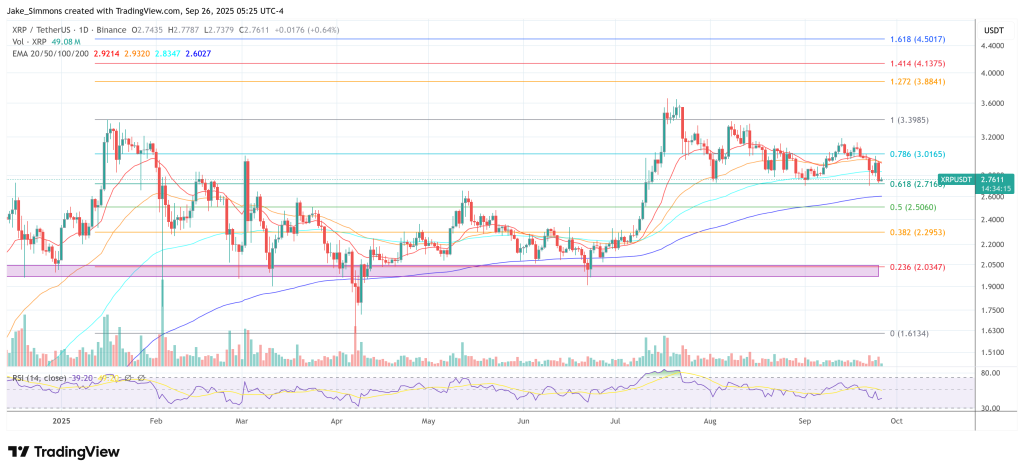
At press time, XRP traded at $2.76.
XRP price
Disclaimer: The articles reposted on this site are sourced from public platforms and are provided for informational purposes only. They do not necessarily reflect the views of MEXC. All rights remain with the original authors. If you believe any content infringes on third-party rights, please contact service@support.mexc.com for removal. MEXC makes no guarantees regarding the accuracy, completeness, or timeliness of the content and is not responsible for any actions taken based on the information provided. The content does not constitute financial, legal, or other professional advice, nor should it be considered a recommendation or endorsement by MEXC.

You May Also Like

Buterin pushes Layer 2 interoperability as cornerstone of Ethereum’s future

Buterin pushes Layer 2 interoperability as cornerstone of Ethereum’s future

Ethereum founder, Vitalik Buterin, has unveiled new goals for the Ethereum blockchain today at the Japan Developer Conference. The plan lays out short-term, mid-term, and long-term goals touching on L2 interoperability and faster responsiveness among others. In terms of technology, he said again that he is sure that Layer 2 options are the best way […]
Share
Cryptopolitan2025/09/18 01:15
White House meeting could unfreeze the crypto CLARITY Act this week, but crypto rewards likely to be the price

White House meeting could unfreeze the crypto CLARITY Act this week, but crypto rewards likely to be the price

White House stablecoin meeting could unfreeze the CLARITY Act, but your USDC rewards may be the price The newly confirmed Feb. 10 White House meeting on stablecoin
Share
CryptoSlate2026/02/09 18:48
Aave DAO to Shut Down 50% of L2s While Doubling Down on GHO

Aave DAO to Shut Down 50% of L2s While Doubling Down on GHO

The post Aave DAO to Shut Down 50% of L2s While Doubling Down on GHO appeared on BitcoinEthereumNews.com. Aave DAO is gearing up for a significant overhaul by shutting down over 50% of underperforming L2 instances. It is also restructuring its governance framework and deploying over $100 million to boost GHO. This could be a pivotal moment that propels Aave back to the forefront of on-chain lending or sparks unprecedented controversy within the DeFi community. Sponsored Sponsored ACI Proposes Shutting Down 50% of L2s The “State of the Union” report by the Aave Chan Initiative (ACI) paints a candid picture. After a turbulent period in the DeFi market and internal challenges, Aave (AAVE) now leads in key metrics: TVL, revenue, market share, and borrowing volume. Aave’s annual revenue of $130 million surpasses the combined cash reserves of its competitors. Tokenomics improvements and the AAVE token buyback program have also contributed to the ecosystem’s growth. Aave global metrics. Source: Aave However, the ACI’s report also highlights several pain points. First, regarding the Layer-2 (L2) strategy. While Aave’s L2 strategy was once a key driver of success, it is no longer fit for purpose. Over half of Aave’s instances on L2s and alt-L1s are not economically viable. Based on year-to-date data, over 86.6% of Aave’s revenue comes from the mainnet, indicating that everything else is a side quest. On this basis, ACI proposes closing underperforming networks. The DAO should invest in key networks with significant differentiators. Second, ACI is pushing for a complete overhaul of the “friendly fork” framework, as most have been unimpressive regarding TVL and revenue. In some cases, attackers have exploited them to Aave’s detriment, as seen with Spark. Sponsored Sponsored “The friendly fork model had a good intention but bad execution where the DAO was too friendly towards these forks, allowing the DAO only little upside,” the report states. Third, the instance model, once a smart…
Share
BitcoinEthereumNews2025/09/18 02:28