Rio de Janeiro Civil Police launched an operation targeting a Comando Vermelho operational nucleus and found a crypto mining setup with roughly 30 computers arrangedRio de Janeiro Civil Police launched an operation targeting a Comando Vermelho operational nucleus and found a crypto mining setup with roughly 30 computers arranged

Brazilian gang raid reveals a new crypto-crime model: turning stolen power into digital money

2026/05/23 17:53
5 min read
For feedback or concerns regarding this content, please contact us at crypto.news@mexc.com

Rio de Janeiro Civil Police launched an operation targeting a Comando Vermelho operational nucleus and found a crypto mining setup with roughly 30 computers arranged on shelves in a room on an apparently abandoned lot.

The farm drew power from a clandestine electrical connection running directly from a utility pole. The machines carried high-capacity fans and exhaust systems, including remote-monitoring hardware.

As G1 reported, police are investigating whether the faction used the structure for money movement or laundering.

The physical configuration already describes the possibility that a criminal organization with territorial control can convert stolen electricity into portable digital value.

Territorial control provides access to space and utilities, a clandestine electricity connection eliminates the primary operating cost, and the mining output converts directly into portable value.
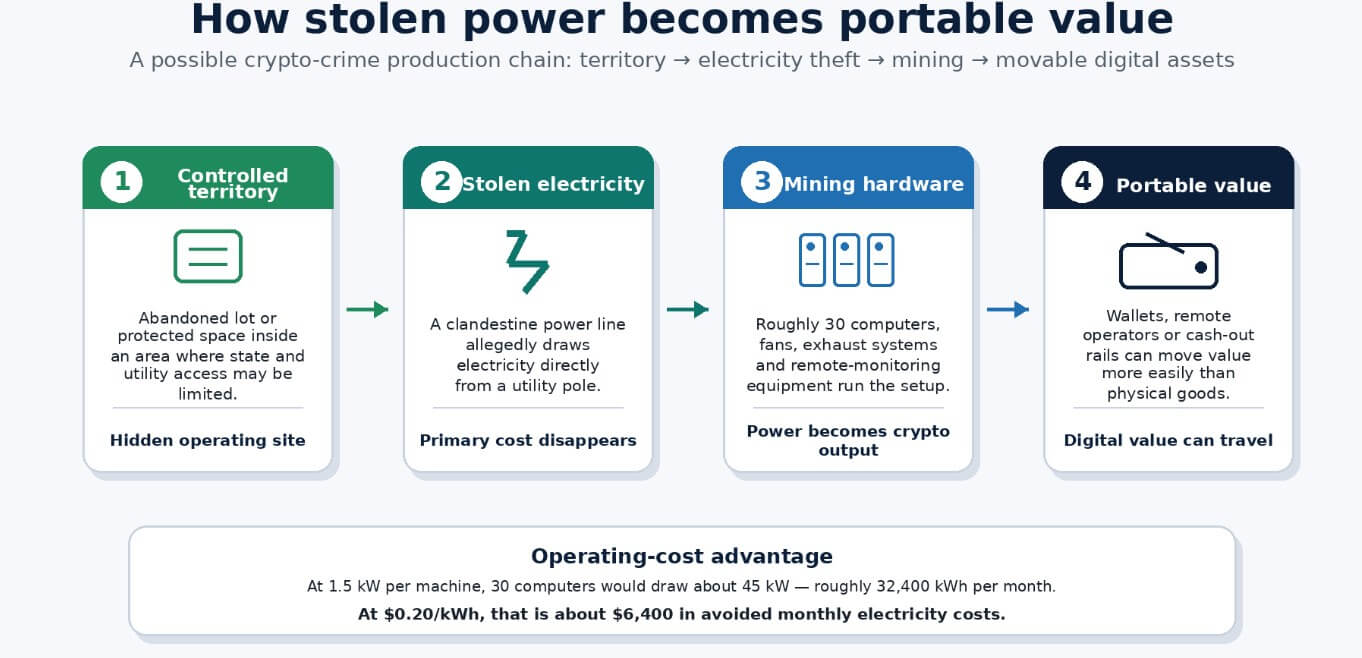
Stolen power becomes portable value for crypto crimeAn infographic maps the four-step model allegedly used in Rio's Complexo do Lins: controlled territory, stolen electricity, mining hardware and portable digital value output.

Stolen electricity is the load-bearing element of that model, since mining only makes economic sense when electricity is cheap, subsidized, or free.

Cambridge's Bitcoin Electricity Consumption Index methodology identifies electricity as one of mining's highest operating costs. Brazil's electricity regulator, ANEEL, reported that energy theft and other non-technical losses cost the country roughly $2 billion in 2024, with Rio de Janeiro among the states recording the highest levels of power theft.

At 1.5 kilowatts per machine, 30 computers would draw about 45 kilowatts, consuming about 32,400 kilowatt-hours per month. At $0.20 per kilowatt-hour, that is $6,400 in avoided monthly electricity costs, a real operating advantage delivered without payment.

The unknowns are the hardware type, the coin mined, the hash rate, and whether the crypto was ever cashed out. Stolen electricity removes one of mining's highest variable costs regardless of those unknowns.

Comando Vermelho's infrastructure evolution

The UK Home Office identifies Comando Vermelho as one of Brazil's two largest organized criminal groups alongside PCC, with territorial reach across urban favelas, border areas, and the Amazon.

The organization originated in Rio's prison system in the late 1970s, expanding into international cocaine trafficking and control of working-class neighborhoods where armed groups often manage basic services, including gas, internet, and transportation.

AP reported in 2025 that Rio police accused Comando Vermelho of coercing over 300 motorcycle drivers into using a clandestine ride-hailing app in Vila Kennedy, generating up to $200,000 per month, with revenue allegedly funneled through shell companies to finance drug trafficking.

On May 4, local news Folha reported that CV had intensified its presence in illegal gold mining near Brazil's border with Peru, treating gold as a profitable and stable alternative to cocaine and using the activity for investment and money laundering.

Activity Controlled resource Revenue logic Why it matters
Drug trafficking Territory, armed control, routes Traditional illicit commodity flow Core historical business
Clandestine ride-hailing app Local transport networks Fees from coerced drivers / shell-company flows Shows control over urban services
Illegal gold mining Land, extraction zones, cross-border access Gold as investment and laundering vehicle Shows move into commodities
Crypto mining setup Space, stolen electricity, hardware Converts unpaid power into digital value Shows possible move into crypto production

Each activity monetizes territory and controlled resources as a standalone revenue line, with transaction flows that run outside the cash-and-drugs channels investigators have historically targeted.

The Rio findings also sharpen the current picture of crypto crime in Brazil.

Folha reported on May 9 that Brazil's Federal Police seized $14 million in crypto in 2025, with seized assets appearing across drug trafficking, money laundering, human rights violations, environmental crimes, and online fraud.

On May 12, a national operation spanning 16 states deployed 165 search-and-seizure warrants and 71 arrest warrants focused on drug trafficking, criminal factions, and money laundering.

Chainalysis' 2026 Crypto Crime Report described the illicit on-chain landscape as having built large-scale infrastructure to help transnational criminal networks procure goods and launder crypto.

A Malaysian comparison provides the stolen power model with global context, as reports have noted that Malaysia's national utility, Tenaga Nasional, lost more than $1 billion to illegal power use by crypto miners between 2020 and August 2025.

Malaysian authorities responded with raids, smart meters, and databases of suspicious premises.

Where the grid trail leads

In the bull case, police link the setup to faction finances, locate wallet addresses or remote operators connected to CV leadership, and the case becomes the first documented example of a major Brazilian criminal faction running crypto production as a formal revenue line.

The investigative perimeter would then need to expand to include hardware procurement, power theft, cooling equipment, and utility access.

Scenario What investigators find What it would mean Story implication
Bull case Wallets, remote operators or financial links tied to CV leadership Crypto mining becomes part of faction finance Major Brazilian faction may be using crypto production as a revenue line
Base case Local operators used CV-controlled territory but with weak central links Territorial control enabled the setup indirectly Still shows how gang territory can shelter crypto infrastructure
Bear case Independent operators, no faction wallet trail, limited revenue Opportunistic power theft, not faction strategy Story becomes a local energy-theft case
Black-swan case Multiple farms, coordinated hardware purchases, exchange accounts or cross-border cash-out Replicable criminal mining infrastructure Police may need to monitor grids as closely as blockchains

In the bear case, investigators identify independent operators who opportunistically used a CV-controlled area, find no faction wallet trail, and the setup generates too little revenue to function as a viable operation.

Investigators seize the machines, operators face energy-theft charges, and the case closes as a local footnote.

The configuration of clandestine power, remote monitoring, an abandoned lot, and a controlled neighborhood serves as a replicable model for anyone with access to a gang-controlled grid.

The power line shows that organized crime can build crypto-production infrastructure from territorial control, stolen electricity, and off-the-shelf hardware, forcing investigators to watch the grid as closely as they watch the blockchain.

The post Brazilian gang raid reveals a new crypto-crime model: turning stolen power into digital money appeared first on CryptoSlate.


Market Opportunity
Realio Logo
Realio Price(RIO)
$0.03496
$0.03496$0.03496
-1.99%
USD
Realio (RIO) Live Price Chart

Get Covered, Share 1M USDT

Get Covered, Share 1M USDTGet Covered, Share 1M USDT

Higher VVIP tiers, higher compensation odds.

Disclaimer: The articles reposted on this site are sourced from public platforms and are provided for informational purposes only. They do not necessarily reflect the views of MEXC. All rights remain with the original authors. If you believe any content infringes on third-party rights, please contact crypto.news@mexc.com for removal. MEXC makes no guarantees regarding the accuracy, completeness, or timeliness of the content and is not responsible for any actions taken based on the information provided. The content does not constitute financial, legal, or other professional advice, nor should it be considered a recommendation or endorsement by MEXC.

You May Also Like

The changing face of elder care in Malaysia — Sayed Mohammad Reza Yamani Sayed Umar

The changing face of elder care in Malaysia — Sayed Mohammad Reza Yamani Sayed Umar

JULY 10 — An elderly society is becoming increasingly prevalent in Malaysia at present. It is projected that the p...
Share
Malaymail2026/07/10 15:24
Not a loophole: Singapore AI export controls let China tap US AI legally

Not a loophole: Singapore AI export controls let China tap US AI legally

American AI technology is reaching Chinese tech giants through a route that US export controls were never designed to close: Singapore. The city-state sits outside
Share
The Cryptonomist2026/07/10 14:46
Unlocking Massive Value: Curve Finance Revenue Sharing Proposal for CRV Holders

Unlocking Massive Value: Curve Finance Revenue Sharing Proposal for CRV Holders

BitcoinWorld Unlocking Massive Value: Curve Finance Revenue Sharing Proposal for CRV Holders The dynamic world of decentralized finance (DeFi) is constantly evolving, bringing forth new opportunities and innovations. A significant development is currently unfolding at Curve Finance, a leading decentralized exchange (DEX). Its founder, Michael Egorov, has put forth an exciting proposal designed to offer a more direct path for token holders to earn revenue. This initiative, centered around a new Curve Finance revenue sharing model, aims to bolster the value for those actively participating in the protocol’s governance. What is the “Yield Basis” Proposal and How Does it Work? At the core of this forward-thinking initiative is a new protocol dubbed Yield Basis. Michael Egorov introduced this concept on the CurveDAO governance forum, outlining a mechanism to distribute sustainable profits directly to CRV holders. Specifically, it targets those who stake their CRV tokens to gain veCRV, which are essential for governance participation within the Curve ecosystem. Let’s break down the initial steps of this innovative proposal: crvUSD Issuance: Before the Yield Basis protocol goes live, $60 million in crvUSD will be issued. Strategic Fund Allocation: The funds generated from the sale of these crvUSD tokens will be strategically deployed into three distinct Bitcoin-based liquidity pools: WBTC, cbBTC, and tBTC. Pool Capping: To ensure balanced risk and diversified exposure, each of these pools will be capped at $10 million. This carefully designed structure aims to establish a robust and consistent income stream, forming the bedrock of a sustainable Curve Finance revenue sharing mechanism. Why is This Curve Finance Revenue Sharing Significant for CRV Holders? This proposal marks a pivotal moment for CRV holders, particularly those dedicated to the long-term health and governance of Curve Finance. Historically, generating revenue for token holders in the DeFi space can often be complex. The Yield Basis proposal simplifies this by offering a more direct and transparent pathway to earnings. By staking CRV for veCRV, holders are not merely engaging in governance; they are now directly positioned to benefit from the protocol’s overall success. The significance of this development is multifaceted: Direct Profit Distribution: veCRV holders are set to receive a substantial share of the profits generated by the Yield Basis protocol. Incentivized Governance: This direct financial incentive encourages more users to stake their CRV, which in turn strengthens the protocol’s decentralized governance structure. Enhanced Value Proposition: The promise of sustainable revenue sharing could significantly boost the inherent value of holding and staking CRV tokens. Ultimately, this move underscores Curve Finance’s dedication to rewarding its committed community and ensuring the long-term vitality of its ecosystem through effective Curve Finance revenue sharing. Understanding the Mechanics: Profit Distribution and Ecosystem Support The distribution model for Yield Basis has been thoughtfully crafted to strike a balance between rewarding veCRV holders and supporting the wider Curve ecosystem. Under the terms of the proposal, a substantial portion of the value generated by Yield Basis will flow back to those who contribute to the protocol’s governance. Returns for veCRV Holders: A significant share, specifically between 35% and 65% of the value generated by Yield Basis, will be distributed to veCRV holders. This flexible range allows for dynamic adjustments based on market conditions and the protocol’s performance. Ecosystem Reserve: Crucially, 25% of the Yield Basis tokens will be reserved exclusively for the Curve ecosystem. This allocation can be utilized for various strategic purposes, such as funding ongoing development, issuing grants, or further incentivizing liquidity providers. This ensures the continuous growth and innovation of the platform. The proposal is currently undergoing a democratic vote on the CurveDAO governance forum, giving the community a direct voice in shaping the future of Curve Finance revenue sharing. The voting period is scheduled to conclude on September 24th. What’s Next for Curve Finance and CRV Holders? The proposed Yield Basis protocol represents a pioneering approach to sustainable revenue generation and community incentivization within the DeFi landscape. If approved by the community, this Curve Finance revenue sharing model has the potential to establish a new benchmark for how decentralized exchanges reward their most dedicated participants. It aims to foster a more robust and engaged community by directly linking governance participation with tangible financial benefits. This strategic move by Michael Egorov and the Curve Finance team highlights a strong commitment to innovation and strengthening the decentralized nature of the protocol. For CRV holders, a thorough understanding of this proposal is crucial for making informed decisions regarding their staking strategies and overall engagement with one of DeFi’s foundational platforms. FAQs about Curve Finance Revenue Sharing Q1: What is the main goal of the Yield Basis proposal? A1: The primary goal is to establish a more direct and sustainable way for CRV token holders who stake their tokens (receiving veCRV) to earn revenue from the Curve Finance protocol. Q2: How will funds be generated for the Yield Basis protocol? A2: Initially, $60 million in crvUSD will be issued and sold. The funds from this sale will then be allocated to three Bitcoin-based pools (WBTC, cbBTC, and tBTC), with each pool capped at $10 million, to generate profits. Q3: Who benefits from the Yield Basis revenue sharing? A3: The proposal states that between 35% and 65% of the value generated by Yield Basis will be returned to veCRV holders, who are CRV stakers participating in governance. Q4: What is the purpose of the 25% reserve for the Curve ecosystem? A4: This 25% reserve of Yield Basis tokens is intended to support the broader Curve ecosystem, potentially funding development, grants, or other initiatives that contribute to the platform’s growth and sustainability. Q5: When is the vote on the Yield Basis proposal? A5: A vote on the proposal is currently underway on the CurveDAO governance forum and is scheduled to run until September 24th. If you found this article insightful and valuable, please consider sharing it with your friends, colleagues, and followers on social media! Your support helps us continue to deliver important DeFi insights and analysis to a wider audience. To learn more about the latest DeFi market trends, explore our article on key developments shaping decentralized finance institutional adoption. This post Unlocking Massive Value: Curve Finance Revenue Sharing Proposal for CRV Holders first appeared on BitcoinWorld.


Share
Coinstats2025/09/18 00:35

Record Ads, Stock Down 7%

Record Ads, Stock Down 7%Record Ads, Stock Down 7%

Jul 29: Meta earnings face the market's question.
