US Seizes Nearly $1B in Iranian Crypto, Treasury Says
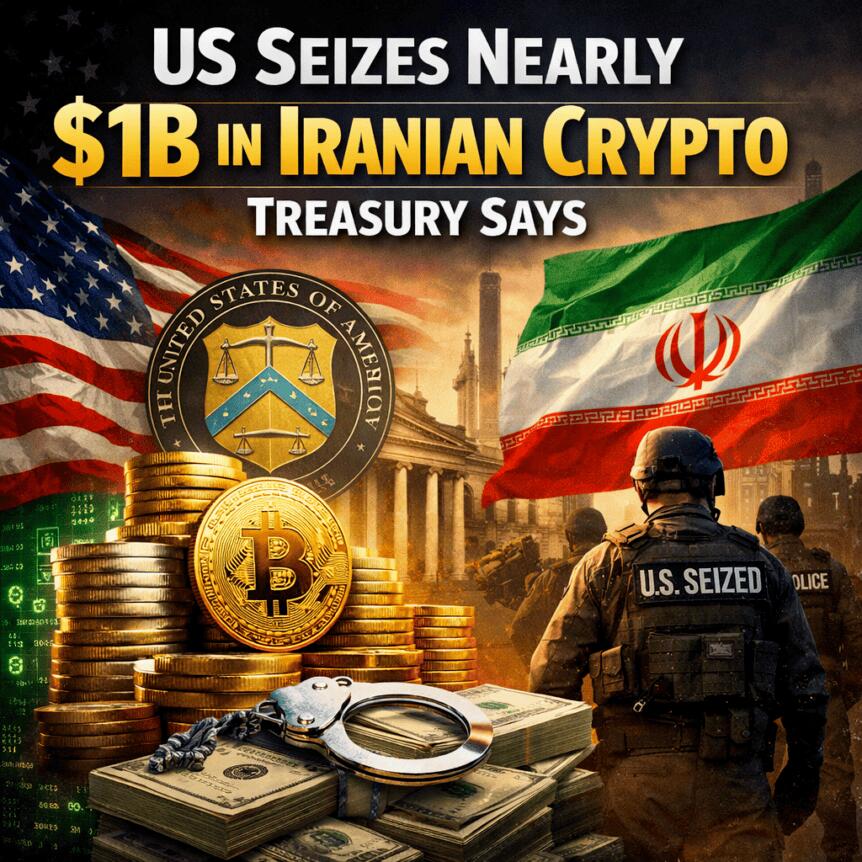
The United States has publicly documented a major advance in its sanction regime against Iran, reporting the seizure of about $1 billion in Iranian cryptocurrency assets. Speaking at the Reagan National Economic Forum, Treasury Secretary Scott Bessent said the U.S. has “outright grabbed the wallets,” a maneuver he described as part of a broader financial pressure campaign. Some wallet holders may still be unaware that their funds have been seized, he added in remarks that drew attention to the speed and scale of asset freezes conducted under the administration’s sanctions strategy.
Officials characterized the seizures as a component of Operation Economic Fury, a coordinated effort launched in March 2025 to disrupt Iranian access to funds held in digital assets, as well as traditional financial channels. Bessent framed the operation as a decisive step in tightening the financial noose around Tehran, arguing that the campaign has effectively cut off critical liquidity for the regime. “I think between five and a half to six weeks of an incredibly successful military campaign and Operation Economic Fury, where we have really cut them off. They are at the end of their tether now financially,” he said, underscoring the administration’s posture on Iran’s financial resilience.
Key takeaways
- Approximately $1 billion in Iranian crypto assets have been seized, according to remarks at the Reagan National Economic Forum in which Scott Bessent spoke.
- The seizures are described as part of Operation Economic Fury, a multi-front effort launched in March 2025 to disrupt Iran’s access to crypto and other financial resources.
- Iran’s economic situation, as characterized by the official account, appears dire: inflation above 200%, widespread internet shutdowns, consumer support programs, and significant payroll issues for the armed forces.
- The newly disclosed total markedly exceeds prior public figures, roughly doubling the $500 million previously cited in late April and far above the $344 million in crypto assets frozen after sanctions in April.
- Separately, Iran has signaled interest in monetizing the Strait of Hormuz through a Bitcoin-based insurance framework, a proposal that has been described in state-linked media channels and could redefine how a strategic chokepoint is insured and priced in crypto terms.
Escalating asset seizures and Tehran’s financial squeeze
The claim of a $1 billion crypto seizure arrives as part of a broader narrative presented by U.S. officials about the effectiveness of financial pressure tools against Iran. Bessent’s remarks highlighted the rapid pace at which some crypto wallets were identified and seized, with an emphasis on the notion that “the wallets” could be pulled from holders who may not yet realize the funds have been redirected. The assertion aligns with a continued emphasis on cutting-edge enforcement tools that target digital assets alongside traditional sanctions mechanisms.
While the public cast is blunt about the impact on Iran’s finances, the underlying picture, as outlined by the official account, portrays a regime under stress. Bessent described a scenario in which Iran was siphoning roughly $400 million to $500 million per month, distributing proceeds among about 80 elite figures, before the intervention. The official narrative also paints a bleak macroeconomic environment: inflation surging past 200%, consumer subsidies being issued, the internet intermittently restricted, and a substantial portion of the regular pay for armed forces and security personnel disrupted or withheld.
The statements come as U.S. and allied authorities continue to pursue a multi-pronged approach—blending asset freezes, banking restrictions, and international cooperation—to constrain Tehran’s financial flows. The administration has cited progress across different fronts, including crypto-focused seizures and partnerships with European allies to extend property confiscations tied to illicit activity. Critics, meanwhile, stress the challenge of tracing and freezing decentralized assets and the potential for collateral effects on ordinary users who may hold assets in accounts unrelated to sanctioned entities.
From wallet seizures to Hormuz: Iran’s Bitcoin-based ambitions under scrutiny
Beyond the asset seizures, Iran’s broader geopolitical and economic strategy has included exploratory discussions about monetizing control over the Strait of Hormuz through crypto-enabled mechanisms. Cointelegraph reports that a state document circulated by Fars News Agency—a media outlet with close ties to the Islamic Revolutionary Guard Corps—outlined a platform named “Hormuz Safe.” The concept envisions selling digital marine insurance paid in Bitcoin and settled on the blockchain, with the potential to unlock substantial revenue for the country—projected at over $10 billion in annual terms if enacted at scale.
In related coverage, Iran has been reported to consider a model where ships passing through Hormuz would pay a tariff in Bitcoin—specifically, a $1 per barrel charge—to clear passage. The idea reflects a broader trend of state-backed crypto experimentation and aims to leverage Bitcoin’s settlement properties to simplify cross-border charging and revenue collection for a critical strategic artery. Iran’s government-linked proclamations emphasize that such a framework would be settled on-chain, potentially enabling more transparent and auditable toll collection than traditional approaches.
These discussions come amid ongoing negotiations related to Iran’s broader ties with the U.S. and allied powers, amplified by recent strikes that have targeted regime figures and key infrastructure in the region. The exact status and feasibility of Hormuz Safe remain uncertain, and observers caution that any such program would require robust international coordination, regulatory clarity, and secure settlement rails to avoid unintended consequences for global shipping and finance.
For readers tracking the crypto-policy angle, the Hormuz Safe concept intersects with broader questions about how states might use distributed ledger technologies to capture value from strategic chokepoints. If realized, a BTC-based insurance and settlement model could set a precedent for asset-backed, borderless revenue streams tied to critical maritime corridors. Yet the practicalities—risk management, liquidity, sovereignty concerns, and cross-border fiat integration—remain unresolved and subject to regulatory pushback and geopolitical risk.
Context and what to watch next
By tying crypto seizures to a broader sanctions playbook, U.S. authorities appear intent on signaling that digital assets are not a safe haven for sanctioned entities. The discrepancy between the new $1 billion figure and prior public disclosures—roughly $500 million announced in late April and about $344 million sanctioned in April—suggests a rapid acceleration in enforcement activity and asset identification. Still, the opaque and rapidly evolving nature of blockchain addresses and wallet ownership means that some seizures may unfold quietly over time, with beneficiaries or oblivious wallet holders discovering the losses only later.
Investors and observers should watch for two pivotal developments. First, how the United States and its allies operationalize and expand the “Economic Fury” framework, including potential cross-border asset coordination and the extension of sanctions into new cryptographic asset classes or platforms. Second, the Hormuz Safe proposal and similar state-led crypto initiatives will need to prove viable in a real-world maritime and financial environment. Any movement toward an on-chain toll collection system or insurance mechanism would have to contend with international shipping laws, sanctions compliance, and the volatility inherent in crypto markets.
As market participants digest these developments, several questions remain unsettled. Will more Iranian crypto wallets be identified and frozen, or will enforcement cap at the current level? How will the Hormuz Safe concept evolve—if it moves beyond a policy paper to a concrete program, what safeguards and oversight will be required? And how will financial institutions and crypto platforms adapt to heightened scrutiny around sanctioned jurisdictions and their digital assets?
Further coverage continues to emerge from outlets monitoring the intersection of sanctions policy and crypto markets. Cointelegraph has previously reported on market reactions to related U.S. actions and the broader implications for Bitcoin and crypto markets under geopolitical stress. As the regulatory and enforcement landscape tightens, market participants should treat any official disclosures with caution and consider how these developments might influence liquidity, risk management, and cross-border settlement in the months ahead.
For now, the narrative centers on a clearer message from policymakers: digital assets are increasingly entangled with national security and foreign-policy aims, and the consequences—whether in seized wallets or new insurance frameworks—will ripple through exchanges, custodians, and users worldwide. The next few weeks could reveal whether Tehran’s financial strategy shifts to accommodate tighter controls or whether new, untested crypto-instrument concepts move from talk to policy.
Sources and related context: remarks from the Reagan National Economic Forum and statements around Operation Economic Fury, including prior reporting on crypto seizures and sanctions timelines. Additionally, state-linked reporting on Hormuz Safe and Bitcoin-based tolls for the Strait of Hormuz has been cited in coverage tracing the potential monetization of critical maritime routes through crypto-native mechanisms.
This article was originally published as US Seizes Nearly $1B in Iranian Crypto, Treasury Says on Crypto Breaking News – your trusted source for crypto news, Bitcoin news, and blockchain updates.


You May Also Like

Bitcoin treasury sell-off accelerates as Riot, Bhutan, and public companies exit positions

PMI-ACP Exam Preparation: How to Use a Simulator and Practice Questions Effectively
'Idiocracy feels like a documentary': Trump event exposes scam playbook