

Elon Musk Becomes the World’s First Trillionaire as SpaceX Starts Trading
TLDR
- SpaceX debuted on Nasdaq under ticker SPCX, opening around 30% above its IPO price of $135
- The IPO raised $75 billion, making it the largest in history, surpassing Saudi Aramco’s 2019 offering
- Elon Musk became the world’s first trillionaire as SpaceX’s valuation hit roughly $2.29 trillion
- Bulls see SpaceX as a vertically integrated AI giant; bears point to a $4.94 billion net loss in 2025
- Governance concerns include Musk holding 80–85% of voting rights, limiting public shareholder influence
SpaceX went public on Nasdaq on Friday under the ticker SPCX, opening around 30% above its IPO price of $135 per share. The stock was indicated to open near $175, pushing the company’s valuation to approximately $2.29 trillion.
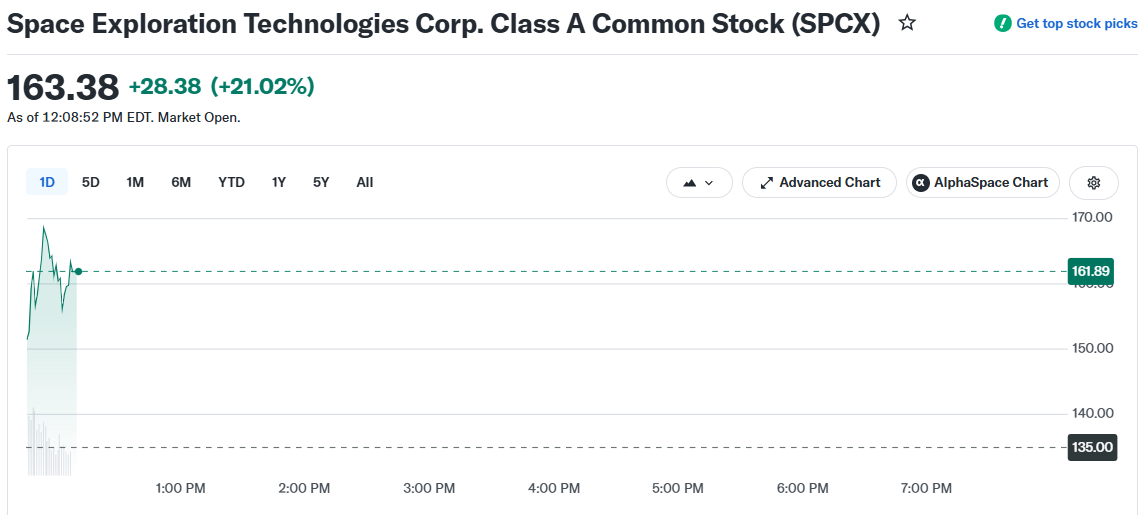 Space Exploration Technologies Corp. Class A Common Stock (SPCX)
The IPO raised $75 billion, making it the largest in history. That easily beats Saudi Aramco’s $26 billion raise in 2019.
Elon Musk rang a ceremonial bell from Starbase in South Texas to mark the opening of trading. With the listing, Forbes estimates Musk’s net worth crossed $1 trillion, making him the world’s first trillionaire.
SpaceX priced its shares at $135 each and sold 555.56 million of them. Retail demand alone was reported at over $100 billion, with BlackRock placing a single $5 billion institutional order.
The company allocated 30% of shares to retail buyers, an unusual move in large IPOs. It also skipped the traditional roadshow process that bankers typically use to gauge demand.
What SpaceX Actually Does
Founded in 2002, SpaceX says its mission is to make life multiplanetary. Its Starlink satellite internet service now connects customers in 164 countries and accounts for roughly 60% of the company’s $18.67 billion in 2025 revenue.
SpaceX says its operations account for more than 80% of the mass launched into orbit over the past three years. Starlink currently serves around 10.3 million users across a constellation of 9,600 satellites.
SpaceX completed a merger with Elon Musk’s AI company xAI in early 2026. Oppenheimer became the first major brokerage to cover the stock, giving it an outperform rating and a $190 price target. New Street Research set a 12-month target of $165.
Goldman Sachs projections included a potential 100-fold increase in AI revenue to $322 billion by 2030, though analysts have flagged uncertainty around that forecast.
The Bear Case
Not everyone is convinced the price is justified. Morningstar valued SpaceX at just $63 per share, calling the IPO “significantly overvalued.” Valuation professor Aswath Damodaran put the enterprise value at $1.22 trillion, well below the IPO implied figure.
Short seller Jim Chanos said the company is not worth $1.75 trillion “based on any reasonable assumptions.” He noted SpaceX trades at roughly 90 times sales, compared to Tesla’s 14 times multiple.
SpaceX posted a $4.94 billion net loss in 2025, reversing a $791 million profit in 2024. The loss came after the xAI merger. Revenue did rise 33% year over year.
Elon Musk holds an estimated 80–85% of voting rights, giving public investors limited say. Pension funds in California and New York sent a letter opposing the IPO structure, citing super voting shares and mandatory arbitration in place of shareholder lawsuits.
S&P Global declined to fast-track SpaceX into the S&P 500, meaning passive index fund buying may be slower than some investors expected. Nasdaq did revise its rules to allow faster entry into Nasdaq-linked index funds, with inclusion possible within 15 days of listing.
The post Elon Musk Becomes the World’s First Trillionaire as SpaceX Starts Trading appeared first on CoinCentral.


You May Also Like

Justice Department has 'gone off the rails' for Trump's 'pretzel logic': analysis

Securitize Tokenized AAA CLO Fund Hits Solana With $250M Ethena Backing
3 Reasons Investors Are Following Mutuum Finance (MUTM) Since Q1 2025



