Binance Mesh Investment at $2B Would Double Valuation in 6 Months
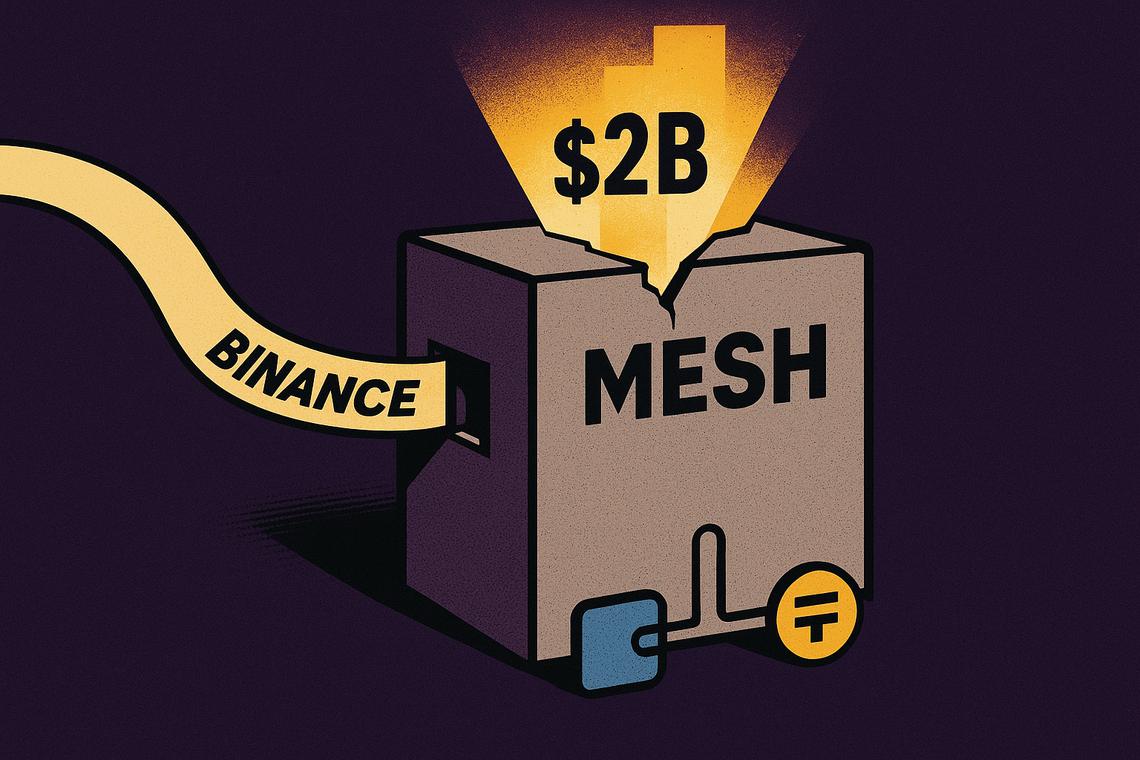
A reported $2 billion investment round led by Binance could reshape the competitive dynamics of crypto payments infrastructure — and the speed of the valuation jump alone tells you something important about where institutional money is flowing. According to a report from Axios, Binance is moving to spearhead a major funding round for Mesh, a company building the plumbing that connects crypto wallets, exchanges, and fiat payment rails. Neither Binance nor Mesh has officially confirmed the deal.
Key takeaways
- Binance plans to lead a $2 billion funding round for Mesh, a crypto payments and settlement infrastructure provider, according to Axios.
- The new round would value Mesh at approximately $2 billion — double its $1 billion valuation from January 2026.
- Mesh raised $75 million in a Series C round led by Dragonfly Capital in January 2026, with Paradigm, Coinbase Ventures, and others participating.
- Mesh’s technology connects crypto wallets, exchanges, digital currencies, and fiat rails — solving asset conversion challenges for merchants and service providers.
- The investment reflects a broader industry shift toward stablecoin settlement and crypto payments infrastructure as a primary growth vertical.
Binance’s Planned $2 Billion Investment in Mesh
If the numbers hold, this would be one of the fastest valuation doublings in recent crypto history. Just months ago, in January 2026, Mesh closed a $75 million Series C financing round that placed its valuation at $1 billion. Dragonfly Capital led that round, with notable co-investors including Paradigm, Moderne Ventures, Coinbase Ventures, SBI Investment, and Liberty City Ventures. Now, a Binance-anchored round could push that figure to $2 billion — all within roughly half a year.
That kind of acceleration is not accidental. It reflects a deliberate repositioning of capital within the crypto sector, away from pure trading platforms and speculative token projects, and toward companies solving real infrastructure problems at the settlement layer.
Why the Valuation Jump Matters
Doubling in six months is not just a headline number — it signals that sophisticated investors see Mesh’s positioning as uniquely valuable in a market that is maturing fast. When Dragonfly Capital led the Series C alongside names like Coinbase Ventures and Paradigm, that was already a strong endorsement. A follow-on round anchored by the world’s largest crypto exchange by volume would be a different level of validation entirely.
It also raises the stakes for Mesh itself. At a $2 billion valuation, the company moves from promising infrastructure startup to a central node in the emerging crypto payments ecosystem — with the expectations and scrutiny that come with that position.
Mesh’s Crypto Payment and Settlement Infrastructure
Mesh — previously known as Front Finance — builds the connective tissue of the crypto economy. Its core technology creates seamless connections between cryptocurrency wallets, exchange platforms, digital currencies, and conventional fiat payment rails. In practical terms, that means solving one of the most stubborn friction points in everyday crypto use.
The problem is familiar to anyone who has tried to pay for something using digital assets: you hold one type of crypto, the merchant wants another, or prefers fiat entirely. Mesh provides the conversion and settlement infrastructure that bridges that gap in real time, removing the need for manual swaps, multiple wallets, or off-ramp delays.
Strategic Partnerships and Market Position
The company has been building out its partner network steadily. In 2024, Mesh formed a partnership with Conio, an Italian cryptocurrency wallet provider, giving Conio’s users enhanced access to multiple exchange platforms and improved withdrawal capabilities through Mesh’s connectivity layer. It’s a modest but telling example of how Mesh grows — by embedding itself into existing wallets and platforms rather than competing directly with them.
That model — infrastructure provider rather than consumer-facing product — is also what makes Mesh an attractive acquisition or investment target. It doesn’t need to win customers; it needs to be indispensable to the companies that already have them.
Market Drivers and Industry Trends
The broader context makes this investment even easier to understand. Stablecoin adoption is accelerating, regulatory frameworks are becoming clearer in multiple jurisdictions, and institutional appetite for crypto settlement infrastructure has moved from exploratory to strategic.
Circle, for instance, recently introduced regulated stablecoin settlement capabilities following regulatory approval in Luxembourg, now facilitating USDC, USDG, and its EURI token for enterprise-level fiat-to-crypto conversions. Meanwhile, prominent U.S. financial institutions are collaborating through the Clearing House on a tokenized deposit infrastructure expected to roll out in early 2027, which would enable banks to process tokenized deposits continuously within established regulatory parameters.
Where Mesh Fits in the Institutional Picture
These are not parallel developments — they are converging ones. As regulated stablecoins expand and tokenized deposits approach commercial rollout, the demand for companies that can route, convert, and settle across multiple asset types will grow sharply. Mesh sits precisely at that intersection.
The Binance investment, if confirmed, would represent more than capital. It would signal that major exchanges are no longer content to be passive beneficiaries of this infrastructure buildout — they want strategic stakes in the companies making it work. That shift in posture, from exchange to infrastructure investor, is one of the more consequential trends unfolding quietly beneath the surface of crypto market headlines right now.
Investment capital has increasingly moved away from basic trading applications toward platforms supporting compliant payments, international transfers, and asset settlement. Mesh’s reported valuation trajectory is a direct reflection of that shift — and Binance’s reported involvement suggests the exchange intends to be more than a bystander in what comes next.
FAQ
What is the size of Binance’s planned investment in Mesh?
According to a report from Axios, Binance plans to lead a $2 billion funding round for Mesh. Neither Binance nor Mesh has officially confirmed the investment.
How has Mesh’s valuation changed recently?
Mesh was valued at $1 billion in January 2026 following its $75 million Series C round. The new Binance-led funding round could double that valuation to approximately $2 billion within roughly six months.
What does Mesh’s technology do in the crypto payments space?
Mesh develops infrastructure that connects crypto wallets, exchanges, digital currencies, and fiat payment rails, enabling real-time asset conversion so that users can pay merchants or service providers in their preferred currency or asset type.
Why is Binance investing in payment and settlement infrastructure?
The reported investment reflects a recognition that payment and settlement infrastructure is a critical growth area in crypto — driven by expanding stablecoin adoption, clearer regulatory frameworks, and institutional initiatives in tokenization and digital asset settlement.
Article produced with the assistance of artificial intelligence and reviewed by the editorial team.


You May Also Like

SIXR Presale Guide: Tokenomics, Features & How to Buy $SIXR

Tether Freezes USDT In 131 TRON Wallets After OFAC Sanctions Update