

What does it take to translate a play from English to Filipino? ‘Yemaya’ team shows how
Yemaya is unlike any play being staged in the Philipping theater circuit today, and that’s exactly what director Ed Lacson Jr. set out to do.
As 9 Works Theatrical’s first attempt at a straight play, Yemaya is a triumph for stage, sound, and lights design. The Black Box at The Proscenium Theater in Rockwell is transformed into an otherworldly space, like a cavern at the bottom of the ocean. The audience is immersed in a world swathed in blue hues and warm sunshine that seems to be situated somewhere on sand and below sea. Set pieces float and sink like anchors from above. A beautiful soundscape ripples throughout the theater space. Everyday items like dominos and coconuts, feathers and rice, and SPAM and Coca-Cola become the focal points of emotionally charged choreography.
Nothing less is to be expected from Lacson. He is a multiple Gawad Buhay Award winner, two of which he won Outstanding Stage Direction and Outstanding Set Design for his last directorial work for 9Works Theatrical, Himala: Isang Musikal. Building worlds on stage through imagery and scenic design is his greatest love and biggest strength. It is what attracted him to Yemaya’s Belly in the first place when he first encountered the obscure but beautiful script by Pulitzer Prize winner Quiara Alegría Hudes.
“I knew it was going to be a difficult material to do. But it has a lot to offer as a material to a director because of the images it conjures in your mind, and then how you’re going to use your imagination to create this world that [Hudes] painted for you.”
 MAGIC IN EVERY SCENE. Benedix Ramos as Jesus/Mulo performs on a stage that feels like its own very real world. Photo by Dan Esguerra
The play follows a boy overcoming hardships with persistence and imagination, leading him to hop on a raft to sail towards the United States of America, a land of dreams, wonders and the promise of a fresh start. Hudes’ storytelling is rooted in magical realism, where a sip of Coca-Cola becomes a mystical experience and voices from the sea call their children to them. It is also grounded in very real experiences of domestic life, death, displacement, and immigration. If the Odyssey is about a hero’s journey home, this epic is about what it takes to leave it behind.
The material checked all the boxes Lacson was looking for in a comeback production after years away at sea working on cruise ships. Choosing an obscure but beautiful work by a non-white female playwright allowed him to introduce a new voice to Philippine theater as well as exercise his scenic design muscles. But there was just one more hurdle they needed to overcome: the play is in English.
Filipino, but not the Philippines
“I was very specific to do [this production] in Tagalog. That was a non-negotiable for me. So luckily, 9Works was brave enough and kind enough to just accommodate my request and I asked Eljay, of course, to translate for me.”
Eljay Castro Deldoc is a Palanca award-winning playwright, director, and translator. His celebrated work, Si Maria Isabella at ang Guryon ng mga Tala, led to his first collaboration with Lacson, who directed a production of it back in 2015. Lacson describes Deldoc’s command of the Filipino language as masterful.
“The lyricism that Eljay uses is on that fine line of accessible but not too colloquial. It’s an elevated way of using the Tagalog language, which I think is very beautiful.”
However, Deldoc’s challenge was not simply translating the material to Filipino, but fulfilling both his responsibility to the original playwright and upholding the trust and vision of his director.
“Yes, confident ako sa pag-handle ko ng Filipino language. Pero siyempre, di ko rin alam kung anong naririnig ni Ed sa vision niya, sa imagination niya. Malinaw sa akin na ang ise-serve ko ay si Alegria [Hudes] tapos si Ed, silang dalawa. I have to be faithful [to the source material] dahil translation siya tapos pagdating naman kay Ed, kailangan kong ma-capture kung ano man ang naiimagine niya na feeling niya kaya kong i-deliver.”
(Yes, I’m confident in my grasp of the Filipino language. But of course, I didn’t know what Ed hears in his vision, in his imagination. It’s clear to me that I will serve Alegría Hudes and Ed, the two of them. I have to be faithful to the source material since it’s a translation, and when it comes to Ed, I have to capture what in his imagination that he feels I can deliver.)
As he faced these expectations head on, Deldoc shared that the initial draft of the translation flowed smoothly. He was more prepared for the project than he thought, as his artistic sensibilities are similar to Hudes’ in that they both draw from archipelagic experience and utilize images of water as metaphors, some sensibilities that Filipinos and the Puerto Rican diaspora have in common.
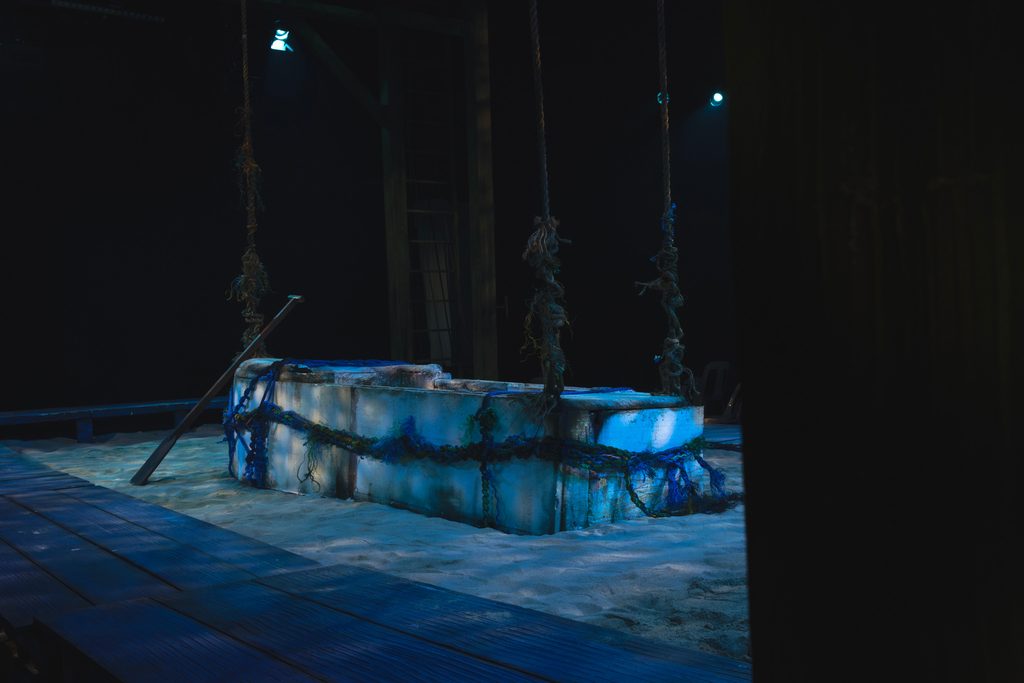 ON SAND AND BELOW SEA. Yemaya’s stage design emphasizes the mysterious and magical role of water in the play. Photo courtesy of 9 Works Theatrical
But there was a delicate balance to how Filipino Yemaya could be, from the language to the set pieces and costumes. It had to be very clear that despite the play being delivered in the Filipino language, the world of Yemaya is not set in the Philippines.
All the creative minds involved in the project had to be conscious that it is a Filipino translation, not an adaptation. It was important for Lacson and Deldoc to remain faithful and respectful of the source material created by Hudes, as it is embedded with sensibilities unique to her and her heritage. They refrained from altering details, inserting elements, and choosing words that are not inherent in the script and would change its context.
One example was intentionally excluding from the stage and the script the words “opo” and “po” because it was too specific to the Philippines. “It drags you to a different location,” Lacson said. “I want to be very clear that it’s not set in the Philippines.”
On the other end, they also had to discern what words to retain from the original text, as they chose to keep the sprinkles of Spanish words within the English work in the Filipino translation. “The good thing is, as Filipinos, we do have Spanish in our language,” Lacson said. “It’s part of our regular conversations, the use of Spanish words. Going back to the source material, it’s inherent to that material.”
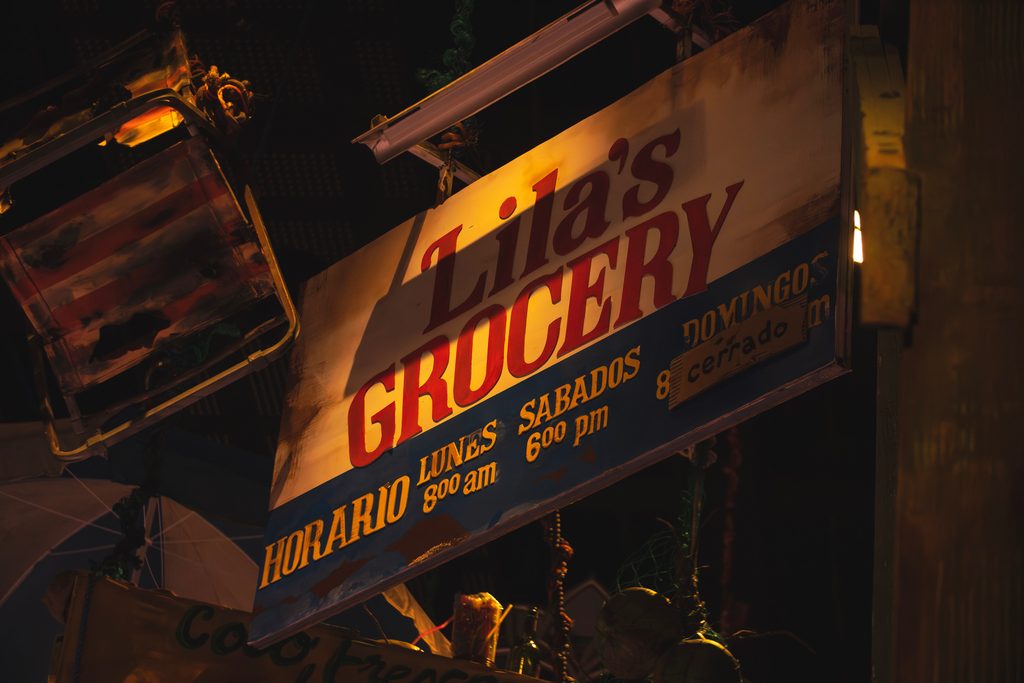 A LANGUAGE MELTING POT. From the dialogue to the set pieces, Spanish, English, and Filipino words coexist in the world of Yemaya. Photo courtesy of 9 Works Theatrical
The third piece of the puzzle: the actors
Capturing Lacson’s vision was also a big responsibility to bear for the actors, who were cast based on how comfortable they were with the elegant flavor of Filipino they were aspiring for in the translation.
This resulted in a cast composed of seasoned veterans and rising stars. Bituin Escalante, Herbie Go, Benedix Ramos, Tommy Alejandrino, Sheena Belarmino, Ness Roque, Sheenly Gener, and Wenah Nagales deliver transcendent performances, embodying their characters through a deep understanding of the material they helped shape.
“They are the third part of the puzzle,” Lacson said. “Because I know that at this point, I need the actors to speak it. I need the actor’s mind to work on it, to help us make sense of it better because they’re the ones who will be the vessels of the words, of the language. It’s up to them what flows for them.”
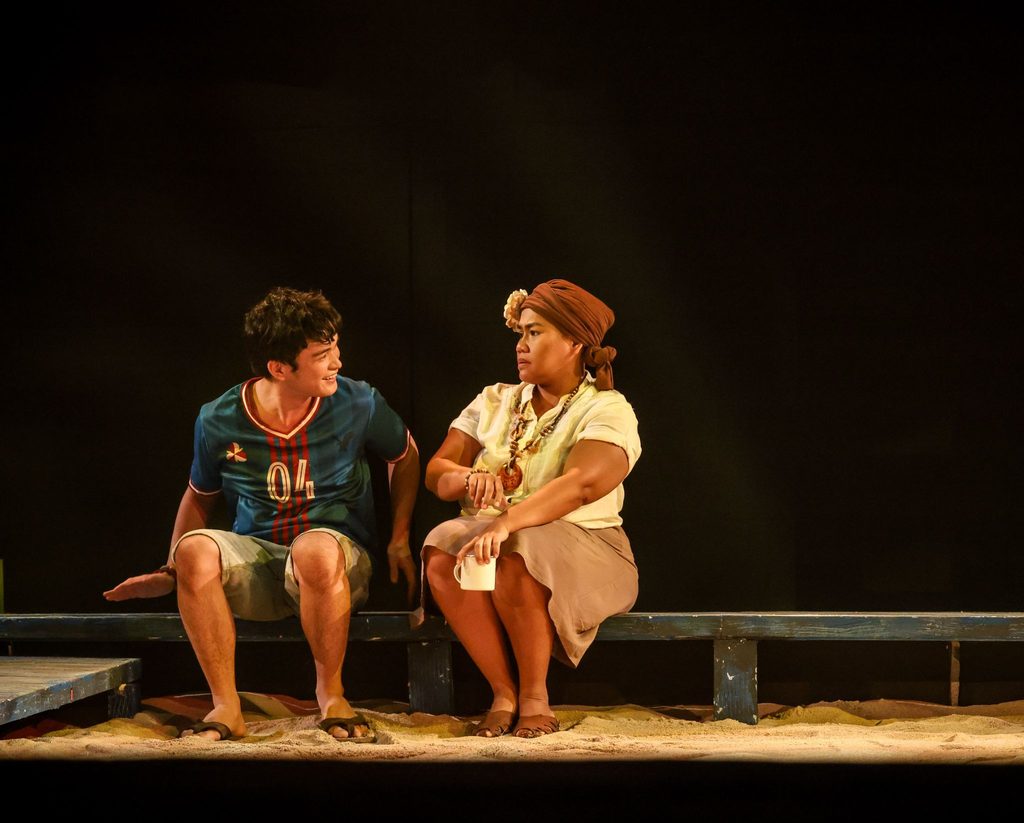 VETERANS AND RISING STARS. Tommy Alejandrino and Bituin Escalante share the stage in some of the play’s most poignant moments. Photo by Myra Ho
Lacson and Deldoc both emphasize the crucial contributions of the actors in the process of putting together the final form of the translation.
“It’s a constant exchange of notes and revisions,” said Lacson. “It’s really that open, especially for the actors because I’m surrounded by some of the best ones around, who know language, who know how to speak the language, who’ve done translations before, especially Herbie [Go]. So it’s invaluable and to not use their brain power would have been a waste.”
Deldoc said that hearing the cast deliver lines that carefully intertwined Filipino, Spanish, and English contributed seamlessly to the world building of Yemaya.
“Nung binibigkas na [ang translation] ng actors, it flows naturally, kahit pa nagco-code switch sila from time to time. Alam mo na sa mundong ‘yun, hindi ‘to Pilipinas, hindi ito Cuba, pero sa mundong ‘yun, bukas na bukas ang mundong ‘yun sa influence ng other languages, ng other culture.”
(When the actors are delivering their lines, it flows naturally, even if they code switch from time to time. You know that in that world, it’s not the Philippines, it’s not Cuba, but in that world, it is open to the influence of other languages, of other cultures.)
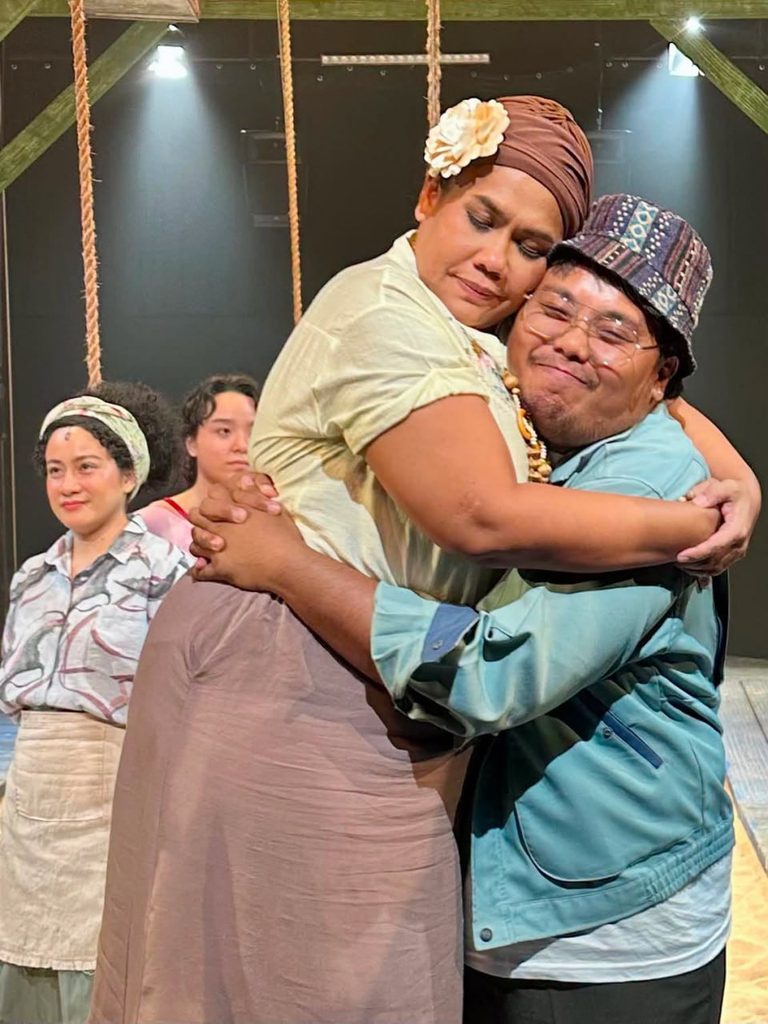 THOSE WHO KNOW LANGUAGE. Bituin Escalante and Eljay Castro Deldoc at a curtain call of Yemaya. Photo by Max Celada
Nothing worth having comes easy
The effect is a play that hits so close to home yet feels so far away from it. The characters, the story, the world doesn’t exist in the reality we live in, but instead, it settles inside the plane of our imagination and grows roots in our hearts. When the show ends, we don’t want to leave our characters where we left them, we don’t want to leave the world they inhabit. It isn’t real, but it becomes real to us. It’s difficult to understand but easy to take in and experience.
“But that’s the thing with plays that have a lot of symbolism, a lot of images on stage,” Lacson said. “The human mind is wired to find connections. I personally prefer it when, as an audience or as a director, vice versa, that you are actively watching. You’re not just being spoon-fed the information. I remember watching plays where I really had to focus and think about what’s going on on stage for me to understand. It’s not a new idea. It’s just something that I felt is getting lost. Now, people are feeling uneasy because they have to think hard to understand what’s going on. I think that’s a better way of watching something.”
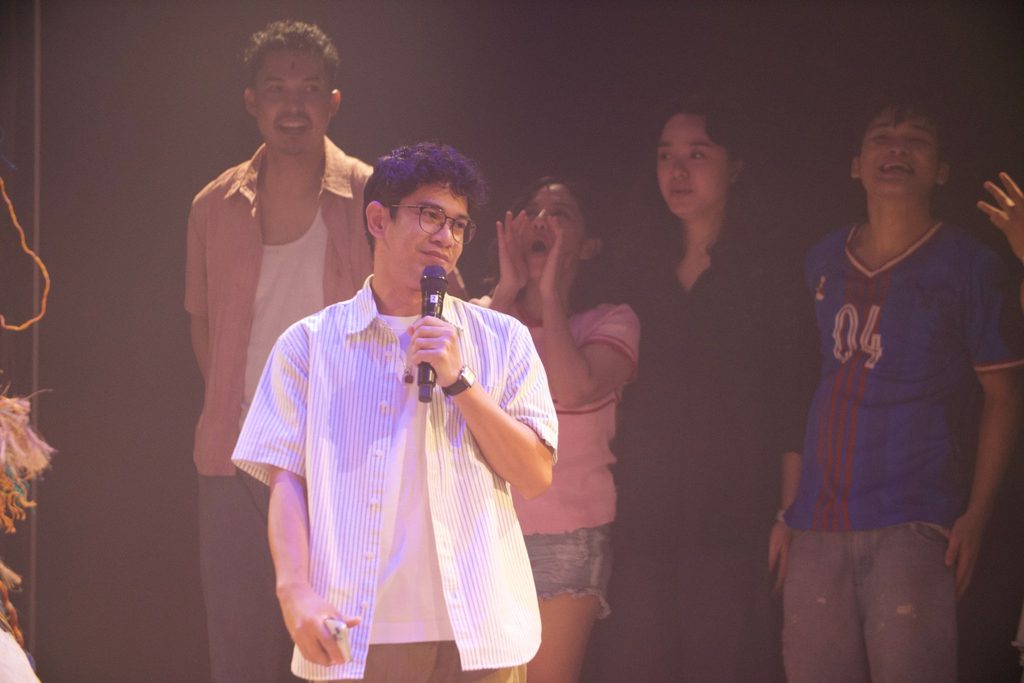 A CHALLENGE THAT PAID OFF. Director Ed Lacson Jr. taking his bow after a performance of Yemaya. Photo courtesy of 9 Works Theatrical
Yemaya is unique, vibrant, and a challenging play to read, stage, watch, and take in. But for Lacson, that was the point. Through translation, open collaboration, limitless imagination, and the audacity to take on a challenge, Yemaya became a beautiful production that Philippine theater needs and needs more of. It is a rallying cry to search for new voices, stretch the imagination, and break through comfort zones.
“What’s the point if things are easy?” Lacson laughed. But then he backtracked. “I say that now. Two weeks ago, I was like, ‘Why, Ed, why?'” -Rappler.com
Elise Suarez is a Rappler intern from Puerto Princesa City and a Humanities student of the University of Asia & the Pacific.


You May Also Like

The Onchain Leaders Gathering: where the decision-makers come together

EU Ends MiCA Transition, Barring Unauthorized Crypto Firms


