Bitcoin-Backed Borrowing: How Circle Unlocks USDC
Overview
Circle has launched Digital Asset-Backed Borrowing for eligible Circle Mint LLC customers, creating an integrated institutional workflow that allows Bitcoin holders to access USDC liquidity without first selling their BTC. Launched on September 21, 2026, the service allows eligible customers to deposit BTC, mint Circle Wrapped Bitcoin (cirBTC), move that tokenized collateral through a wallet they control into supported third-party lending markets, and receive borrowed USDC directly in Circle Mint. The workflow is available across Arc and Ethereum, with Morpho-supported markets included at launch.
The structure is important because Circle itself is not simply making a conventional balance-sheet loan against customer Bitcoin. Borrowing rates, collateral requirements, liquidation thresholds and available liquidity are determined by the supported third-party lending market. Circle instead integrates BTC custody, cirBTC issuance, DeFi collateralization and USDC distribution into a single institutional workflow.
That changes the economic role Bitcoin can play for an institutional holder. BTC can remain part of a longer-term treasury strategy while also supporting short-term dollar liquidity. Yet the arrangement does not eliminate risk: wrapping introduces custody and tokenization dependencies, borrowing creates leverage, and a decline in BTC can trigger liquidation under the selected lending market’s rules.
The significance of Bitcoin-backed borrowing is therefore not simply that institutions can borrow against BTC. It is that BTC, wrapped collateral, stablecoin liquidity and onchain credit are increasingly being connected into one capital-management stack.
Key Takeaways
- Eligible Circle Mint LLC customers can now use BTC to access USDC liquidity through an integrated workflow.
- BTC is converted into 1:1-backed cirBTC before being supplied to supported third-party lending markets.
- Circle is not acting as the conventional lender; third-party markets determine rates, collateral requirements and liquidation thresholds.
- DABB is available on Arc and Ethereum, with Morpho-supported markets included at launch.
- The larger opportunity is turning institutional BTC holdings into productive collateral without requiring an outright sale.
How Does Circle's Bitcoin-Backed Borrowing Actually Work?
The Product Connects Several Existing Financial Functions Into One Workflow
Circle’s Digital Asset-Backed Borrowing product begins with native BTC. An eligible Circle Mint LLC customer deposits Bitcoin and mints an equivalent amount of cirBTC, Circle’s wrapped Bitcoin asset. The customer can then move cirBTC through a wallet under its control into a supported third-party lending market, pledge it as collateral and borrow USDC, which can be delivered directly into Circle Mint.
The individual components are not entirely new. Wrapped Bitcoin has existed for years, DeFi protocols already accept crypto collateral, and stablecoin loans are well established. The innovation is operational integration. Institutional users no longer need to independently coordinate BTC custody, wrapped-token issuance, a lending protocol and the return of stablecoin liquidity into an enterprise account environment.
That matters because institutional adoption often depends less on whether a transaction is technically possible and more on whether the workflow can be controlled, monitored and reconciled by treasury and risk teams. By linking Circle Mint, cirBTC and third-party lending markets, Circle is attempting to make onchain borrowing resemble a unified financial service rather than a sequence of disconnected DeFi operations.
Is Circle Directly Lending USDC Against BTC?
Not in the conventional sense. Circle explicitly states that customer collateral is supplied to supported third-party lending protocols, while borrowing rates, collateral requirements, liquidation thresholds, liquidity and availability are determined by the selected market. Morpho-supported markets were available at launch, with Circle indicating that additional markets and third-party platforms could be supported over time.
This distinction is essential for evaluating risk. A Circle Mint customer may use Circle infrastructure to enter and exit the workflow, but the economic terms of the loan are not fixed solely by Circle. The lending protocol, collateral market and available liquidity determine how much USDC can be borrowed and under what conditions the collateral could be liquidated.
For an institution, due diligence therefore cannot stop with Circle. Risk teams need to understand both the wrapped BTC structure and the specific third-party market where the borrowing occurs.
Why Does BTC Need to Become cirBTC First?
Native Bitcoin Cannot Directly Enter Ethereum or Arc Smart Contracts
Bitcoin is highly liquid and widely recognized as digital collateral, but native BTC exists on the Bitcoin network and cannot be inserted directly into Ethereum or Arc smart contracts. A lending protocol on those networks therefore needs a tokenized representation that can interact with programmable collateral and liquidation logic.
cirBTC performs that function. Circle states that every cirBTC is backed 1:1 by native BTC, with reserves independently verifiable onchain. Circle also says the underlying BTC is safeguarded through Circle National Trust and held separately from Circle’s corporate assets.
The wrapper effectively separates the asset’s economic backing from the environment in which it can be used. Native BTC remains secured in custody on Bitcoin, while cirBTC moves through smart contracts on supported networks. This makes Bitcoin usable in credit, settlement and trading workflows that the base Bitcoin network does not natively support.
That functionality comes with an additional dependency. Holding native BTC involves Bitcoin network and custody risk; holding cirBTC also requires confidence in the wrapper’s issuance, redemption, reserve management and custody structure. Wrapped Bitcoin therefore improves composability while adding a layer of counterparty and operational risk.
How Does the Circle Borrowing Flow Work?
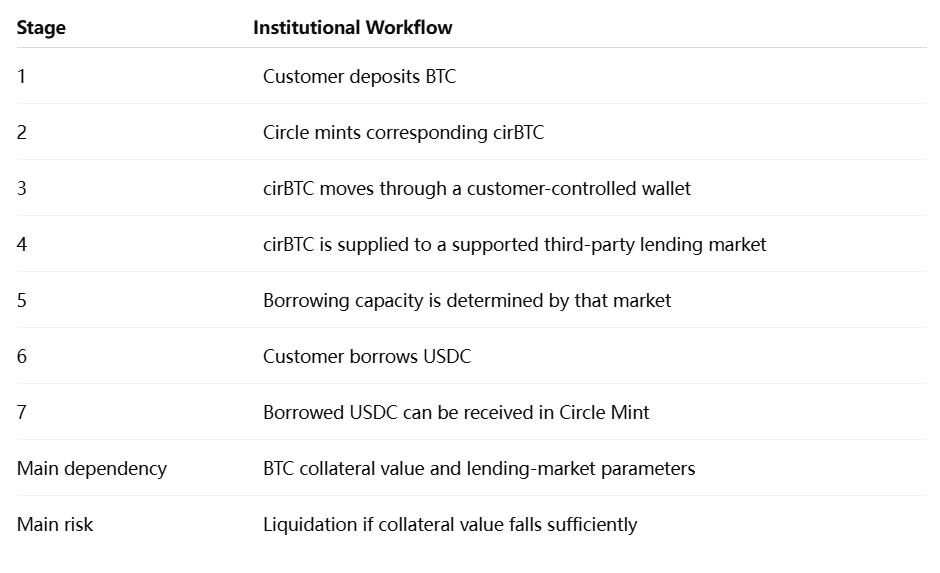
The flow shows why describing the product simply as a “Circle Bitcoin loan” is incomplete. Circle provides the infrastructure connecting the assets and the user, while the credit layer remains onchain and market-specific.
Why Would an Institution Borrow Against BTC Instead of Selling It?
Collateralization Separates Liquidity Needs From Investment Decisions
An institution holding BTC may need dollar liquidity without wanting to reduce its Bitcoin position. A treasury could require working capital, a market maker could need additional settlement liquidity, or a trading firm might need USDC to deploy across digital-asset markets. Selling BTC solves the liquidity problem but also changes the institution’s market exposure.
Bitcoin-backed borrowing creates another option. The institution can maintain economic exposure to BTC while pledging the wrapped asset as collateral for USDC. If the borrowed liquidity is used productively and the collateral remains sufficiently overcollateralized, the treasury can access dollars without permanently disposing of the Bitcoin position.
This is a standard idea in traditional finance. Securities, government bonds and other assets routinely serve as collateral for financing. What is changing is the ability to place Bitcoin into a comparable programmable credit workflow.
However, “without selling BTC” should not be confused with “without risking BTC.” Once the asset is pledged, a sufficiently large decline in Bitcoin can lead to liquidation. The borrower may avoid a voluntary sale at the beginning of the transaction only to face a forced sale later if collateral requirements are breached.
Bitcoin-Backed Borrowing Introduces Leverage to Treasury Holdings
Consider an institution with $10 million of BTC that borrows $5 million of USDC against it. At inception, the collateral may appear comfortably above the debt. If Bitcoin falls 30%, however, collateral value drops to $7 million while the USDC liability remains roughly unchanged before interest. The effective loan-to-value ratio increases sharply even though the institution has taken no additional action.
This is why collateral requirements and liquidation thresholds matter as much as the ability to borrow. Circle explicitly notes that these parameters are determined by the selected third-party market and can change.
For institutional treasury teams, productive collateral is valuable only when the leverage can be managed through stressed conditions. The relevant risk metric is therefore not merely how much USDC can be borrowed, but how much BTC price volatility the position can withstand before liquidation becomes likely.
Why Do Arc and Ethereum Matter?
Ethereum Provides Existing DeFi Liquidity
Ethereum offers a mature environment for onchain credit. Lending markets, decentralized exchanges, stablecoin liquidity and institutional tokenization products already operate there, making it a natural venue for cirBTC collateral. Circle launched cirBTC on Ethereum in June 2026, describing the network as a market where institutional DeFi and tokenized-asset infrastructure had already reached meaningful scale.
For institutions, existing liquidity is critical. A wrapped BTC asset has limited usefulness if there are no credible venues willing to accept it as collateral. Ethereum gives cirBTC access to an established ecosystem in which borrowing, trading and settlement can interact.
The disadvantage is that institutions must still operate across infrastructure controlled by multiple independent protocols. Circle can streamline the entry and exit workflow, but it cannot eliminate the market and smart-contract risks of external applications.
Arc Creates a More Integrated Circle-Native Stack
Arc adds a different strategic dimension. Circle launched Arc mainnet on September 16, 2026 as an open Layer 1 designed for financial markets and real-time money movement, with native integration into Circle’s broader platform.
With cirBTC now available on both Arc and Ethereum, Circle can connect several parts of its stack: BTC enters through cirBTC, dollar liquidity is represented by USDC, Circle Mint provides institutional asset management and Arc provides a blockchain environment built around financial applications. Circle’s current cirBTC page describes the asset as available on both networks and integrated with USDC and Circle Mint.
This does not mean Arc automatically replaces Ethereum or existing DeFi markets. Ethereum offers established liquidity and network effects, while Arc gives Circle greater architectural integration. The more interesting question is whether institutions eventually split activity between deep third-party DeFi liquidity and more vertically integrated financial networks.
What Makes cirBTC Different From Simply Holding BTC?
Reserve Transparency Is Central to Wrapped Collateral
Circle positions cirBTC around 1:1 BTC backing, segregated custody and independently verifiable reserves. The company uses Chainlink Proof of Reserve and publishes reserve information intended to allow counterparties to compare native BTC backing with circulating cirBTC.
For a wrapped asset used as loan collateral, this is more than a branding issue. Lending markets need confidence that the token can be redeemed and that its backing remains intact during periods of stress. If a wrapper loses credibility, its market value could diverge from BTC and collateral liquidations could accelerate even without a major change in Bitcoin’s underlying price.
That creates two distinct layers of collateral analysis: the market risk of BTC itself and the structural risk of the wrapper. Institutional adoption depends on both.
What Are the Main Risks of Bitcoin-Backed Borrowing?
BTC Volatility Remains the Dominant Economic Risk
Bitcoin can move by double-digit percentages over short periods, and borrowing against it turns those price movements into credit risk. The borrower has a fixed or accumulating USDC liability while the collateral value fluctuates continuously. If the market falls quickly enough, a lending protocol can liquidate cirBTC to protect lenders.
The danger becomes larger when borrowers operate near maximum permitted LTV ratios. Higher leverage unlocks more immediate liquidity but reduces the amount of adverse price movement the position can absorb. For institutional users, conservative collateralization may therefore be more important than maximizing capital efficiency.
Markets also operate continuously. A treasury team cannot assume that liquidation risk pauses outside banking hours. Automated smart contracts can respond to BTC price movements at any time, making monitoring and collateral management inherently 24/7.
Wrapper and Smart-Contract Risks Add New Dependencies
Using cirBTC requires confidence that the underlying BTC is properly safeguarded, that minting and redemption remain operational and that the token maintains reliable 1:1 backing. Circle’s segregated reserve structure and proof-of-reserve system are designed to address those concerns, but they do not make wrapped assets economically identical to native BTC.
The third-party lending protocol introduces another risk layer. A smart-contract vulnerability, oracle failure, liquidity shortage or unexpected governance change could affect the borrowing position even if cirBTC itself remains fully backed.
This means the integrated workflow improves usability but does not collapse multiple risk layers into one. Institutions still need to evaluate custody, tokenization, protocol, oracle and market risk separately.
Bitcoin-Backed Borrowing vs Traditional Crypto Loans
FeatureTraditional Centralized BTC LoanCircle DABB WorkflowOriginal collateralBTCBTCOnchain collateral representationUsually not requiredcirBTCCredit venueCentralized lenderSupported third-party lending marketBorrowed assetFiat or stablecoinUSDCSmart-contract exposureUsually limitedYesBorrowing parametersSet by lenderSet by selected marketNetworkPrimarily offchainArc / EthereumPrimary advantageSimpler bilateral structureProgrammable, integrated liquidityAdditional riskLender counterparty riskWrapper + protocol + liquidation risk
Neither model is universally superior. Centralized lending concentrates risk in a financial intermediary, while onchain lending distributes functionality across custody, tokenization and smart contracts. Institutional preference will depend on transparency, capital efficiency, legal treatment and operational controls.
MEXC View: BTC Is Becoming Productive Institutional Collateral
The important metric for institutional Bitcoin adoption may increasingly be not only how much BTC companies hold, but how effectively that BTC can support other financial activities without being permanently sold. Digital-asset treasury strategies have historically emphasized accumulation and custody; the next stage is likely to focus more heavily on collateral efficiency.
Circle’s workflow illustrates that transition. BTC begins as a treasury asset, becomes cirBTC for programmable use, supports a USDC loan through a third-party market and can then feed back into payments, settlement, trading or treasury operations. The result is a capital stack in which Bitcoin is no longer purely passive inventory.
That development should be evaluated carefully. More productive collateral can improve capital efficiency, but it can also increase leverage across the digital-asset system. The most useful indicators will therefore include average LTV ratios, borrowing volume, liquidation frequency, lending-market depth and how positions behave during sharp BTC drawdowns. Sustainable adoption depends on whether institutions can unlock liquidity without turning long-term BTC holdings into fragile leveraged positions.
Circle Is Turning Bitcoin Into Institutional Working Capital
Circle’s Digital Asset-Backed Borrowing product is significant because it connects several previously separate parts of institutional digital-asset infrastructure into one coordinated workflow. Eligible Circle Mint LLC customers can deposit BTC, mint cirBTC, place the wrapped asset into supported third-party lending markets and receive USDC without voluntarily selling the Bitcoin that backs the position.
The distinction between infrastructure provider and lender remains critical. Circle facilitates the workflow and issues cirBTC, while third-party lending markets determine borrowing rates, collateral requirements and liquidation conditions. That means the product’s risk cannot be evaluated by looking at Circle alone; the specific credit market matters just as much.
The broader development is nevertheless important. Bitcoin-backed borrowing turns BTC from a balance-sheet asset into programmable collateral, while USDC provides the dollar-denominated liquidity needed for trading, payments and treasury management. With Arc and Ethereum supporting the workflow, Circle is building a bridge between Bitcoin reserves and onchain dollar credit.
The next test will be how the model performs under stress. If institutions can use conservative collateral ratios, maintain transparent reserve backing and manage liquidation risk across volatile markets, BTC could become increasingly integrated into institutional credit infrastructure. If leverage grows faster than risk controls, the same capital efficiency could amplify losses. The long-term importance of Bitcoin-backed borrowing will therefore depend not on how much liquidity it unlocks in calm markets, but on how reliably that liquidity survives volatile ones.
Sources
https://www.circle.com/blog/digital-asset-backed-borrowing-is-now-available-in-circle-mint
https://www.circle.com/blog/cirbtc-is-now-live-on-ethereum
https://www.circle.com/blog/cirbtc-a-clearer-reserve-standard-for-wrapped-btc
https://www.circle.com/blog/how-usdc-and-cirbtc-unlock-capital-efficiency
Risk Disclaimer: This article is for reference only and does not constitute investment advice. The cryptocurrency market is highly volatile. Please make decisions cautiously based on your individual circumstances.
You May Also Like

Why Are Bitcoin and Ethereum Rising Today?
GSTOCK Surges as the Stock Meme Trade Gains Momentum