Key Points: ➡️ Bitcoin’s limitations — Slow transaction speeds (3–7 TPS) and lack of smart contracts restrict its role in modern blockchain innovation. ➡️ Bitcoin Hyper solution — A Layer-2 powered by the Solana Virtual Machine, enabling fast payments, DeFi, NFTs, and interoperable apps on Bitcoin. ➡️ Presale momentum — Nearly $23M raised with staged pricing; strong tokenomics allocate funds to growth, marketing, and liquidity. ➡️ Upside potential — With staking yields at 51% and listings planned, $HYPER could reach $0.2 by end of 2025 and as high as $1.20 by 2030.Key Points: ➡️ Bitcoin’s limitations — Slow transaction speeds (3–7 TPS) and lack of smart contracts restrict its role in modern blockchain innovation. ➡️ Bitcoin Hyper solution — A Layer-2 powered by the Solana Virtual Machine, enabling fast payments, DeFi, NFTs, and interoperable apps on Bitcoin. ➡️ Presale momentum — Nearly $23M raised with staged pricing; strong tokenomics allocate funds to growth, marketing, and liquidity. ➡️ Upside potential — With staking yields at 51% and listings planned, $HYPER could reach $0.2 by end of 2025 and as high as $1.20 by 2030.

2025’s Best Crypto Presale Ends This Quarter: Bitcoin Hyper Nears $23M Raised

6 min read
2025’s Best Crypto Presale Ends This Quarter: Bitcoin Hyper Nears $23M Raised

Bitcoin is the world’s leading cryptocurrency. With a market cap in the trillions and unmatched global brand recognition, it remains the undisputed leader of the digital asset revolution.

Bitcoin's share of total market cap.

Yet, despite its dominance, Bitcoin faces significant challenges that hinder its ability to advance into the next phase of blockchain innovation. These issues have shifted from minor annoyances to serious limitations, highlighting the need for a solution.

Transaction Speed and Scalability

At the base layer, Bitcoin processes only 3-7 transactions per second (TPS). This is significantly lower than modern blockchains like Solana or Avalanche, which handle thousands.

During periods of high demand, Bitcoin’s network often slows further, with confirmation times stretching and fees surging to painful levels. For everyday users, this makes sending small transactions or micro-payments impractical.

Lack of Smart Contract Flexibility

Bitcoin was created as a peer-to-peer electronic cash and a store of value. Its scripting language is intentionally limited to ensure network security simplicity.

However, this constraint means developers cannot deploy decentralized finance (DeFi) protocols, gaming applications, or NFT ecosystems directly on Bitcoin, as the original Layer 1 doesn’t fully support the complex smart contracts required for those applications.

Instead, they migrate to Ethereum ($92B DeFi TVL), Solana ($12.5B DeFi TVL), or other chains, taking innovation and liquidity with them.

Modern Demands, Legacy Infrastructure

Users demand ultra-fast settlement, scalable financial apps, and cross-chain interoperability from modern, payment-ready blockchains. Bitcoin, while unmatched in security and decentralization, struggles to support these use cases.

The consequences are visible:

  • Sending less than $1 worth of BTC may cost more in fees than the transaction itself. Notoriously, during a period of severe congestion in 2021, transaction fees reached over $59.
  • During NFT booms or market surges, Bitcoin transactions clog while competitors handle surges seamlessly.
  • Bitcoin is secure and trusted – but it isn’t ready for DeFi and the broader crypto economy that has evolved over the decades since Bitcoin was launched.

That’s the gap Bitcoin Hyper aims to fill.

Bitcoin Hyper’s Utility

Bitcoin Hyper ($HYPER) is a Layer-2 network built on Bitcoin, designed to bring scalability, programmability, and speed to the world’s largest cryptocurrency. By combining Bitcoin’s security with modern blockchain architecture, Hyper offers a way to unlock new utility without compromising Bitcoin’s core principles.

High-Performance Architecture

At its core, Bitcoin Hyper leverages the Solana Virtual Machine (SVM) to achieve lightning-fast throughput and efficient smart contract execution. This allows developers to deploy decentralized applications (dApps), token standards, and financial services directly on a Bitcoin-anchored ecosystem.

Canonical Bridge and Zero-Knowledge Proofs

Hyper uses a canonical bridge that allows users to lock $BTC on the main chain and mint a wrapped version for use on Layer-2. This approach ensures Bitcoin remains the settlement layer while Hyper handles scalable transaction activity.

To preserve integrity, Bitcoin Hyper batches transactions and commits them back to Bitcoin using zero-knowledge proofs. These proofs guarantee transaction validity while minimizing the cost and storage burden on Bitcoin’s blockchain.

Token Utility and Governance

The native token, $HYPER, powers the network. It is used for:

  • Paying transaction fees
  • Staking and securing the Layer-2
  • Governance and protocol upgrades
  • Incentivizing ecosystem growth through rewards and grants

Early phases of Hyper feature aggressive staking rewards to attract liquidity and ensure strong adoption.

Stake to earn Bitcoin Hyper.


Unlocking New Use Cases

With these tools, Bitcoin Hyper unlocks a range of possibilities:

  • Fast, cheap Bitcoin payments: BTC can move instantly across the Layer-2, enabling micropayments, remittances, and gaming use cases.
  • DeFi on Bitcoin: Lending, borrowing, decentralized exchanges, and liquidity pools can operate natively in the Hyper ecosystem.
  • NFTs and tokenized assets: Creators and enterprises can mint digital assets while remaining tied to the Bitcoin blockchain.
  • Interoperable apps: Developers can build composable apps within Hyper’s environment, replicating the SVM’s versatility while remaining anchored to Bitcoin’s security.

Bitcoin Hyper’s most significant potential lies in the opportunity to further increase Bitcoin’s dominance. If Hyper succeeds, developers and capital that normally migrate to other blockchains could remain within the Bitcoin ecosystem.

This means that Bitcoin, already the largest cryptocurrency by far, could strengthen its lead by becoming both the world’s premier store of value and a fully programmable, scalable blockchain economy.

Presale, Tokenomics, and Potential

Bitcoin Hyper isn’t waiting around. With the presale well-advanced, the next evolution of Bitcoin is nearly ready to launch.
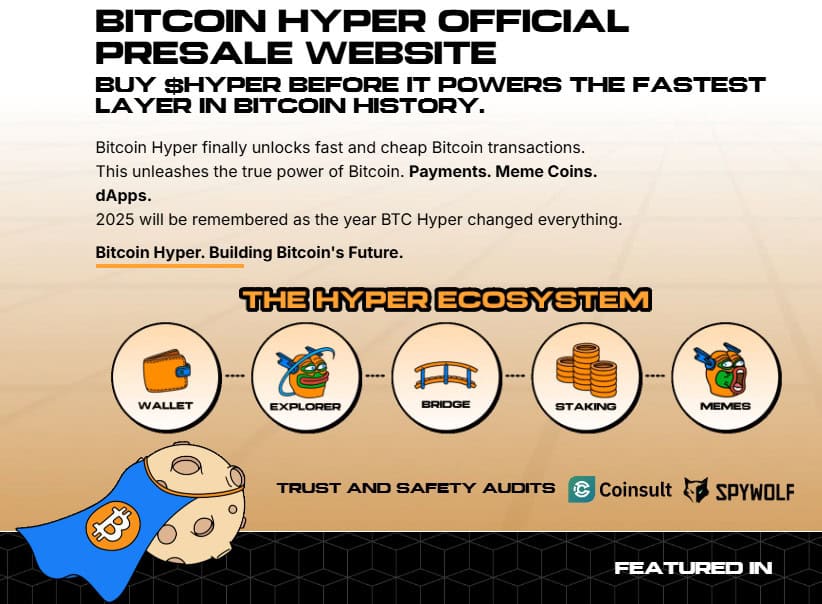
Bitcoin Hyper presale ready to launch.

Presale Progress

The Bitcoin Hyper presale launched in May 2025 and gained momentum quickly. The project has raised nearly $23M, placing it among the year’s best crypto presales.

The presale structure involves multiple stages, with prices increasing over time to reward early investors. Initial pricing started at $0.0115 per token, with the current presale stage already at $0.013085.

Tokenomics Breakdown

Bitcoin Hyper features a total supply of 21B $HYPER tokens, distributed as follows:

  • Development and Layer-2 growth: 30%
  • Treasury and reserves: 25%
  • Marketing and ecosystem outreach: 20%
  • Rewards and staking incentives: 15%
  • Liquidity and exchange listings: 10%

The tokenomics ensures sufficient funding for long-term development while also promoting aggressive marketing during the critical presale stages and providing deep liquidity upon launch.

Beyond the project itself, there are plenty of reasons to drive demand for $HYPER:

  • Transaction fees: Every dApp and transaction on Hyper can be paid in $HYPER, anchoring utility demand.
  • Staking yields: Early staking rewards are among the most competitive in the market – currently at 51% – designed to bootstrap adoption.
  • Listings: Planned CEX and DEX listings post-presale will open the token to wider liquidity and speculation.
With strong upside potential, the $HYPER token could surge significantly post-launch. Our price prediction indicates that $HYPER may potentially reach $0.2 by the end of 2025.

Longer-term projections (2025–2030) range from $0.50 to $1.20, assuming sustained adoption, ecosystem growth, and continued Bitcoin bull cycles. To gain the best position, learn how to buy Bitcoin Hyper with our guide.

Has Bitcoin’s Next Era Arrived?

Bitcoin Hyper arrives at a critical moment. Bitcoin dominates as a store of value but struggles to meet the demands of modern blockchain adoption.

Hyper solves that problem by fusing Bitcoin’s security with the SVM’s scalability and programmability. Bitcoin Hyper could transform Bitcoin from a secure but slow asset into the backbone of a thriving, fast, and versatile blockchain ecosystem.

With nearly $23M already raised in its presale, strong tokenomics, and a bold technological vision, Bitcoin Hyper is positioning itself not just as another token launch, but as a genuine attempt to reimagine Bitcoin’s future.

As always, do your own research. This isn’t financial advice.

Market Opportunity
Hyperlane Logo
Hyperlane Price(HYPER)
$0.10324
$0.10324$0.10324
-1.83%
USD
Hyperlane (HYPER) Live Price Chart
Disclaimer: The articles reposted on this site are sourced from public platforms and are provided for informational purposes only. They do not necessarily reflect the views of MEXC. All rights remain with the original authors. If you believe any content infringes on third-party rights, please contact service@support.mexc.com for removal. MEXC makes no guarantees regarding the accuracy, completeness, or timeliness of the content and is not responsible for any actions taken based on the information provided. The content does not constitute financial, legal, or other professional advice, nor should it be considered a recommendation or endorsement by MEXC.

You May Also Like

Cashing In On University Patents Means Giving Up On Our Innovation Future

Cashing In On University Patents Means Giving Up On Our Innovation Future

The post Cashing In On University Patents Means Giving Up On Our Innovation Future appeared on BitcoinEthereumNews.com. “It’s a raid on American innovation that would deliver pennies to the Treasury while kneecapping the very engine of our economic and medical progress,” writes Pipes. Getty Images Washington is addicted to taxing success. Now, Commerce Secretary Howard Lutnick is floating a plan to skim half the patent earnings from inventions developed at universities with federal funding. It’s being sold as a way to shore up programs like Social Security. In reality, it’s a raid on American innovation that would deliver pennies to the Treasury while kneecapping the very engine of our economic and medical progress. Yes, taxpayer dollars support early-stage research. But the real payoff comes later—in the jobs created, cures discovered, and industries launched when universities and private industry turn those discoveries into real products. By comparison, the sums at stake in patent licensing are trivial. Universities collectively earn only about $3.6 billion annually in patent income—less than the federal government spends on Social Security in a single day. Even confiscating half would barely register against a $6 trillion federal budget. And yet the damage from such a policy would be anything but trivial. The true return on taxpayer investment isn’t in licensing checks sent to Washington, but in the downstream economic activity that federally supported research unleashes. Thanks to the bipartisan Bayh-Dole Act of 1980, universities and private industry have powerful incentives to translate early-stage discoveries into real-world products. Before Bayh-Dole, the government hoarded patents from federally funded research, and fewer than 5% were ever licensed. Once universities could own and license their own inventions, innovation exploded. The result has been one of the best returns on investment in government history. Since 1996, university research has added nearly $2 trillion to U.S. industrial output, supported 6.5 million jobs, and launched more than 19,000 startups. Those companies pay…
Share
BitcoinEthereumNews2025/09/18 03:26
VectorUSA Achieves Fortinet’s Engage Preferred Services Partner Designation

VectorUSA Achieves Fortinet’s Engage Preferred Services Partner Designation

TORRANCE, Calif., Feb. 3, 2026 /PRNewswire/ — VectorUSA, a trusted technology solutions provider, specializes in delivering integrated IT, security, and infrastructure
Share
AI Journal2026/02/05 00:02
Top Solana Treasury Firm Forward Industries Unveils $4 Billion Capital Raise To Buy More SOL ⋆ ZyCrypto

Top Solana Treasury Firm Forward Industries Unveils $4 Billion Capital Raise To Buy More SOL ⋆ ZyCrypto

The post Top Solana Treasury Firm Forward Industries Unveils $4 Billion Capital Raise To Buy More SOL ⋆ ZyCrypto appeared on BitcoinEthereumNews.com. Advertisement &nbsp &nbsp Forward Industries, the largest publicly traded Solana treasury company, has filed a $4 billion at-the-market (ATM) equity offering program with the U.S. SEC  to raise more capital for additional SOL accumulation. Forward Strategies Doubles Down On Solana Strategy In a Wednesday press release, Forward Industries revealed that the 4 billion ATM equity offering program will allow the company to issue and sell common stock via Cantor Fitzgerald under a sales agreement dated Sept. 16, 2025. Forward said proceeds will go toward “general corporate purposes,” including the pursuit of its Solana balance sheet and purchases of income-generating assets. The sales of the shares are covered by an automatic shelf registration statement filed with the US Securities and Exchange Commission that is already effective – meaning the shares will be tradable once they’re sold. An automatic shelf registration allows certain publicly listed companies to raise capital with flexibility swiftly.  Kyle Samani, Forward’s chairman, astutely described the ATM offering as “a flexible and efficient mechanism” to raise and deploy capital for the company’s Solana strategy and bolster its balance sheet.  Advertisement &nbsp Though the maximum amount is listed as $4 billion, the firm indicated that sales may or may not occur depending on existing market conditions. “The ATM Program enhances our ability to continue scaling that position, strengthen our balance sheet, and pursue growth initiatives in alignment with our long-term vision,” Samani said. Forward Industries kicked off its Solana treasury strategy on Sept. 8. The Wednesday S-3 form follows Forward’s $1.65 billion private investment in public equity that closed last week, led by crypto heavyweights like Galaxy Digital, Jump Crypto, and Multicoin Capital. The company started deploying that capital this week, announcing it snatched up 6.8 million SOL for approximately $1.58 billion at an average price of $232…
Share
BitcoinEthereumNews2025/09/18 03:42