Recent advancements in quantum computing have pushed the boundaries of cryptographic security, raising alarms across the crypto industry. Google’s latest experiment demonstrates a breakthrough in quantum advantage, but experts warn that the immense power of future quantum computers may threaten the very foundations of digital assets and blockchain security. This milestone highlights both technological progress [...]Recent advancements in quantum computing have pushed the boundaries of cryptographic security, raising alarms across the crypto industry. Google’s latest experiment demonstrates a breakthrough in quantum advantage, but experts warn that the immense power of future quantum computers may threaten the very foundations of digital assets and blockchain security. This milestone highlights both technological progress [...]

Google’s Willow Processor Maps Molecules 13,000x Faster Than Supercomputers
Google’s Willow Processor Maps Molecules 13,000x Faster Than Supercomputers
Recent advancements in quantum computing have pushed the boundaries of cryptographic security, raising alarms across the crypto industry. Google’s latest experiment demonstrates a breakthrough in quantum advantage, but experts warn that the immense power of future quantum computers may threaten the very foundations of digital assets and blockchain security. This milestone highlights both technological progress and the urgent need for the crypto community to prepare for a post-quantum future.
  • Google’s quantum experiment achieved the first verifiable quantum advantage using the Willow quantum processor.
  • The experiment maps the structure of a molecule 13,000 times faster than classical supercomputers.
  • Future quantum computers could compromise cryptographic algorithms securing cryptocurrencies like Bitcoin and Ethereum.
  • Experts are calling for accelerated development and adoption of quantum-resistant encryption standards.
  • Regulatory and industry efforts are underway to address the potential risks posed by powerful quantum systems.

Researchers at Google have announced a significant milestone in quantum computing: they have successfully mapped out a molecule 13,000 times faster than the most advanced classical supercomputers, claiming the achievement as the first verifiable quantum advantage. This breakthrough was accomplished using Google’s Willow Quantum processor combined with innovative techniques known as “quantum echoes,” which utilize targeted waves to precisely image objects in detail.

The experiment focused on a single qubit, the fundamental unit of quantum information, applying a specific signal to induce a reaction. By reversing the process and measuring the returning “echo,” the scientists could efficiently capture detailed information about the molecule’s structure. Google confirms that this process is verifiable and reproducible on other quantum systems with similar specifications, marking a critical step toward practical quantum applications.

This groundbreaking development has important implications beyond scientific curiosity. A sufficiently powerful quantum computer could effectively break the cryptographic algorithms currently safeguarding digital assets. Encryption methods such as elliptic curve digital signatures, which underpin Bitcoin and many other cryptocurrencies, could become obsolete as early as 2030, according to experts.
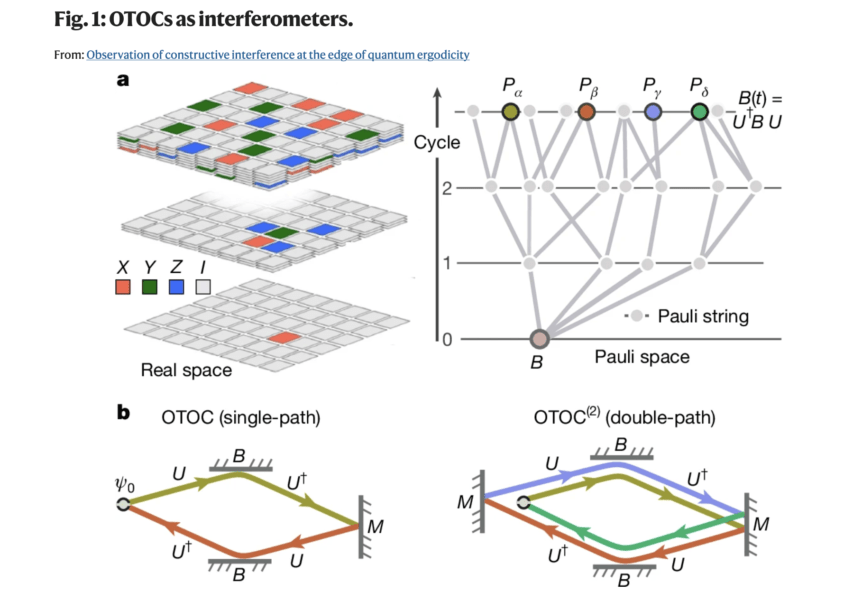
Quantum Interference and SecurityAn illustration demonstrating how quantum interference strengthens echoes for detailed information mapping. Source: Nature

While current quantum computers lack the power to crack modern encryption—thanks to large key sizes ranging from 2,048 to 4,096 bits—advances in hardware could change this paradigm. Experts like David Carvalho, chief scientist at the Naoris cybersecurity protocol, warn that the threat to Bitcoin and other decentralized protocols is imminent if the community does not act proactively. The industry is now racing to adopt post-quantum cryptography standards before powerful quantum systems become a reality.

Despite ongoing efforts, some remain skeptical about how soon quantum computers will reach the ability to threaten crypto security. Pseudonymous tech analyst Mental Outlaw explains that current quantum systems are only capable of breaking very small keys, far from the size needed for secure encryption today.

Nevertheless, regulators and industry leaders are pushing for measures to mitigate future risks. The U.S. Securities and Exchange Commission (SEC) has received proposals outlining a roadmap for quantum-safe encryption standards by 2035. The crypto sector recognizes that addressing quantum threats now could safeguard digital assets and foster continued innovation in blockchain, DeFi, NFT platforms, and beyond.

This article was originally published as Google’s Willow Processor Maps Molecules 13,000x Faster Than Supercomputers on Crypto Breaking News – your trusted source for crypto news, Bitcoin news, and blockchain updates.

Market Opportunity
QUANTUM Logo
QUANTUM Price(QUANTUM)
$0.003014
$0.003014$0.003014
+0.26%
USD
QUANTUM (QUANTUM) Live Price Chart
Disclaimer: The articles reposted on this site are sourced from public platforms and are provided for informational purposes only. They do not necessarily reflect the views of MEXC. All rights remain with the original authors. If you believe any content infringes on third-party rights, please contact service@support.mexc.com for removal. MEXC makes no guarantees regarding the accuracy, completeness, or timeliness of the content and is not responsible for any actions taken based on the information provided. The content does not constitute financial, legal, or other professional advice, nor should it be considered a recommendation or endorsement by MEXC.

You May Also Like

Raydium’s 200% volume spike tests RAY’s breakout strength – Here’s why

Raydium’s 200% volume spike tests RAY’s breakout strength – Here’s why

The post Raydium’s 200% volume spike tests RAY’s breakout strength – Here’s why appeared on BitcoinEthereumNews.com. RAY surged over 11% in 24 hours to $0.69 as
Share
BitcoinEthereumNews2026/02/17 18:10
Vitalik Buterin lays out new Ethereum roadmap at EDCON

Vitalik Buterin lays out new Ethereum roadmap at EDCON

The post Vitalik Buterin lays out new Ethereum roadmap at EDCON appeared on BitcoinEthereumNews.com. At EDCON 2025 in Osaka, Ethereum co-founder Vitalik Buterin delivered fresh details of Ethereum’s technical roadmap, delineating both short-term scaling goals and longer-term protocol transformations. The immediate priority, according to slides from the presentation, is scaling at the L1 level by raising the gas limit while maintaining decentralization. Tools such as block-level access lists, ZK-EVMs, gas repricing, and slot optimization were highlighted as means to improve throughput and efficiency. A central theme of the presentation was privacy, divided into protections for on-chain “writes” (transactions, voting, DeFi operations) and “reads” (retrieving blockchain state). Write privacy could be achieved through client-side zero-knowledge proofs, encrypted voting, and mixnet-based transaction relays. Read privacy efforts include trusted execution environments, private information retrieval techniques, dummy queries to obscure access patterns, and partial state nodes that reveal only necessary data. These measures aim to reduce information leakage across both ends of user interaction. In the medium term, Ethereum’s focus shifts to cross-Layer-2 interoperability. Vitalik described trustless L2 asset transfers, proof aggregation, and faster settlement mechanisms as key milestones toward a seamless rollup ecosystem. Faster slots and stronger finality, supported by techniques like erasure coding and three-stage finalization (3SF), are also in scope to enhance responsiveness and security. The roadmap also includes Stage 2 rollup advancements to strengthen verification efficiency, alongside a call for broader community participation to help build and maintain these improvements. The long-term “Lean Ethereum” blueprint emphasizes security, simplicity and optimization, with ambitions for quantum-resistant cryptography, formal verification of the protocol, and adoption of ideal primitives for hashing, signatures, and zero-knowledge proofs. Buterin stressed that these improvements are not just for scalability but to make Ethereum a stable, trustworthy foundation for the broader decentralized ecosystem. This is a developing story. This article was generated with the assistance of AI and reviewed by editor Jeffrey Albus before publication.…
Share
BitcoinEthereumNews2025/09/18 03:22
South Korea’s first won-pegged stablecoin KRW1 launches on Avalanche

South Korea’s first won-pegged stablecoin KRW1 launches on Avalanche

The launch remains in a PoC stage and is not publicly circulated, as the regulations around stablecoins remain unclear in South Korea.
Share
Coinstats2025/09/18 12:25