Japan has officially stepped into the regulated stablecoin era with the launch of JPYC EX, the country’s first fully licensed digital yen under the revised Payment Services Act. This milestone marks a pivotal moment for Japan’s financial sector, bridging traditional banking infrastructure with the Web3 ecosystem. Related Reading: Ethereum OG Drives $500M Liquidity Flow Into ConcreteXYZ & Stable Vaults – Details Building on earlier versions of JPYC, the new JPYC EX is designed to serve as a compliant, yen-backed stablecoin connecting the nation’s banking system to blockchain-based commerce, DeFi applications, and cross-border payments. With full legal authorization and asset backing, it positions the yen as a future cornerstone in global digital finance. According to CryptoQuant, the total stablecoin market capitalization has now surpassed $150 billion, forming the backbone of liquidity for crypto markets, DeFi protocols, and global payments. Analysts from Citi and Bloomberg project that this figure could expand to between $1.6 and $4 trillion by 2030. Within that rapid growth, JPYC is forecasted to capture roughly 2% of the market, reaching a valuation of around $70 billion. A Fully Regulated Digital Yen Bridging Japan’s Finance and Web3 What distinguishes JPYC EX from other stablecoins is its combination of regulatory clarity, asset backing, and technical versatility. Domestic bank deposits and Japanese government bonds fully collateralize each token, ensuring complete transparency and stability. This structure makes JPYC EX one of the world’s most legally robust stablecoins. A benchmark for compliance-driven innovation in digital finance. Built on Ethereum, Polygon, and Avalanche, JPYC EX provides instant yen transfers with near-zero fees. Making it a practical tool for businesses and individuals alike. It supports commerce, payroll, peer-to-peer payments, and DeFi applications, offering the efficiency of blockchain without sacrificing legal or operational safeguards. Related Reading: Bitcoin Heat Macro Phase Signals Accumulation Before Next Growth Wave JPYC EX also aligns closely with Japan’s digital transformation strategy, which aims to merge traditional finance with emerging Web3 systems. By serving as a settlement layer for e-commerce platforms, NFT marketplaces, and cross-border transactions, the stablecoin enables instant yen transfers across Asia, lowering costs and increasing accessibility for international trade. Looking ahead, analysts forecast JPYC’s market capitalization could reach $70 billion by 2030. It represents roughly 2% of the global stablecoin market. This growth potential underscores Japan’s ambition to establish the digital yen as a key pillar of the decentralized global economy. With its blend of regulatory trust, technological precision, and global reach, JPYC EX may redefine how national currencies operate in the Web3 era. Stablecoin Dominance Shows a Cooling Phase After Recent Surge The chart shows that stablecoin market dominance currently sits around 8.31%, following a sharp rise earlier in October that pushed the ratio above 9%. This level often signals heightened demand for liquidity and safety, as traders move capital into stable assets amid market uncertainty. Over the past few months, dominance has steadily climbed from the 7.3%–7.5% range, reflecting a cautious sentiment as Bitcoin and major altcoins face selling pressure. However, the recent pullback suggests that some funds are beginning to rotate back into risk assets, a potential early sign of market stabilization. Technically, the dominance remains above both the 50-day and 200-day moving averages, indicating a broader uptrend in liquidity positioning. If this level holds, it may serve as a buffer during continued volatility. Conversely, a sustained drop below 8% could signal that traders are redeploying capital into crypto assets, possibly fueling short-term rallies. Related Reading: Bitcoin STH-SOPR Falls Below 1.0 for the First Time Since April – What This Means Stablecoin dominance remains elevated — a sign that market participants still prefer holding dry powder. Until dominance begins a more decisive decline, this cautious stance will likely persist, underscoring the market’s fragile balance between risk-off sentiment and the readiness for re-entry into volatile assets. Featured image from ChatGPT, chart from TradingView.comJapan has officially stepped into the regulated stablecoin era with the launch of JPYC EX, the country’s first fully licensed digital yen under the revised Payment Services Act. This milestone marks a pivotal moment for Japan’s financial sector, bridging traditional banking infrastructure with the Web3 ecosystem. Related Reading: Ethereum OG Drives $500M Liquidity Flow Into ConcreteXYZ & Stable Vaults – Details Building on earlier versions of JPYC, the new JPYC EX is designed to serve as a compliant, yen-backed stablecoin connecting the nation’s banking system to blockchain-based commerce, DeFi applications, and cross-border payments. With full legal authorization and asset backing, it positions the yen as a future cornerstone in global digital finance. According to CryptoQuant, the total stablecoin market capitalization has now surpassed $150 billion, forming the backbone of liquidity for crypto markets, DeFi protocols, and global payments. Analysts from Citi and Bloomberg project that this figure could expand to between $1.6 and $4 trillion by 2030. Within that rapid growth, JPYC is forecasted to capture roughly 2% of the market, reaching a valuation of around $70 billion. A Fully Regulated Digital Yen Bridging Japan’s Finance and Web3 What distinguishes JPYC EX from other stablecoins is its combination of regulatory clarity, asset backing, and technical versatility. Domestic bank deposits and Japanese government bonds fully collateralize each token, ensuring complete transparency and stability. This structure makes JPYC EX one of the world’s most legally robust stablecoins. A benchmark for compliance-driven innovation in digital finance. Built on Ethereum, Polygon, and Avalanche, JPYC EX provides instant yen transfers with near-zero fees. Making it a practical tool for businesses and individuals alike. It supports commerce, payroll, peer-to-peer payments, and DeFi applications, offering the efficiency of blockchain without sacrificing legal or operational safeguards. Related Reading: Bitcoin Heat Macro Phase Signals Accumulation Before Next Growth Wave JPYC EX also aligns closely with Japan’s digital transformation strategy, which aims to merge traditional finance with emerging Web3 systems. By serving as a settlement layer for e-commerce platforms, NFT marketplaces, and cross-border transactions, the stablecoin enables instant yen transfers across Asia, lowering costs and increasing accessibility for international trade. Looking ahead, analysts forecast JPYC’s market capitalization could reach $70 billion by 2030. It represents roughly 2% of the global stablecoin market. This growth potential underscores Japan’s ambition to establish the digital yen as a key pillar of the decentralized global economy. With its blend of regulatory trust, technological precision, and global reach, JPYC EX may redefine how national currencies operate in the Web3 era. Stablecoin Dominance Shows a Cooling Phase After Recent Surge The chart shows that stablecoin market dominance currently sits around 8.31%, following a sharp rise earlier in October that pushed the ratio above 9%. This level often signals heightened demand for liquidity and safety, as traders move capital into stable assets amid market uncertainty. Over the past few months, dominance has steadily climbed from the 7.3%–7.5% range, reflecting a cautious sentiment as Bitcoin and major altcoins face selling pressure. However, the recent pullback suggests that some funds are beginning to rotate back into risk assets, a potential early sign of market stabilization. Technically, the dominance remains above both the 50-day and 200-day moving averages, indicating a broader uptrend in liquidity positioning. If this level holds, it may serve as a buffer during continued volatility. Conversely, a sustained drop below 8% could signal that traders are redeploying capital into crypto assets, possibly fueling short-term rallies. Related Reading: Bitcoin STH-SOPR Falls Below 1.0 for the First Time Since April – What This Means Stablecoin dominance remains elevated — a sign that market participants still prefer holding dry powder. Until dominance begins a more decisive decline, this cautious stance will likely persist, underscoring the market’s fragile balance between risk-off sentiment and the readiness for re-entry into volatile assets. Featured image from ChatGPT, chart from TradingView.com

Digital Yen Goes Live: JPYC EX Integrates Traditional Finance With DeFi

2025/10/28 03:00
3 min read

Japan has officially stepped into the regulated stablecoin era with the launch of JPYC EX, the country’s first fully licensed digital yen under the revised Payment Services Act. This milestone marks a pivotal moment for Japan’s financial sector, bridging traditional banking infrastructure with the Web3 ecosystem.

Building on earlier versions of JPYC, the new JPYC EX is designed to serve as a compliant, yen-backed stablecoin connecting the nation’s banking system to blockchain-based commerce, DeFi applications, and cross-border payments. With full legal authorization and asset backing, it positions the yen as a future cornerstone in global digital finance.

According to CryptoQuant, the total stablecoin market capitalization has now surpassed $150 billion, forming the backbone of liquidity for crypto markets, DeFi protocols, and global payments. Analysts from Citi and Bloomberg project that this figure could expand to between $1.6 and $4 trillion by 2030. Within that rapid growth, JPYC is forecasted to capture roughly 2% of the market, reaching a valuation of around $70 billion.

Stablecoins vs JPYC (revised projections 2020-2030) | Source: CryptoQuant A Fully Regulated Digital Yen Bridging Japan’s Finance and Web3

What distinguishes JPYC EX from other stablecoins is its combination of regulatory clarity, asset backing, and technical versatility. Domestic bank deposits and Japanese government bonds fully collateralize each token, ensuring complete transparency and stability. This structure makes JPYC EX one of the world’s most legally robust stablecoins. A benchmark for compliance-driven innovation in digital finance.

Built on Ethereum, Polygon, and Avalanche, JPYC EX provides instant yen transfers with near-zero fees. Making it a practical tool for businesses and individuals alike. It supports commerce, payroll, peer-to-peer payments, and DeFi applications, offering the efficiency of blockchain without sacrificing legal or operational safeguards.

JPYC EX also aligns closely with Japan’s digital transformation strategy, which aims to merge traditional finance with emerging Web3 systems. By serving as a settlement layer for e-commerce platforms, NFT marketplaces, and cross-border transactions, the stablecoin enables instant yen transfers across Asia, lowering costs and increasing accessibility for international trade.

Looking ahead, analysts forecast JPYC’s market capitalization could reach $70 billion by 2030. It represents roughly 2% of the global stablecoin market. This growth potential underscores Japan’s ambition to establish the digital yen as a key pillar of the decentralized global economy. With its blend of regulatory trust, technological precision, and global reach, JPYC EX may redefine how national currencies operate in the Web3 era.

Stablecoin Dominance Shows a Cooling Phase After Recent Surge

The chart shows that stablecoin market dominance currently sits around 8.31%, following a sharp rise earlier in October that pushed the ratio above 9%. This level often signals heightened demand for liquidity and safety, as traders move capital into stable assets amid market uncertainty.

Over the past few months, dominance has steadily climbed from the 7.3%–7.5% range, reflecting a cautious sentiment as Bitcoin and major altcoins face selling pressure. However, the recent pullback suggests that some funds are beginning to rotate back into risk assets, a potential early sign of market stabilization.
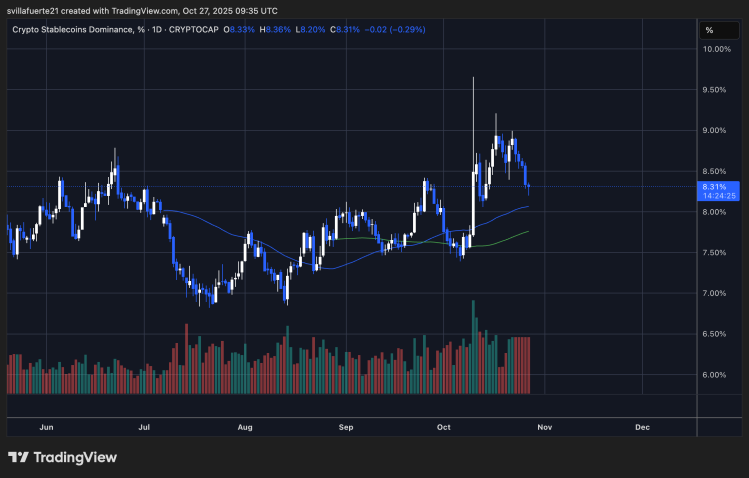
Crypto Stablecoin Dominance % | Source: STABLE.C.D

Technically, the dominance remains above both the 50-day and 200-day moving averages, indicating a broader uptrend in liquidity positioning. If this level holds, it may serve as a buffer during continued volatility. Conversely, a sustained drop below 8% could signal that traders are redeploying capital into crypto assets, possibly fueling short-term rallies.

Stablecoin dominance remains elevated — a sign that market participants still prefer holding dry powder. Until dominance begins a more decisive decline, this cautious stance will likely persist, underscoring the market’s fragile balance between risk-off sentiment and the readiness for re-entry into volatile assets.

Featured image from ChatGPT, chart from TradingView.com

Market Opportunity
SecondLive Logo
SecondLive Price(LIVE)
$0.00001811
$0.00001811$0.00001811
+4.56%
USD
SecondLive (LIVE) Live Price Chart
Disclaimer: The articles reposted on this site are sourced from public platforms and are provided for informational purposes only. They do not necessarily reflect the views of MEXC. All rights remain with the original authors. If you believe any content infringes on third-party rights, please contact service@support.mexc.com for removal. MEXC makes no guarantees regarding the accuracy, completeness, or timeliness of the content and is not responsible for any actions taken based on the information provided. The content does not constitute financial, legal, or other professional advice, nor should it be considered a recommendation or endorsement by MEXC.

You May Also Like

Here’s How Consumers May Benefit From Lower Interest Rates

Here’s How Consumers May Benefit From Lower Interest Rates

The post Here’s How Consumers May Benefit From Lower Interest Rates appeared on BitcoinEthereumNews.com. Topline The Federal Reserve on Wednesday opted to ease interest rates for the first time in months, leading the way for potentially lower mortgage rates, bond yields and a likely boost to cryptocurrency over the coming weeks. Average long-term mortgage rates dropped to their lowest levels in months ahead of the central bank’s policy shift. Copyright{2018} The Associated Press. All rights reserved. Key Facts The central bank’s policymaking panel voted this week to lower interest rates, which have sat between 4.25% and 4.5% since December, to a new range of 4% and 4.25%. How Will Lower Interest Rates Impact Mortgage Rates? Mortgage rates tend to fall before and during a period of interest rate cuts: The average 30-year fixed-rate mortgage dropped to 6.35% from 6.5% last week, the lowest level since October 2024, mortgage buyer Freddie Mac reported. Borrowing costs on 15-year fixed-rate mortgages also dropped to 5.5% from 5.6% as they neared the year-ago rate of 5.27%. When the Federal Reserve lowered the funds rate to between 0% and 0.25% during the pandemic, 30-year mortgage rates hit record lows between 2.7% and 3% by the end of 2020, according to data published by Freddie Mac. Consumers who refinanced their mortgages in 2020 saved about $5.3 billion annually as rates dropped, according to the Consumer Financial Protection Bureau. Similarly, mortgage rates spiked around 7% as interest rates were hiked in 2022 and 2023, though mortgage rates appeared to react within weeks of the Fed opting to cut or raise rates. How Do Treasury Bonds Respond To Lower Interest Rates? Long-term Treasury yields are more directly influenced by interest rates, as lower rates tend to result in lower yields. When the Fed pushed rates to near zero during the pandemic, 10-year Treasury yields fell to an all-time low of 0.5%. As…
Share
BitcoinEthereumNews2025/09/18 05:59
Stripe-Backed Bridge Secures U.S. National Trust Banking License

Stripe-Backed Bridge Secures U.S. National Trust Banking License

The payment giant's stablecoin subsidiary is the latest crypto-native company to secure a banking license.
Share
Coinstats2026/02/18 05:28
Revolutionary Trio Accelerates Development To Dominate 2027 Market

Revolutionary Trio Accelerates Development To Dominate 2027 Market

The post Revolutionary Trio Accelerates Development To Dominate 2027 Market appeared on BitcoinEthereumNews.com. Apple AI Wearables: Revolutionary Trio Accelerates
Share
BitcoinEthereumNews2026/02/18 05:46