Circle Internet Group (NYSE: CRCL) has launched the public testnet for Arc, its open Layer-1 blockchain designed to bring more economic activity onchain. In a press release, Circle explains Arc is positioned as a new “Economic Operating System” for the internet, it combines predictable dollar-based fees, sub-second transaction finality, configurable privacy, and direct integration with Circle’s full-stack platform. The network has already attracted collaboration from more than 100 institutions across global finance and technology — including BlackRock, Visa, and Amazon Web Services (AWS) — along with major capital markets, banks, and fintech players. Developers and enterprises can now deploy, test, and build applications on Arc as Circle aims to create a unified, programmable financial infrastructure for the global economy. Circle CEO Jeremy Allaire described Arc as “purpose-built to connect every local market to the global economy,”highlighting its mission to enable faster, more inclusive, and internet-native financial systems. Institutions and Capital Markets Join the Testnet Arc’s early partners include some of the world’s largest financial institutions and asset managers — among them Goldman Sachs, BNY Mellon, Société Générale, Standard Chartered, State Street, and Apollo Global Management. These participants will experiment with tokenized assets, lending, and programmable FX settlement on the network. According to Robert Mitchnick, Global Head of Digital Assets at BlackRock, the project offers “insight into how stablecoin-denominated settlement and onchain FX could enable more efficient capital markets.” Expanding the Onchain Payments Beyond capital markets, Arc’s testnet features integration with global payments and fintech leaders such as Mastercard, Nuvei, Brex, Cloudflare, FIS, and dLocal. The network aims to power cross-border payments, merchant settlements, and programmable finance — including use by AI-driven autonomous agents to send, exchange, and settle value in real time. Visa’s Head of Crypto, Cuy Sheffield, said the company is exploring how Arc’s design — integrating stablecoin-based gas fees and deterministic finality — could “help scale emerging onchain infrastructure.” The Road to Decentralized Governance While Circle is currently stewarding Arc’s early development, the company plans to transition toward distributed, community-driven governance. The network’s roadmap includes expanding validator participation and establishing transparent frameworks to ensure open, verifiable operations. Ultimately, Circle envisions Arc as a shared, neutral layer of economic infrastructure — a blockchain backbone for global finance that bridges regulated institutions, fintech innovators, and decentralized networks. With major players like BlackRock, Visa, and AWS already onboard, Arc’s testnet marks a decisive step toward making onchain finance mainstream. Price Action Shares of Circle Internet Group Inc. (NYSE: CRCL) climbed 7.2% over the past month, closing at $143.29 on Monday amid renewed investor optimism surrounding the company’s blockchain expansion efforts. The stock opened at $146.93, trading between a monthly low of $138.10 and a high of $147.44, with a current market capitalization of $32.95 billion. While the pre-market price shows a slight dip to $141.57 (-1.20%), Circle’s recent momentum reflects growing confidence in the company’s long-term strategy to become a core infrastructure provider for the digital asset economy. Arc’s launch marks a strategic evolution for Circle, best known as the issuer of USDC, one of the world’s leading stablecoins. The new blockchain aims to serve as a foundation for tokenized assets, onchain payments, and programmable finance, integrating directly with Circle’s existing products and services. Investors have interpreted the Arc testnet launch — and its backing by major financial institutions — as a signal that Circle is deepening its role in bridging traditional finance and blockchain technology. Analysts suggest that the company’s partnerships with BNY Mellon, Goldman Sachs, and Société Générale through Arc could attract institutional liquidity and strengthen Circle’s positioning in the onchain settlement market. The broader crypto sector has also shown signs of renewed activity, with sentiment improving after the approval of multiple digital asset ETFs and growing institutional participation in blockchain infrastructureCircle Internet Group (NYSE: CRCL) has launched the public testnet for Arc, its open Layer-1 blockchain designed to bring more economic activity onchain. In a press release, Circle explains Arc is positioned as a new “Economic Operating System” for the internet, it combines predictable dollar-based fees, sub-second transaction finality, configurable privacy, and direct integration with Circle’s full-stack platform. The network has already attracted collaboration from more than 100 institutions across global finance and technology — including BlackRock, Visa, and Amazon Web Services (AWS) — along with major capital markets, banks, and fintech players. Developers and enterprises can now deploy, test, and build applications on Arc as Circle aims to create a unified, programmable financial infrastructure for the global economy. Circle CEO Jeremy Allaire described Arc as “purpose-built to connect every local market to the global economy,”highlighting its mission to enable faster, more inclusive, and internet-native financial systems. Institutions and Capital Markets Join the Testnet Arc’s early partners include some of the world’s largest financial institutions and asset managers — among them Goldman Sachs, BNY Mellon, Société Générale, Standard Chartered, State Street, and Apollo Global Management. These participants will experiment with tokenized assets, lending, and programmable FX settlement on the network. According to Robert Mitchnick, Global Head of Digital Assets at BlackRock, the project offers “insight into how stablecoin-denominated settlement and onchain FX could enable more efficient capital markets.” Expanding the Onchain Payments Beyond capital markets, Arc’s testnet features integration with global payments and fintech leaders such as Mastercard, Nuvei, Brex, Cloudflare, FIS, and dLocal. The network aims to power cross-border payments, merchant settlements, and programmable finance — including use by AI-driven autonomous agents to send, exchange, and settle value in real time. Visa’s Head of Crypto, Cuy Sheffield, said the company is exploring how Arc’s design — integrating stablecoin-based gas fees and deterministic finality — could “help scale emerging onchain infrastructure.” The Road to Decentralized Governance While Circle is currently stewarding Arc’s early development, the company plans to transition toward distributed, community-driven governance. The network’s roadmap includes expanding validator participation and establishing transparent frameworks to ensure open, verifiable operations. Ultimately, Circle envisions Arc as a shared, neutral layer of economic infrastructure — a blockchain backbone for global finance that bridges regulated institutions, fintech innovators, and decentralized networks. With major players like BlackRock, Visa, and AWS already onboard, Arc’s testnet marks a decisive step toward making onchain finance mainstream. Price Action Shares of Circle Internet Group Inc. (NYSE: CRCL) climbed 7.2% over the past month, closing at $143.29 on Monday amid renewed investor optimism surrounding the company’s blockchain expansion efforts. The stock opened at $146.93, trading between a monthly low of $138.10 and a high of $147.44, with a current market capitalization of $32.95 billion. While the pre-market price shows a slight dip to $141.57 (-1.20%), Circle’s recent momentum reflects growing confidence in the company’s long-term strategy to become a core infrastructure provider for the digital asset economy. Arc’s launch marks a strategic evolution for Circle, best known as the issuer of USDC, one of the world’s leading stablecoins. The new blockchain aims to serve as a foundation for tokenized assets, onchain payments, and programmable finance, integrating directly with Circle’s existing products and services. Investors have interpreted the Arc testnet launch — and its backing by major financial institutions — as a signal that Circle is deepening its role in bridging traditional finance and blockchain technology. Analysts suggest that the company’s partnerships with BNY Mellon, Goldman Sachs, and Société Générale through Arc could attract institutional liquidity and strengthen Circle’s positioning in the onchain settlement market. The broader crypto sector has also shown signs of renewed activity, with sentiment improving after the approval of multiple digital asset ETFs and growing institutional participation in blockchain infrastructure

Circle Launches Arc Testnet With BlackRock, Visa, and AWS — A New Era for Onchain Finance?

2025/10/28 20:18
4 min read

Circle Internet Group (NYSE: CRCL) has launched the public testnet for Arc, its open Layer-1 blockchain designed to bring more economic activity onchain.

In a press release, Circle explains Arc is positioned as a new “Economic Operating System” for the internet, it combines predictable dollar-based fees, sub-second transaction finality, configurable privacy, and direct integration with Circle’s full-stack platform.

The network has already attracted collaboration from more than 100 institutions across global finance and technology — including BlackRock, Visa, and Amazon Web Services (AWS) — along with major capital markets, banks, and fintech players.

Developers and enterprises can now deploy, test, and build applications on Arc as Circle aims to create a unified, programmable financial infrastructure for the global economy.

Circle CEO Jeremy Allaire described Arc as “purpose-built to connect every local market to the global economy,”highlighting its mission to enable faster, more inclusive, and internet-native financial systems.

Institutions and Capital Markets Join the Testnet

Arc’s early partners include some of the world’s largest financial institutions and asset managers — among them Goldman Sachs, BNY Mellon, Société Générale, Standard Chartered, State Street, and Apollo Global Management. These participants will experiment with tokenized assets, lending, and programmable FX settlement on the network.

According to Robert Mitchnick, Global Head of Digital Assets at BlackRock, the project offers “insight into how stablecoin-denominated settlement and onchain FX could enable more efficient capital markets.”

Expanding the Onchain Payments

Beyond capital markets, Arc’s testnet features integration with global payments and fintech leaders such as Mastercard, Nuvei, Brex, Cloudflare, FIS, and dLocal. The network aims to power cross-border payments, merchant settlements, and programmable finance — including use by AI-driven autonomous agents to send, exchange, and settle value in real time.

Visa’s Head of Crypto, Cuy Sheffield, said the company is exploring how Arc’s design — integrating stablecoin-based gas fees and deterministic finality — could “help scale emerging onchain infrastructure.”

The Road to Decentralized Governance

While Circle is currently stewarding Arc’s early development, the company plans to transition toward distributed, community-driven governance. The network’s roadmap includes expanding validator participation and establishing transparent frameworks to ensure open, verifiable operations.

Ultimately, Circle envisions Arc as a shared, neutral layer of economic infrastructure — a blockchain backbone for global finance that bridges regulated institutions, fintech innovators, and decentralized networks. With major players like BlackRock, Visa, and AWS already onboard, Arc’s testnet marks a decisive step toward making onchain finance mainstream.

Price Action

Shares of Circle Internet Group Inc. (NYSE: CRCL) climbed 7.2% over the past month, closing at $143.29 on Monday amid renewed investor optimism surrounding the company’s blockchain expansion efforts.
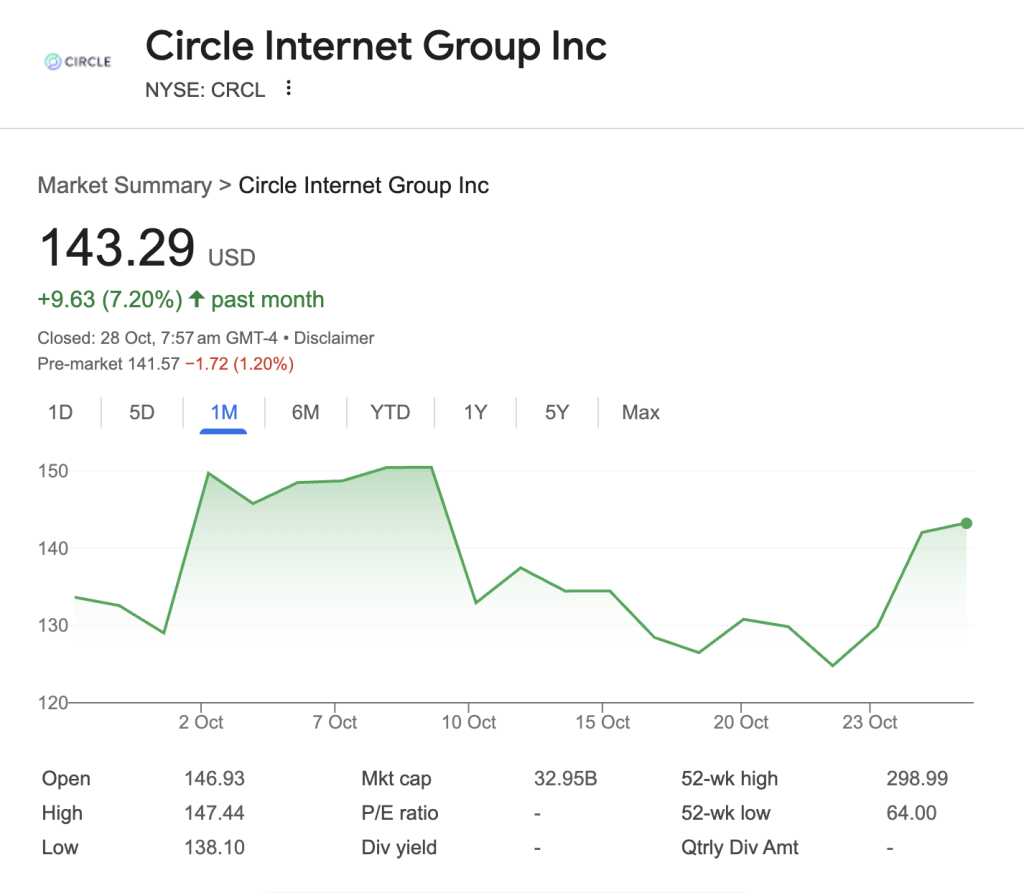
The stock opened at $146.93, trading between a monthly low of $138.10 and a high of $147.44, with a current market capitalization of $32.95 billion. While the pre-market price shows a slight dip to $141.57 (-1.20%), Circle’s recent momentum reflects growing confidence in the company’s long-term strategy to become a core infrastructure provider for the digital asset economy.

Arc’s launch marks a strategic evolution for Circle, best known as the issuer of USDC, one of the world’s leading stablecoins. The new blockchain aims to serve as a foundation for tokenized assets, onchain payments, and programmable finance, integrating directly with Circle’s existing products and services.

Investors have interpreted the Arc testnet launch — and its backing by major financial institutions — as a signal that Circle is deepening its role in bridging traditional finance and blockchain technology.

Analysts suggest that the company’s partnerships with BNY Mellon, Goldman Sachs, and Société Générale through Arc could attract institutional liquidity and strengthen Circle’s positioning in the onchain settlement market.

The broader crypto sector has also shown signs of renewed activity, with sentiment improving after the approval of multiple digital asset ETFs and growing institutional participation in blockchain infrastructure.

Market Opportunity
ARC Logo
ARC Price(ARC)
$0.000499
$0.000499$0.000499
-7.42%
USD
ARC (ARC) Live Price Chart
Disclaimer: The articles reposted on this site are sourced from public platforms and are provided for informational purposes only. They do not necessarily reflect the views of MEXC. All rights remain with the original authors. If you believe any content infringes on third-party rights, please contact service@support.mexc.com for removal. MEXC makes no guarantees regarding the accuracy, completeness, or timeliness of the content and is not responsible for any actions taken based on the information provided. The content does not constitute financial, legal, or other professional advice, nor should it be considered a recommendation or endorsement by MEXC.

You May Also Like

Stellar (XLM) Powers IRL’s Stealth Crypto Onboarding at Major Cultural Events

Stellar (XLM) Powers IRL’s Stealth Crypto Onboarding at Major Cultural Events

The post Stellar (XLM) Powers IRL’s Stealth Crypto Onboarding at Major Cultural Events appeared on BitcoinEthereumNews.com. Terrill Dicki Feb 12, 2026 05:39
Share
BitcoinEthereumNews2026/02/13 06:46
Ringgit strength seen extending lower – MUFG

Ringgit strength seen extending lower – MUFG

The post Ringgit strength seen extending lower – MUFG appeared on BitcoinEthereumNews.com. MUFG’s Senior Currency Analyst Lloyd Chan expects USD/MYR to keep trending
Share
BitcoinEthereumNews2026/02/13 07:20
Kalshi debuts ecosystem hub with Solana and Base

Kalshi debuts ecosystem hub with Solana and Base

The post Kalshi debuts ecosystem hub with Solana and Base appeared on BitcoinEthereumNews.com. Kalshi, the US-regulated prediction market exchange, rolled out a new program on Wednesday called KalshiEco Hub. The initiative, developed in partnership with Solana and Coinbase-backed Base, is designed to attract builders, traders, and content creators to a growing ecosystem around prediction markets. By combining its regulatory footing with crypto-native infrastructure, Kalshi said it is aiming to become a bridge between traditional finance and onchain innovation. The hub offers grants, technical assistance, and marketing support to selected projects. Kalshi also announced that it will support native deposits of Solana’s SOL token and USDC stablecoin, making it easier for users already active in crypto to participate directly. Early collaborators include Kalshinomics, a dashboard for market analytics, and Verso, which is building professional-grade tools for market discovery and execution. Other partners, such as Caddy, are exploring ways to expand retail-facing trading experiences. Kalshi’s move to embrace blockchain partnerships comes at a time when prediction markets are drawing fresh attention for their ability to capture sentiment around elections, economic policy, and cultural events. Competitor Polymarket recently acquired QCEX — a derivatives exchange with a CFTC license — to pave its way back into US operations under regulatory compliance. At the same time, platforms like PredictIt continue to push for a clearer regulatory footing. The legal terrain remains complex, with some states issuing cease-and-desist orders over whether these event contracts count as gambling, not finance. This is a developing story. This article was generated with the assistance of AI and reviewed by editor Jeffrey Albus before publication. Get the news in your inbox. Explore Blockworks newsletters: Source: https://blockworks.co/news/kalshi-ecosystem-hub-solana-base
Share
BitcoinEthereumNews2025/09/18 04:40