The post Fusaka Hard Fork enters in Hoodi Testnet appeared on BitcoinEthereumNews.com. The Fusaka hard fork reached its final testnet milestone when Hoodi activated on Oct. 28, 2025, beginning a minimum 30‑day window ahead of a tentative Dec. 3 mainnet target. What did the Hoodi testnet activation prove about Fusaka and PeerDAS? When were Holesky and Sepolia used in testing? Hoodi represents the third and final Fusaka testnet, following earlier activations on Holesky and Sepolia in October. As reported by The Block, the sequence exercised client interoperability and cross‑client syncing under the new rules. How does PeerDAS (EIP-7594) change data availability sampling? PeerDAS, specified in EIP-7594, enables validators to sample smaller segments of layer‑2 data rather than downloading full blobs, improving practical data availability sampling for rollups and other layer‑2 solutions. “Hoodi represents the third and final testnet deployment,” the coverage noted, underscoring the staged rollout. Experts say PeerDAS should lower bandwidth and storage pressure for many node operators and make partial sampling viable for Ethereum layer‑2 data validation. Client teams reported actionable bug reports from Hoodi that narrow the remaining compatibility work. How will Fusaka upgrades affect block gas limits, blob capacity and Ethereum layer2 data handling? What is the block gas limit increase? Fusaka includes proposals that raise the block gas limit to allow more on‑chain execution per block. Developers expect the change to improve throughput for some workloads, but client implementers will watch resource use and syncing behaviour closely. What does expanded blob capacity mean for Layer 2s? Expanded blob capacity increases the on‑chain attestation space for off‑chain data, which affects how rollups and other layer‑2s batch and verify transactions. Combined with PeerDAS, the aim is to make Ethereum layer2 data handling more efficient without forcing every validator to store full payloads. When will the Fusaka hard fork reach mainnet and what must validators do? The Ethereum Foundation and… The post Fusaka Hard Fork enters in Hoodi Testnet appeared on BitcoinEthereumNews.com. The Fusaka hard fork reached its final testnet milestone when Hoodi activated on Oct. 28, 2025, beginning a minimum 30‑day window ahead of a tentative Dec. 3 mainnet target. What did the Hoodi testnet activation prove about Fusaka and PeerDAS? When were Holesky and Sepolia used in testing? Hoodi represents the third and final Fusaka testnet, following earlier activations on Holesky and Sepolia in October. As reported by The Block, the sequence exercised client interoperability and cross‑client syncing under the new rules. How does PeerDAS (EIP-7594) change data availability sampling? PeerDAS, specified in EIP-7594, enables validators to sample smaller segments of layer‑2 data rather than downloading full blobs, improving practical data availability sampling for rollups and other layer‑2 solutions. “Hoodi represents the third and final testnet deployment,” the coverage noted, underscoring the staged rollout. Experts say PeerDAS should lower bandwidth and storage pressure for many node operators and make partial sampling viable for Ethereum layer‑2 data validation. Client teams reported actionable bug reports from Hoodi that narrow the remaining compatibility work. How will Fusaka upgrades affect block gas limits, blob capacity and Ethereum layer2 data handling? What is the block gas limit increase? Fusaka includes proposals that raise the block gas limit to allow more on‑chain execution per block. Developers expect the change to improve throughput for some workloads, but client implementers will watch resource use and syncing behaviour closely. What does expanded blob capacity mean for Layer 2s? Expanded blob capacity increases the on‑chain attestation space for off‑chain data, which affects how rollups and other layer‑2s batch and verify transactions. Combined with PeerDAS, the aim is to make Ethereum layer2 data handling more efficient without forcing every validator to store full payloads. When will the Fusaka hard fork reach mainnet and what must validators do? The Ethereum Foundation and…

Fusaka Hard Fork enters in Hoodi Testnet

3 min read

The Fusaka hard fork reached its final testnet milestone when Hoodi activated on Oct. 28, 2025, beginning a minimum 30‑day window ahead of a tentative Dec. 3 mainnet target.

What did the Hoodi testnet activation prove about Fusaka and PeerDAS?

When were Holesky and Sepolia used in testing?

Hoodi represents the third and final Fusaka testnet, following earlier activations on Holesky and Sepolia in October. As reported by The Block, the sequence exercised client interoperability and cross‑client syncing under the new rules.

How does PeerDAS (EIP-7594) change data availability sampling?

PeerDAS, specified in EIP-7594, enables validators to sample smaller segments of layer‑2 data rather than downloading full blobs, improving practical data availability sampling for rollups and other layer‑2 solutions. “Hoodi represents the third and final testnet deployment,” the coverage noted, underscoring the staged rollout.

Experts say PeerDAS should lower bandwidth and storage pressure for many node operators and make partial sampling viable for Ethereum layer‑2 data validation. Client teams reported actionable bug reports from Hoodi that narrow the remaining compatibility work.

How will Fusaka upgrades affect block gas limits, blob capacity and Ethereum layer2 data handling?

What is the block gas limit increase?

Fusaka includes proposals that raise the block gas limit to allow more on‑chain execution per block. Developers expect the change to improve throughput for some workloads, but client implementers will watch resource use and syncing behaviour closely.

What does expanded blob capacity mean for Layer 2s?

Expanded blob capacity increases the on‑chain attestation space for off‑chain data, which affects how rollups and other layer‑2s batch and verify transactions. Combined with PeerDAS, the aim is to make Ethereum layer2 data handling more efficient without forcing every validator to store full payloads.

When will the Fusaka hard fork reach mainnet and what must validators do?

The Ethereum Foundation and core developers have stated that mainnet activation will occur at least 30 days after Hoodi; core devs have tentatively discussed a Dec. 3 target, giving operators a defined remediation window. The Block also reported that the Foundation ran a four‑week audit contest offering up to $2 million in rewards to surface vulnerabilities before mainnet.

Tip: validators should stage client updates on non‑production nodes, re-run signature and sync tests, and verify partial DAS handling before upgrading mainnet validators.

  • Final testnet: Hoodi — Oct. 28, 2025.
  • Key features: PeerDAS (EIP‑7594), block gas limit increase, expanded blob capacity.
  • Preparation window: at least 30 days after Hoodi; tentative mainnet target Dec. 3.

In brief, the Fusaka hard fork Hoodi rehearsal exercised PeerDAS and related EIPs, producing test‑level fixes and narrowing the client compatibility list ahead of a possible December mainnet activation.

Source: https://en.cryptonomist.ch/2025/10/29/ethereum-fusaka-hard-fork-hoodi-testnet/

Market Opportunity
Omnity Network Logo
Omnity Network Price(OCT)
$0.00684
$0.00684$0.00684
+1.92%
USD
Omnity Network (OCT) Live Price Chart
Disclaimer: The articles reposted on this site are sourced from public platforms and are provided for informational purposes only. They do not necessarily reflect the views of MEXC. All rights remain with the original authors. If you believe any content infringes on third-party rights, please contact service@support.mexc.com for removal. MEXC makes no guarantees regarding the accuracy, completeness, or timeliness of the content and is not responsible for any actions taken based on the information provided. The content does not constitute financial, legal, or other professional advice, nor should it be considered a recommendation or endorsement by MEXC.

You May Also Like

Fed Decides On Interest Rates Today—Here’s What To Watch For

Fed Decides On Interest Rates Today—Here’s What To Watch For

The post Fed Decides On Interest Rates Today—Here’s What To Watch For appeared on BitcoinEthereumNews.com. Topline The Federal Reserve on Wednesday will conclude a two-day policymaking meeting and release a decision on whether to lower interest rates—following months of pressure and criticism from President Donald Trump—and potentially signal whether additional cuts are on the way. President Donald Trump has urged the central bank to “CUT INTEREST RATES, NOW, AND BIGGER” than they might plan to. Getty Images Key Facts The central bank is poised to cut interest rates by at least a quarter-point, down from the 4.25% to 4.5% range where they have been held since December to between 4% and 4.25%, as Wall Street has placed 100% odds of a rate cut, according to CME’s FedWatch, with higher odds (94%) on a quarter-point cut than a half-point (6%) reduction. Fed governors Christopher Waller and Michelle Bowman, both Trump appointees, voted in July for a quarter-point reduction to rates, and they may dissent again in favor of a large cut alongside Stephen Miran, Trump’s Council of Economic Advisers’ chair, who was sworn in at the meeting’s start on Tuesday. It’s unclear whether other policymakers, including Kansas City Fed President Jeffrey Schmid and St. Louis Fed President Alberto Musalem, will favor larger cuts or opt for no reduction. Fed Chair Jerome Powell said in his Jackson Hole, Wyoming, address last month the central bank would likely consider a looser monetary policy, noting the “shifting balance of risks” on the U.S. economy “may warrant adjusting our policy stance.” David Mericle, an economist for Goldman Sachs, wrote in a note the “key question” for the Fed’s meeting is whether policymakers signal “this is likely the first in a series of consecutive cuts” as the central bank is anticipated to “acknowledge the softening in the labor market,” though they may not “nod to an October cut.” Mericle said he…
Share
BitcoinEthereumNews2025/09/18 00:23
While Shiba Inu and Turbo Chase Price, 63% APY Staking Puts APEMARS at the Forefront of the Best Meme Coin Presale 2026 – Stage 6 Ends in 3 Days!

While Shiba Inu and Turbo Chase Price, 63% APY Staking Puts APEMARS at the Forefront of the Best Meme Coin Presale 2026 – Stage 6 Ends in 3 Days!

What if your meme coin investment could generate passive income without selling a single token? Shiba Inu climbed 4.97% as 207 billion tokens left exchanges. Turbo
Share
Coinstats2026/02/04 03:15
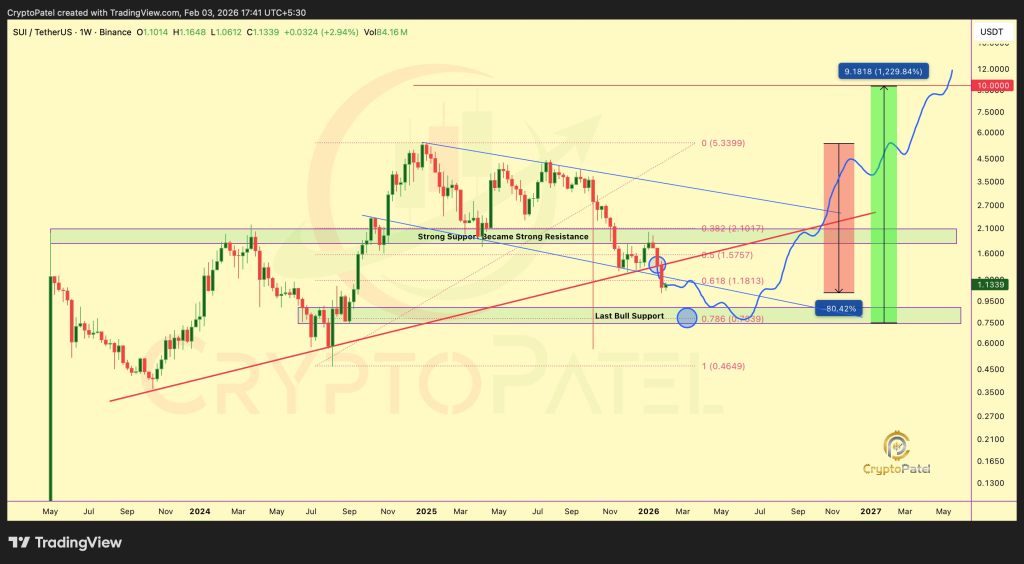
SUI Price Is Down 80%: Price Nears Level Bulls Cannot Afford to Lose

SUI Price Is Down 80%: Price Nears Level Bulls Cannot Afford to Lose

SUI price has quietly slipped into a zone that usually decides everything. Charts show an 80% drop from the peak, yet the market is no longer moving fast. This
Share
Captainaltcoin2026/02/04 03:00