Balaji Srinivasan has distilled 15 years of crypto experimentation down to a stark claim: after Bitcoin, only two core protocol breakthroughs truly matter—Ethereum for programmability and Zcash for privacy. In a wide-ranging appearance on Mert Mumtaz’s “Accelerate with Mert” podcast, Srinivasan argued that the industry has already completed the “programmability era” and is now entering […]Balaji Srinivasan has distilled 15 years of crypto experimentation down to a stark claim: after Bitcoin, only two core protocol breakthroughs truly matter—Ethereum for programmability and Zcash for privacy. In a wide-ranging appearance on Mert Mumtaz’s “Accelerate with Mert” podcast, Srinivasan argued that the industry has already completed the “programmability era” and is now entering […]

Ethereum and Zcash Are Crypto’s True Innovations Post Bitcoin, Says Balaji

2025/11/14 02:00
3 min read

Balaji Srinivasan has distilled 15 years of crypto experimentation down to a stark claim: after Bitcoin, only two core protocol breakthroughs truly matter—Ethereum for programmability and Zcash for privacy.

In a wide-ranging appearance on Mert Mumtaz’s “Accelerate with Mert” podcast, Srinivasan argued that the industry has already completed the “programmability era” and is now entering a decisive phase where privacy and zero-knowledge cryptography become central to crypto’s mission. “The two major innovations on Bitcoin were programmability in the form of Ethereum and privacy in the form of Zcash,” he said.

From Bitcoin To Programmability To Zcash

Srinivasan breaks crypto’s history into three arcs. First, Bitcoin simply had to prove that non-sovereign, cryptographic money could work at all. Then, Ethereum generalized that into a programmable platform with smart contracts, stablecoins, NFTs, DEXs and on-chain capital markets.

By now, he argued, that second phase is effectively validated. “We now have scalable on-chain smart contracts that can support [a] large number of users, large numbers of transactions with finality. There’s multiple good chains. It works. It runs 24/7,” he said, noting that crypto is already functioning in developing markets: “In Bolivia, they quote prices in Tether. In Nigeria, they save in Bitcoin. This stuff is no longer theory. It’s actually there.”

The next phase, he says, is privacy by design. “Now the next eight years… privacy,” Srinivasan said. “Taking everything we just did and encrypting it using ZK.” That includes ZK-based KYC (“ZKYC”), privacy-preserving DEXs, and smart contracts that reveal only the minimum necessary information. He pointed to industry work showing how traditional KYC could be replicated with zero-knowledge proofs: “If you nail ZK then you can replace the entire [compliance] system.”

This is where Zcash matters: not as a marketing brand, but as the first mainstream proof that advanced zero-knowledge privacy can be embedded at the protocol level. Ethereum represents programmability; Zcash represents privacy. In Srinivasan’s framing, the future is about merging those ideas—Ethereum-style expressivity with Zcash-style cryptographic concealment—across L1s, rollups and application-specific systems.

Srinivasan pushed back hard on the idea that crypto is now primarily a speculative or commercial arena. “Crypto isn’t just about the commercial part,” he said. “It’s about the ideological part. It’s about the fact that the banks have failed. It’s about the fact the political system has failed. It’s about the fact that we need an exit. It’s about the fact that we need self-sovereignty. And the missing part of that is privacy.”

He compared this to the way Christmas is often defended by religious believers as more than shopping and Santa. “Remember the reason for the season” becomes, in his telling, a reminder that crypto’s “season” is about exit and self-sovereignty, not just yield, DeFi and token prices. Privacy, he argued, is what reconnects modern “commercial crypto” to those original cypherpunk and anti-censorship roots.

Notably, Srinivasan is a long-time advocate for ZK based technologies. In November 2024, he wrote via X: “Yes, Zcash is great and it’s already fit for purpose. One can continue using it for private transactions. But ZK is to encryption what the transformer is to AI. It generalizes many special case hacks into a new compute paradigm. We will get a ZK economy. So we do want a chain with ZK primitives in addition to a simple Zcash-like chain.”

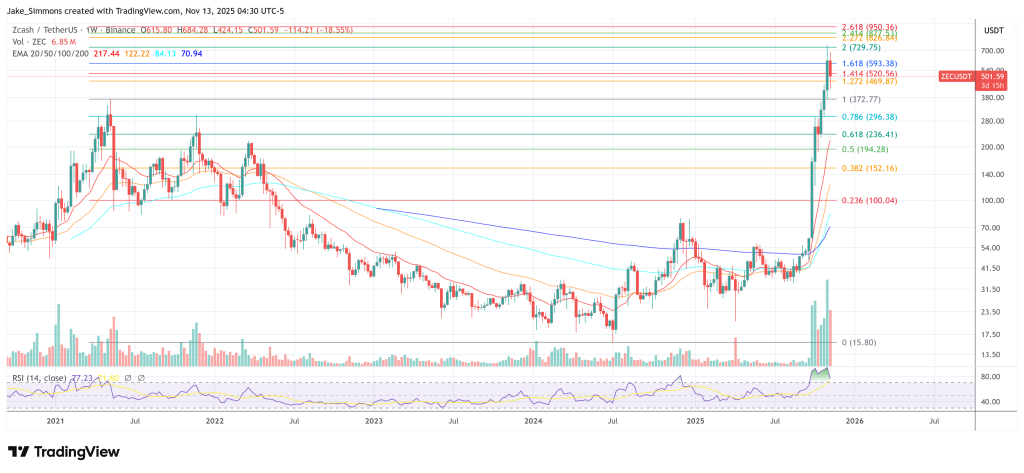
At press time, ZCash traded at $501.59.
Zcash price
Market Opportunity
Core DAO Logo
Core DAO Price(CORE)
$0.08249
$0.08249$0.08249
-5.36%
USD
Core DAO (CORE) Live Price Chart
Disclaimer: The articles reposted on this site are sourced from public platforms and are provided for informational purposes only. They do not necessarily reflect the views of MEXC. All rights remain with the original authors. If you believe any content infringes on third-party rights, please contact service@support.mexc.com for removal. MEXC makes no guarantees regarding the accuracy, completeness, or timeliness of the content and is not responsible for any actions taken based on the information provided. The content does not constitute financial, legal, or other professional advice, nor should it be considered a recommendation or endorsement by MEXC.

You May Also Like

Top Solana Treasury Firm Forward Industries Unveils $4 Billion Capital Raise To Buy More SOL ⋆ ZyCrypto

Top Solana Treasury Firm Forward Industries Unveils $4 Billion Capital Raise To Buy More SOL ⋆ ZyCrypto

The post Top Solana Treasury Firm Forward Industries Unveils $4 Billion Capital Raise To Buy More SOL ⋆ ZyCrypto appeared on BitcoinEthereumNews.com. Advertisement &nbsp &nbsp Forward Industries, the largest publicly traded Solana treasury company, has filed a $4 billion at-the-market (ATM) equity offering program with the U.S. SEC  to raise more capital for additional SOL accumulation. Forward Strategies Doubles Down On Solana Strategy In a Wednesday press release, Forward Industries revealed that the 4 billion ATM equity offering program will allow the company to issue and sell common stock via Cantor Fitzgerald under a sales agreement dated Sept. 16, 2025. Forward said proceeds will go toward “general corporate purposes,” including the pursuit of its Solana balance sheet and purchases of income-generating assets. The sales of the shares are covered by an automatic shelf registration statement filed with the US Securities and Exchange Commission that is already effective – meaning the shares will be tradable once they’re sold. An automatic shelf registration allows certain publicly listed companies to raise capital with flexibility swiftly.  Kyle Samani, Forward’s chairman, astutely described the ATM offering as “a flexible and efficient mechanism” to raise and deploy capital for the company’s Solana strategy and bolster its balance sheet.  Advertisement &nbsp Though the maximum amount is listed as $4 billion, the firm indicated that sales may or may not occur depending on existing market conditions. “The ATM Program enhances our ability to continue scaling that position, strengthen our balance sheet, and pursue growth initiatives in alignment with our long-term vision,” Samani said. Forward Industries kicked off its Solana treasury strategy on Sept. 8. The Wednesday S-3 form follows Forward’s $1.65 billion private investment in public equity that closed last week, led by crypto heavyweights like Galaxy Digital, Jump Crypto, and Multicoin Capital. The company started deploying that capital this week, announcing it snatched up 6.8 million SOL for approximately $1.58 billion at an average price of $232…
Share
BitcoinEthereumNews2025/09/18 03:42
USD/JPY Analysis: Resilient Yen Finds Crucial Support in Japanese Government Bond Dynamics – MUFG Insight

USD/JPY Analysis: Resilient Yen Finds Crucial Support in Japanese Government Bond Dynamics – MUFG Insight

BitcoinWorld USD/JPY Analysis: Resilient Yen Finds Crucial Support in Japanese Government Bond Dynamics – MUFG Insight TOKYO, March 2025 – The USD/JPY currency
Share
bitcoinworld2026/02/19 19:00
Japanese Bitcoin Giant Metaplanet Raises $1.4 Billion to Enter U.S. Market

Japanese Bitcoin Giant Metaplanet Raises $1.4 Billion to Enter U.S. Market

Metaplanet, Japan's largest corporate Bitcoin holder, has completed a massive $1.4 billion fundraising round and launched new subsidiaries in Miami and Tokyo. The Tokyo-listed company more than doubled its initial fundraising target, attracting major institutional investors including sovereign wealth funds.
Share
Brave Newcoin2025/09/18 05:15