Tether, the world’s largest player in the digital asset sector, has taken a deeper step into crypto-backed credit markets with a new investment in Ledn, one of the most established providers of Bitcoin-backed loans. The move comes during a renewed wave of activity across the lending sector, which has already surpassed $1 billion in loan originations this year and is now showing signs of a broader comeback after the severe collapse of 2022–2023. Ledn Crosses $2.8B in Bitcoin Loans as Crypto Lending Market Rebounds Ledn has originated more than $2.8 billion in Bitcoin-backed loans since launch, cementing its position as a major lender in the crypto credit market. https://twitter.com/tether_to/status/1990785750724382900 The company has already issued over $1 billion in 2025 alone, its strongest year on record, and nearly equaled its entire 2024 lending volume in the latest quarter with $392 million in Q3. Its annual recurring revenue now exceeds $100 million, showing growing demand from both retail and institutional borrowers seeking liquidity without selling their Bitcoin. Tether said the investment reflects its long-term vision of building financial infrastructure that allows users to unlock credit while continuing to hold their digital assets. Chief Executive Paolo Ardoino said the partnership strengthens the role of digital assets in real-world finance and supports self-custody models that many crypto users rely on. Ledn’s platform includes custodial safeguards, risk controls, and liquidation systems designed to protect users’ collateral throughout the life of each loan. The investment arrives as the Bitcoin-backed lending market begins to expand again. According to DataIntelo’s outlook, the broader crypto-collateralized credit segment is forecast to grow from $7.8 billion in 2024 to more than $60 billion by 2033. The sector already reached $90 billion in October and is currently at $65.87 billion.Source: DefiLlama Much of the industry’s recovery has been shaped by tighter risk practices after the failures of Celsius, Voyager, BlockFi, Genesis, and other lenders during the last bear market, a collapse driven by reckless lending, toxic collateral, and unsecured loans. Ledn’s decision to double down on Bitcoin-backed products is reinforced by this shift toward safer structures. Co-founder and CEO Adam Reeds said the company’s loan book is on track to nearly triple from 2024 levels, and that demand for Bitcoin financial services is rising quickly as investors seek more predictable forms of credit access across both centralized and decentralized platforms. Tether’s investment is also aligned with the company’s broader strategy of expanding its presence across global financial markets. In its latest attestation, prepared by BDO, Tether reported more than $10 billion in net profit for the year to date, along with $6.8 billion in excess reserves. The firm issued more than $17 billion in new USDT during Q3, lifting the stablecoin’s circulating supply above $174 billion. Tether’s exposure to U.S. Treasuries hit a record $135 billion, placing the company among the world’s largest foreign holders of U.S. debt. Lending Activity Reignites as Major Platforms Expand Services and Regulators Tighten Rules The lending sector as a whole is experiencing renewed movement. Crypto.com recently began integrating Morpho, the second-largest DeFi lending protocol, into its platform, enabling users to borrow stablecoins against wrapped Bitcoin and Ether directly on its Cronos chain. Morpho’s services, already holding over $7.7 billion in value, will be available even to U.S. users despite new restrictions on stablecoin yield payments under the GENIUS Act. Regulators are also adjusting to increased activity. South Korea introduced sweeping guidelines in September that cap lending rates at 20% annually and ban leveraged products that exceed collateral value. The rules follow concerns over aggressive lending programs at major exchanges, where firms had begun offering unusually high borrowing limits before authorities intervenedTether, the world’s largest player in the digital asset sector, has taken a deeper step into crypto-backed credit markets with a new investment in Ledn, one of the most established providers of Bitcoin-backed loans. The move comes during a renewed wave of activity across the lending sector, which has already surpassed $1 billion in loan originations this year and is now showing signs of a broader comeback after the severe collapse of 2022–2023. Ledn Crosses $2.8B in Bitcoin Loans as Crypto Lending Market Rebounds Ledn has originated more than $2.8 billion in Bitcoin-backed loans since launch, cementing its position as a major lender in the crypto credit market. https://twitter.com/tether_to/status/1990785750724382900 The company has already issued over $1 billion in 2025 alone, its strongest year on record, and nearly equaled its entire 2024 lending volume in the latest quarter with $392 million in Q3. Its annual recurring revenue now exceeds $100 million, showing growing demand from both retail and institutional borrowers seeking liquidity without selling their Bitcoin. Tether said the investment reflects its long-term vision of building financial infrastructure that allows users to unlock credit while continuing to hold their digital assets. Chief Executive Paolo Ardoino said the partnership strengthens the role of digital assets in real-world finance and supports self-custody models that many crypto users rely on. Ledn’s platform includes custodial safeguards, risk controls, and liquidation systems designed to protect users’ collateral throughout the life of each loan. The investment arrives as the Bitcoin-backed lending market begins to expand again. According to DataIntelo’s outlook, the broader crypto-collateralized credit segment is forecast to grow from $7.8 billion in 2024 to more than $60 billion by 2033. The sector already reached $90 billion in October and is currently at $65.87 billion.Source: DefiLlama Much of the industry’s recovery has been shaped by tighter risk practices after the failures of Celsius, Voyager, BlockFi, Genesis, and other lenders during the last bear market, a collapse driven by reckless lending, toxic collateral, and unsecured loans. Ledn’s decision to double down on Bitcoin-backed products is reinforced by this shift toward safer structures. Co-founder and CEO Adam Reeds said the company’s loan book is on track to nearly triple from 2024 levels, and that demand for Bitcoin financial services is rising quickly as investors seek more predictable forms of credit access across both centralized and decentralized platforms. Tether’s investment is also aligned with the company’s broader strategy of expanding its presence across global financial markets. In its latest attestation, prepared by BDO, Tether reported more than $10 billion in net profit for the year to date, along with $6.8 billion in excess reserves. The firm issued more than $17 billion in new USDT during Q3, lifting the stablecoin’s circulating supply above $174 billion. Tether’s exposure to U.S. Treasuries hit a record $135 billion, placing the company among the world’s largest foreign holders of U.S. debt. Lending Activity Reignites as Major Platforms Expand Services and Regulators Tighten Rules The lending sector as a whole is experiencing renewed movement. Crypto.com recently began integrating Morpho, the second-largest DeFi lending protocol, into its platform, enabling users to borrow stablecoins against wrapped Bitcoin and Ether directly on its Cronos chain. Morpho’s services, already holding over $7.7 billion in value, will be available even to U.S. users despite new restrictions on stablecoin yield payments under the GENIUS Act. Regulators are also adjusting to increased activity. South Korea introduced sweeping guidelines in September that cap lending rates at 20% annually and ban leveraged products that exceed collateral value. The rules follow concerns over aggressive lending programs at major exchanges, where firms had begun offering unusually high borrowing limits before authorities intervened

Tether Dives Into Bitcoin-Backed Lending as Market Soars Past $1B in Loans

2025/11/19 02:33
4 min read

Tether, the world’s largest player in the digital asset sector, has taken a deeper step into crypto-backed credit markets with a new investment in Ledn, one of the most established providers of Bitcoin-backed loans.

The move comes during a renewed wave of activity across the lending sector, which has already surpassed $1 billion in loan originations this year and is now showing signs of a broader comeback after the severe collapse of 2022–2023.

Ledn Crosses $2.8B in Bitcoin Loans as Crypto Lending Market Rebounds

Ledn has originated more than $2.8 billion in Bitcoin-backed loans since launch, cementing its position as a major lender in the crypto credit market.

https://twitter.com/tether_to/status/1990785750724382900

The company has already issued over $1 billion in 2025 alone, its strongest year on record, and nearly equaled its entire 2024 lending volume in the latest quarter with $392 million in Q3.

Its annual recurring revenue now exceeds $100 million, showing growing demand from both retail and institutional borrowers seeking liquidity without selling their Bitcoin.

Tether said the investment reflects its long-term vision of building financial infrastructure that allows users to unlock credit while continuing to hold their digital assets.

Chief Executive Paolo Ardoino said the partnership strengthens the role of digital assets in real-world finance and supports self-custody models that many crypto users rely on.

Ledn’s platform includes custodial safeguards, risk controls, and liquidation systems designed to protect users’ collateral throughout the life of each loan.

The investment arrives as the Bitcoin-backed lending market begins to expand again. According to DataIntelo’s outlook, the broader crypto-collateralized credit segment is forecast to grow from $7.8 billion in 2024 to more than $60 billion by 2033.

The sector already reached $90 billion in October and is currently at $65.87 billion.
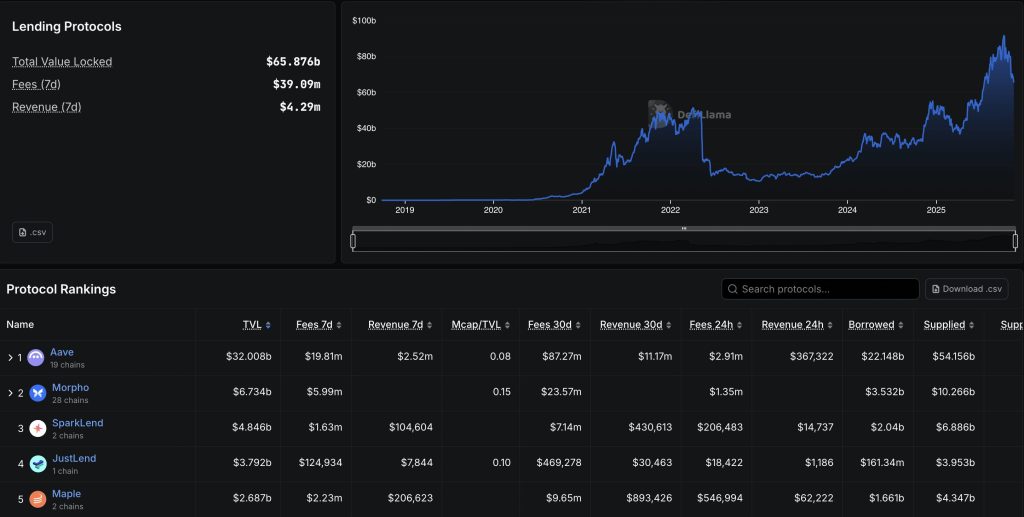
Source: DefiLlama

Much of the industry’s recovery has been shaped by tighter risk practices after the failures of Celsius, Voyager, BlockFi, Genesis, and other lenders during the last bear market, a collapse driven by reckless lending, toxic collateral, and unsecured loans.

Ledn’s decision to double down on Bitcoin-backed products is reinforced by this shift toward safer structures.

Co-founder and CEO Adam Reeds said the company’s loan book is on track to nearly triple from 2024 levels, and that demand for Bitcoin financial services is rising quickly as investors seek more predictable forms of credit access across both centralized and decentralized platforms.

Tether’s investment is also aligned with the company’s broader strategy of expanding its presence across global financial markets.

In its latest attestation, prepared by BDO, Tether reported more than $10 billion in net profit for the year to date, along with $6.8 billion in excess reserves.

The firm issued more than $17 billion in new USDT during Q3, lifting the stablecoin’s circulating supply above $174 billion. Tether’s exposure to U.S. Treasuries hit a record $135 billion, placing the company among the world’s largest foreign holders of U.S. debt.

Lending Activity Reignites as Major Platforms Expand Services and Regulators Tighten Rules

The lending sector as a whole is experiencing renewed movement.

Crypto.com recently began integrating Morpho, the second-largest DeFi lending protocol, into its platform, enabling users to borrow stablecoins against wrapped Bitcoin and Ether directly on its Cronos chain.

Morpho’s services, already holding over $7.7 billion in value, will be available even to U.S. users despite new restrictions on stablecoin yield payments under the GENIUS Act.

Regulators are also adjusting to increased activity. South Korea introduced sweeping guidelines in September that cap lending rates at 20% annually and ban leveraged products that exceed collateral value.

The rules follow concerns over aggressive lending programs at major exchanges, where firms had begun offering unusually high borrowing limits before authorities intervened.

Disclaimer: The articles reposted on this site are sourced from public platforms and are provided for informational purposes only. They do not necessarily reflect the views of MEXC. All rights remain with the original authors. If you believe any content infringes on third-party rights, please contact service@support.mexc.com for removal. MEXC makes no guarantees regarding the accuracy, completeness, or timeliness of the content and is not responsible for any actions taken based on the information provided. The content does not constitute financial, legal, or other professional advice, nor should it be considered a recommendation or endorsement by MEXC.

You May Also Like

First family moves on from Wall Street as Eric Trump backs crypto

First family moves on from Wall Street as Eric Trump backs crypto

Eric Trump says crypto could actually save the U.S. dollar. Not kill it. Not weaken it. On Tuesday, just hours after ringing the Nasdaq opening bell for American Bitcoin’s public debut, a company where he’s got over $500 million stashed, Eric told the Financial Times that crypto is “arguably” the reason the dollar might stay alive. “Mining bitcoin here, and being financially independent and running a kind of financial revolution out of the United States of America…I think it arguably saves the US dollar,” he said. The timing wasn’t random. Eric’s comments came while the dollar was getting dragged. This year, it’s been tanking… fast. The cause? President Donald Trump’s trade war and his endless public jabs at the Federal Reserve, which just slashed interest rates again. The Fed cut rates yesterday, for the first time this year, right after Donald’s latest round of pressure. It’s not helping. Investors are losing confidence in what’s supposed to be the safest currency on Earth. Eric says crypto is fun, family is done with Wall Street Eric isn’t just pushing crypto from the sidelines. His family has gone full throttle into the space. We’re talking a Truth Social Bitcoin ETF, a Bitcoin treasury tied to Trump Media, and two meme coins; $MELANIA and $TRUMP. Eric defended both coins, saying they were meant to be “fun,” and explained why people are buying in: “They want to bet on a coin, or they want to bet on a player. They want to bet on a celebrity, or they want to bet on a famous brand. Or they just love somebody to death, and they want to buy, you know, a kind of small piece of them, via digital currency.” And Eric doesn’t give Wall Street any credit. At all. He made it clear that everything they’ve built was done without the help of big-name banks. “It’s almost like the ultimate revenge against the big banks and modern finance,” he said. That jab came after the Trump Organization filed a lawsuit against Capital One, accusing the bank of closing their accounts in 2021 for political reasons — something the bank denies. But Eric wasn’t done. “You realise you just don’t need them. And frankly, you don’t miss them.” He added that he wasn’t just referring to Capital One, but “all” of Wall Street’s major lenders and their “top people.” Stablecoins, trillions, and the White House betting on crypto Stablecoins have traditional banks spooked. They think cash might flow out of the banking system if coins like Tether or Circle offer better returns. And that fear isn’t fake. It’s growing, especially after Congress passed the first major crypto law in July. Now the White House wants stablecoin issuers to buy up a fat slice of the Treasury’s debt. Why? Because these crypto firms make money on the interest from the bonds they hold. Last year, Eric co-founded World Liberty Financial Inc. (WLFI), a crypto company that runs a stablecoin called USD1, pegged to the U.S. dollar. That project has serious family backing. Donald held 15.75 billion WLFI tokens at the end of 2024, based on official filings. At Wednesday’s trading price, that holding was worth over $3 billion. When asked about the family’s financial gain from crypto, Eric downplayed it. “If my father cared about monetising his life, the last thing he would have done is run for president, where all we’ve done is un-monetise our life.” Your crypto news deserves attention - KEY Difference Wire puts you on 250+ top sites
Share
Coinstats2025/09/18 20:41
Ethereum Working Toward Quantum Resistance, Vitalik Buterin Teases

Ethereum Working Toward Quantum Resistance, Vitalik Buterin Teases

The post Ethereum Working Toward Quantum Resistance, Vitalik Buterin Teases appeared on BitcoinEthereumNews.com. Ethereum (ETH) founder Vitalik Buterin has shared his long-term plans for the blockchain. In a presentation delivered at the Japanese Developer Conference, Buterin provided insights into Ethereum’s current state and its future outlook. Vitalik Buterin on long-term focus Notably, Buterin broke down Ethereum’s development priorities into three phases, namely, the short term, the midterm and the long term. According to the blockchain’s founder, the vision is to build the most secure, future-proof network possible while keeping Ethereum simplified for users. Vitalik presented Ethereum’s roadmap at Japan Dev Conference today: short-term goals focus on scaling and increasing L1 gas limits; mid-term aims target cross-L2 interoperability and faster responsiveness; long-term vision emphasizes a secure, simple, quantum-resistant, and… — Wu Blockchain (@WuBlockchain) September 17, 2025 The long-term goal is to improve the overall security of Ethereum by making it withstand whatever threats might come from quantum computing. This indicates that security remains a core pillar of Ethereum’s improvement, given the numerous malicious attacks by hackers and scammers in the space. Buterin explained that Ethereum intends to use mathematical methods to verify the safety and accuracy of Ethereum’s code and protocols. However, while focusing on all of these, developers will ensure that Ethereum remains simple and all unnecessary complexities are eliminated. The ultimate goal is to ensure that Ethereum is more efficient and easier to maintain while not compromising the safety and security of users’ assets. In the short term, Buterin intends to make Ethereum improve transaction efficiency on the blockchain. It is also linked to its midterm goals of improving the speed of transactions, especially across layer-2 networks. Market reaction as Ethereum holds above $4,000 Earlier in July 2025, Vitalik Buterin had also shared ideas on how to improve layer-2 solutions and ensure success. He had suggested that relying on layer-1 offerings in terms of data,…
Share
BitcoinEthereumNews2025/09/18 16:03
Vitalik Buterin wants to build ‘the next generation of finance’ – Here’s how

Vitalik Buterin wants to build ‘the next generation of finance’ – Here’s how

The post Vitalik Buterin wants to build ‘the next generation of finance’ – Here’s how appeared on BitcoinEthereumNews.com. Journalist Posted: February 16, 2026
Share
BitcoinEthereumNews2026/02/16 11:01