What to Know: Bitcoin Hyper turns Bitcoin into a programmable, SVM-powered Layer 2, enabling low-latency BTC payments, DeFi, and gaming while anchoring security to Bitcoin. SUBBD leverages AI and Web3 to give creators lower fees, token-gated content, and crypto payouts, targeting the $85 billion content industry. Solana’s high throughput, low fees, and new US spot ETF support cement its role as a leading institutional-grade Layer‑1 blockchain. Bolivia’s reserve stress and banking pivot to digital assets underscore the growing demand for crypto infrastructure in the real world, rather than purely speculative tokens. A country’s financial stress often shows up in its policy decisions long before it appears in headlines. Bolivia’s reversal of its crypto ban and its move to let banks custody digital assets isn’t a quirky policy pivot. It’s what happens when foreign reserves fall from over $15B to roughly $2B. In such an environment, stablecoins and liquid crypto rails suddenly appear as essential survival tools. When a country with a long history of monetary controls starts legitimizing digital assets, it shows where macro pressure is heading. Capital wants neutral, censorship-resistant settlement layers. It also wants programmable money that can plug into banking pipes without IMF approval. That shift is why narrowing down the best crypto to buy means focusing on projects with real-world utility. Payment rails that can settle in BTC, high-throughput chains institutions can rely on, and creator-economy infrastructure all rise to the top. Against that backdrop, three plays stand out. Bitcoin Hyper ($HYPER) is emerging as a Bitcoin-native execution layer with near-Solana speeds. SUBBD ($SUBBD) is building AI-driven tools for creators, while a US spot ETF now backs Solana (SOL) and remains the institutional high-performance L1. Each taps into a concrete use case that becomes more valuable as countries like Bolivia rethink their financial plumbing. In markets where traditional tools fail, crypto infrastructure fills the gaps. That’s why these three assets sit at the center of the reshaping underway. 1. Bitcoin Hyper ($HYPER) — First SVM-Powered Bitcoin Layer 2 If Bolivia’s banks begin holding BTC, the next logical step is faster, programmable rails that still inherit Bitcoin’s security. Bitcoin Hyper positions itself precisely as the first Bitcoin Layer 2, running the Solana Virtual Machine (SVM). The goal is simple: Solana-level execution speed with Bitcoin-level trust. The design is modular. Bitcoin handles settlement, while a real-time SVM execution layer processes smart contracts and high-throughput workloads. A single sequencer currently manages ordering, with periodic state commitments anchoring everything back to Bitcoin. A Decentralized Canonical Bridge moves BTC between layers as wrapped assets. That setup enables high-speed payments, near-instant confirmations, and low fees, all powered by wrapped BTC. Developers can port SPL-style tokens, use Rust SDKs, and deploy Solana-style dApps without leaving Bitcoin’s trust model. On the capital side, the $HYPER presale has already raised over $28.6M, with tokens at $0.013345. That momentum has already fed into broader market modelling, with analysts mapping out where the ecosystem could trade once the network goes live. 📖 For a deeper breakdown of potential upside ranges, you can check our Bitcoin Hyper price prediction guide. Two high-net-worth wallets accumulated $396K recently, including a $53K buy. Staking opens right after TGE with high APY and a short seven-day presale vesting model. If you expect banks and emerging markets to route payments through Bitcoin over time, a Bitcoin-native SVM execution layer becomes a clear infrastructure play. You can learn more about Bitcoin Hyper or join the $HYPER presale directly. 2. SUBBD ($SUBBD) — AI + Web3 Stack for Creators Under Pressure Bolivia’s pivot is about financial survival, but creators are facing their own pressure as platform cuts rise and ad cycles tighten. SUBBD ($SUBBD) responds by merging AI and Web3 to give creators more control over distribution and monetization. The platform bundles AI Personal Assistants, AI Voice Cloning, and AI Influencer Creation into one toolkit. Creators can automate interactions and gate premium posts or communities behind token-based access that settles in crypto. This shift matters because programmable monetization lets a YouTuber in La Paz or a musician in Buenos Aires earn in crypto and keep ownership of their catalog. In regions dealing with FX friction and banking limits, that flexibility becomes real economic optionality. On the numbers, the SUBBD presale has raised over $1.3M, with tokens at $0.05705 and 20% first-year staking. That mix of AI tooling and on-chain monetization positions SUBBD as a targeted bet on the $85B creator economy moving into Web3. Explore the SUBBD presale today. 3. Solana ($SOL) — High-Throughput L1 Now Backed By a US Spot ETF You also want exposure to infrastructure that institutions can actually use. Solana ($SOL) has evolved from a ‘fast L1 experiment’ into a high-performance settlement layer with thousands of TPS and sub-cent fees. That performance profile matters as banks and corporates explore routing stablecoin payments or tokenized treasuries across public chains. Solana’s throughput and low fees give it real advantages for scalable payments, order books, and consumer apps. Its ecosystem has matured into one of the strongest in crypto. NFTs, DeFi, and consumer-grade applications now operate at scale without the bottlenecks seen on older networks. The shift became unmistakable when Bitwise launched the first US spot Solana ETF on October 28, 2025. It pulled in roughly $420M in the first week, signaling that institutions now treat SOL as investable infrastructure. For investors watching countries like Bolivia normalize digital assets, Solana offers liquid, battle-tested exposure to high-performance public chains. It also complements higher-beta presale plays by anchoring a broader conviction in scalable blockchain rails. Recap: As Bolivia’s reserves decline and banks adopt digital assets, structural demand shifts toward the real utility of these assets. Bitcoin Hyper, SUBBD, and Solana all align with this trend. Bitcoin Hyper targets BTC-native execution, SUBBD rewires creator monetization, and Solana anchors institutional-grade throughput, together forming a diversified way to front-run the next phase of adoption. This article is for informational purposes only and does not constitute financial, investment, or trading advice; always do your own research. Authored by Aaron Walker, NewsBTC – https://www.newsbtc.com/news/best-crypto-to-buy-bolivia-banks-digital-assetsWhat to Know: Bitcoin Hyper turns Bitcoin into a programmable, SVM-powered Layer 2, enabling low-latency BTC payments, DeFi, and gaming while anchoring security to Bitcoin. SUBBD leverages AI and Web3 to give creators lower fees, token-gated content, and crypto payouts, targeting the $85 billion content industry. Solana’s high throughput, low fees, and new US spot ETF support cement its role as a leading institutional-grade Layer‑1 blockchain. Bolivia’s reserve stress and banking pivot to digital assets underscore the growing demand for crypto infrastructure in the real world, rather than purely speculative tokens. A country’s financial stress often shows up in its policy decisions long before it appears in headlines. Bolivia’s reversal of its crypto ban and its move to let banks custody digital assets isn’t a quirky policy pivot. It’s what happens when foreign reserves fall from over $15B to roughly $2B. In such an environment, stablecoins and liquid crypto rails suddenly appear as essential survival tools. When a country with a long history of monetary controls starts legitimizing digital assets, it shows where macro pressure is heading. Capital wants neutral, censorship-resistant settlement layers. It also wants programmable money that can plug into banking pipes without IMF approval. That shift is why narrowing down the best crypto to buy means focusing on projects with real-world utility. Payment rails that can settle in BTC, high-throughput chains institutions can rely on, and creator-economy infrastructure all rise to the top. Against that backdrop, three plays stand out. Bitcoin Hyper ($HYPER) is emerging as a Bitcoin-native execution layer with near-Solana speeds. SUBBD ($SUBBD) is building AI-driven tools for creators, while a US spot ETF now backs Solana (SOL) and remains the institutional high-performance L1. Each taps into a concrete use case that becomes more valuable as countries like Bolivia rethink their financial plumbing. In markets where traditional tools fail, crypto infrastructure fills the gaps. That’s why these three assets sit at the center of the reshaping underway. 1. Bitcoin Hyper ($HYPER) — First SVM-Powered Bitcoin Layer 2 If Bolivia’s banks begin holding BTC, the next logical step is faster, programmable rails that still inherit Bitcoin’s security. Bitcoin Hyper positions itself precisely as the first Bitcoin Layer 2, running the Solana Virtual Machine (SVM). The goal is simple: Solana-level execution speed with Bitcoin-level trust. The design is modular. Bitcoin handles settlement, while a real-time SVM execution layer processes smart contracts and high-throughput workloads. A single sequencer currently manages ordering, with periodic state commitments anchoring everything back to Bitcoin. A Decentralized Canonical Bridge moves BTC between layers as wrapped assets. That setup enables high-speed payments, near-instant confirmations, and low fees, all powered by wrapped BTC. Developers can port SPL-style tokens, use Rust SDKs, and deploy Solana-style dApps without leaving Bitcoin’s trust model. On the capital side, the $HYPER presale has already raised over $28.6M, with tokens at $0.013345. That momentum has already fed into broader market modelling, with analysts mapping out where the ecosystem could trade once the network goes live. 📖 For a deeper breakdown of potential upside ranges, you can check our Bitcoin Hyper price prediction guide. Two high-net-worth wallets accumulated $396K recently, including a $53K buy. Staking opens right after TGE with high APY and a short seven-day presale vesting model. If you expect banks and emerging markets to route payments through Bitcoin over time, a Bitcoin-native SVM execution layer becomes a clear infrastructure play. You can learn more about Bitcoin Hyper or join the $HYPER presale directly. 2. SUBBD ($SUBBD) — AI + Web3 Stack for Creators Under Pressure Bolivia’s pivot is about financial survival, but creators are facing their own pressure as platform cuts rise and ad cycles tighten. SUBBD ($SUBBD) responds by merging AI and Web3 to give creators more control over distribution and monetization. The platform bundles AI Personal Assistants, AI Voice Cloning, and AI Influencer Creation into one toolkit. Creators can automate interactions and gate premium posts or communities behind token-based access that settles in crypto. This shift matters because programmable monetization lets a YouTuber in La Paz or a musician in Buenos Aires earn in crypto and keep ownership of their catalog. In regions dealing with FX friction and banking limits, that flexibility becomes real economic optionality. On the numbers, the SUBBD presale has raised over $1.3M, with tokens at $0.05705 and 20% first-year staking. That mix of AI tooling and on-chain monetization positions SUBBD as a targeted bet on the $85B creator economy moving into Web3. Explore the SUBBD presale today. 3. Solana ($SOL) — High-Throughput L1 Now Backed By a US Spot ETF You also want exposure to infrastructure that institutions can actually use. Solana ($SOL) has evolved from a ‘fast L1 experiment’ into a high-performance settlement layer with thousands of TPS and sub-cent fees. That performance profile matters as banks and corporates explore routing stablecoin payments or tokenized treasuries across public chains. Solana’s throughput and low fees give it real advantages for scalable payments, order books, and consumer apps. Its ecosystem has matured into one of the strongest in crypto. NFTs, DeFi, and consumer-grade applications now operate at scale without the bottlenecks seen on older networks. The shift became unmistakable when Bitwise launched the first US spot Solana ETF on October 28, 2025. It pulled in roughly $420M in the first week, signaling that institutions now treat SOL as investable infrastructure. For investors watching countries like Bolivia normalize digital assets, Solana offers liquid, battle-tested exposure to high-performance public chains. It also complements higher-beta presale plays by anchoring a broader conviction in scalable blockchain rails. Recap: As Bolivia’s reserves decline and banks adopt digital assets, structural demand shifts toward the real utility of these assets. Bitcoin Hyper, SUBBD, and Solana all align with this trend. Bitcoin Hyper targets BTC-native execution, SUBBD rewires creator monetization, and Solana anchors institutional-grade throughput, together forming a diversified way to front-run the next phase of adoption. This article is for informational purposes only and does not constitute financial, investment, or trading advice; always do your own research. Authored by Aaron Walker, NewsBTC – https://www.newsbtc.com/news/best-crypto-to-buy-bolivia-banks-digital-assets

Best Crypto To Buy As Bolivia’s Reserves Fall From $15B To $2B And Banks Embrace Digital Assets

2025/11/28 19:53
6 min read

What to Know:

  • Bitcoin Hyper turns Bitcoin into a programmable, SVM-powered Layer 2, enabling low-latency BTC payments, DeFi, and gaming while anchoring security to Bitcoin.
  • SUBBD leverages AI and Web3 to give creators lower fees, token-gated content, and crypto payouts, targeting the $85 billion content industry.
  • Solana’s high throughput, low fees, and new US spot ETF support cement its role as a leading institutional-grade Layer‑1 blockchain.
  • Bolivia’s reserve stress and banking pivot to digital assets underscore the growing demand for crypto infrastructure in the real world, rather than purely speculative tokens.

A country’s financial stress often shows up in its policy decisions long before it appears in headlines.

Bolivia’s reversal of its crypto ban and its move to let banks custody digital assets isn’t a quirky policy pivot. It’s what happens when foreign reserves fall from over $15B to roughly $2B. In such an environment, stablecoins and liquid crypto rails suddenly appear as essential survival tools.

When a country with a long history of monetary controls starts legitimizing digital assets, it shows where macro pressure is heading. Capital wants neutral, censorship-resistant settlement layers. It also wants programmable money that can plug into banking pipes without IMF approval.

Bolivia Crypto Ban Reversal

That shift is why narrowing down the best crypto to buy means focusing on projects with real-world utility. Payment rails that can settle in BTC, high-throughput chains institutions can rely on, and creator-economy infrastructure all rise to the top.

Against that backdrop, three plays stand out. Bitcoin Hyper ($HYPER) is emerging as a Bitcoin-native execution layer with near-Solana speeds. SUBBD ($SUBBD) is building AI-driven tools for creators, while a US spot ETF now backs Solana (SOL) and remains the institutional high-performance L1.

Each taps into a concrete use case that becomes more valuable as countries like Bolivia rethink their financial plumbing. In markets where traditional tools fail, crypto infrastructure fills the gaps. That’s why these three assets sit at the center of the reshaping underway.

1. Bitcoin Hyper ($HYPER) — First SVM-Powered Bitcoin Layer 2

If Bolivia’s banks begin holding BTC, the next logical step is faster, programmable rails that still inherit Bitcoin’s security. Bitcoin Hyper positions itself precisely as the first Bitcoin Layer 2, running the Solana Virtual Machine (SVM). The goal is simple: Solana-level execution speed with Bitcoin-level trust.

The design is modular. Bitcoin handles settlement, while a real-time SVM execution layer processes smart contracts and high-throughput workloads. A single sequencer currently manages ordering, with periodic state commitments anchoring everything back to Bitcoin.

A Decentralized Canonical Bridge moves BTC between layers as wrapped assets. That setup enables high-speed payments, near-instant confirmations, and low fees, all powered by wrapped BTC. Developers can port SPL-style tokens, use Rust SDKs, and deploy Solana-style dApps without leaving Bitcoin’s trust model.

On the capital side, the $HYPER presale has already raised over $28.6M, with tokens at $0.013345. That momentum has already fed into broader market modelling, with analysts mapping out where the ecosystem could trade once the network goes live.

📖 For a deeper breakdown of potential upside ranges, you can check our Bitcoin Hyper price prediction guide.

Two high-net-worth wallets accumulated $396K recently, including a $53K buy. Staking opens right after TGE with high APY and a short seven-day presale vesting model.

If you expect banks and emerging markets to route payments through Bitcoin over time, a Bitcoin-native SVM execution layer becomes a clear infrastructure play.

You can learn more about Bitcoin Hyper or join the $HYPER presale directly.

2. SUBBD ($SUBBD) — AI + Web3 Stack for Creators Under Pressure

Bolivia’s pivot is about financial survival, but creators are facing their own pressure as platform cuts rise and ad cycles tighten. SUBBD ($SUBBD) responds by merging AI and Web3 to give creators more control over distribution and monetization.

The platform bundles AI Personal Assistants, AI Voice Cloning, and AI Influencer Creation into one toolkit. Creators can automate interactions and gate premium posts or communities behind token-based access that settles in crypto.

This shift matters because programmable monetization lets a YouTuber in La Paz or a musician in Buenos Aires earn in crypto and keep ownership of their catalog. In regions dealing with FX friction and banking limits, that flexibility becomes real economic optionality.

On the numbers, the SUBBD presale has raised over $1.3M, with tokens at $0.05705 and 20% first-year staking. That mix of AI tooling and on-chain monetization positions SUBBD as a targeted bet on the $85B creator economy moving into Web3.

Explore the SUBBD presale today.

3. Solana ($SOL) — High-Throughput L1 Now Backed By a US Spot ETF

You also want exposure to infrastructure that institutions can actually use. Solana ($SOL) has evolved from a ‘fast L1 experiment’ into a high-performance settlement layer with thousands of TPS and sub-cent fees.

That performance profile matters as banks and corporates explore routing stablecoin payments or tokenized treasuries across public chains. Solana’s throughput and low fees give it real advantages for scalable payments, order books, and consumer apps.
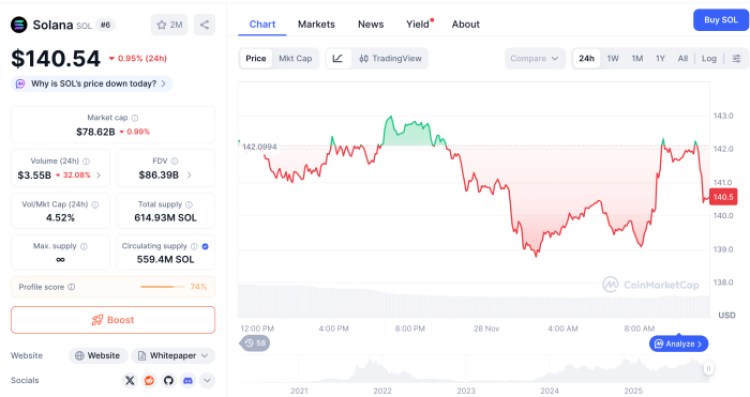
Solana price today CoinMarketCap

Its ecosystem has matured into one of the strongest in crypto. NFTs, DeFi, and consumer-grade applications now operate at scale without the bottlenecks seen on older networks.

The shift became unmistakable when Bitwise launched the first US spot Solana ETF on October 28, 2025. It pulled in roughly $420M in the first week, signaling that institutions now treat SOL as investable infrastructure.

For investors watching countries like Bolivia normalize digital assets, Solana offers liquid, battle-tested exposure to high-performance public chains. It also complements higher-beta presale plays by anchoring a broader conviction in scalable blockchain rails.

Recap: As Bolivia’s reserves decline and banks adopt digital assets, structural demand shifts toward the real utility of these assets. Bitcoin Hyper, SUBBD, and Solana all align with this trend. Bitcoin Hyper targets BTC-native execution, SUBBD rewires creator monetization, and Solana anchors institutional-grade throughput, together forming a diversified way to front-run the next phase of adoption.

This article is for informational purposes only and does not constitute financial, investment, or trading advice; always do your own research.

Authored by Aaron Walker, NewsBTC – https://www.newsbtc.com/news/best-crypto-to-buy-bolivia-banks-digital-assets

Market Opportunity
Best Wallet Logo
Best Wallet Price(BEST)
$0.001431
$0.001431$0.001431
+0.13%
USD
Best Wallet (BEST) Live Price Chart
Disclaimer: The articles reposted on this site are sourced from public platforms and are provided for informational purposes only. They do not necessarily reflect the views of MEXC. All rights remain with the original authors. If you believe any content infringes on third-party rights, please contact service@support.mexc.com for removal. MEXC makes no guarantees regarding the accuracy, completeness, or timeliness of the content and is not responsible for any actions taken based on the information provided. The content does not constitute financial, legal, or other professional advice, nor should it be considered a recommendation or endorsement by MEXC.

You May Also Like

Let insiders trade – Blockworks
Let insiders trade – Blockworks

The post Let insiders trade – Blockworks appeared on BitcoinEthereumNews.com. This is a segment from The Breakdown newsletter. To read more editions, subscribe ​​“The most valuable commodity I know of is information.” — Gordon Gekko, Wall Street Ten months ago, FBI agents raided Shayne Coplan’s Manhattan apartment, ostensibly in search of evidence that the prediction market he founded, Polymarket, had illegally allowed US residents to place bets on the US election. Two weeks ago, the CFTC gave Polymarket the green light to allow those very same US residents to place bets on whatever they like. This is quite the turn of events — and it’s not just about elections or politics. With its US government seal of approval in hand, Polymarket is reportedly raising capital at a valuation of $9 billion — a reflection of the growing belief that prediction markets will be used for much more than betting on elections once every four years. Instead, proponents say prediction markets can provide a real service to the world by providing it with better information about nearly everything. I think they might, too — but only if insiders are free to participate. Yesterday, for example, Polymarket announced new betting markets on company earnings reports, with a promise that it would improve the information that investors have to work with.  Instead of waiting three months to find out how a company is faring, investors could simply watch the odds on Polymarket.  If the probability of an earnings beat is rising, for example, investors would know at a glance that things are going well. But that will only happen if enough of the people betting actually know how things are going. Relying on the wisdom of crowds to magically discern how a business is doing won’t add much incremental knowledge to the world; everyone’s guesses are unlikely to average out to the truth. If…
Share
BitcoinEthereumNews2025/09/18 05:16
Morning Crypto Report: 'I Am Capitulating': What's Vitalik Buterin Talking About? Bitcoin Quantum Threat Drama Gets 20,000 BTC Twist, Cardano out of Top 10 as Bitcoin Cash Wins Back 25% of BCH Price

Morning Crypto Report: 'I Am Capitulating': What's Vitalik Buterin Talking About? Bitcoin Quantum Threat Drama Gets 20,000 BTC Twist, Cardano out of Top 10 as Bitcoin Cash Wins Back 25% of BCH Price

February 8, Sunday: Buterin says he is "capitulating" as X naming drama spills into the crypto market, Bitcoin's quantum threat adds a 20,000 BTC angle and Bitcoin
Share
Coinstats2026/02/08 21:51
Pi Network Users Criticize Core Team After Celebratory Post

Pi Network Users Criticize Core Team After Celebratory Post

The post Pi Network Users Criticize Core Team After Celebratory Post appeared on BitcoinEthereumNews.com. Home » Crypto Bits The first Friday of February was supposed
Share
BitcoinEthereumNews2026/02/08 22:11