Cardano is entering a very important phase in its development, as its founding institutions are attempting to deliver the core infrastructure that every major blockchain already treats as standard. On Nov. 27, a new proposal sought community approval to allocate 70 million ADA tokens (worth about $30 million) to onboard tier-one stablecoins, custody providers, cross-chain […] The post Cardano to finally turn passive ADA holders into real DeFi participants with $30M liquidity push appeared first on CryptoSlate.Cardano is entering a very important phase in its development, as its founding institutions are attempting to deliver the core infrastructure that every major blockchain already treats as standard. On Nov. 27, a new proposal sought community approval to allocate 70 million ADA tokens (worth about $30 million) to onboard tier-one stablecoins, custody providers, cross-chain […] The post Cardano to finally turn passive ADA holders into real DeFi participants with $30M liquidity push appeared first on CryptoSlate.

Cardano to finally turn passive ADA holders into real DeFi participants with $30M liquidity push

4 min read

Cardano is entering a very important phase in its development, as its founding institutions are attempting to deliver the core infrastructure that every major blockchain already treats as standard.

On Nov. 27, a new proposal sought community approval to allocate 70 million ADA tokens (worth about $30 million) to onboard tier-one stablecoins, custody providers, cross-chain bridges, pricing oracles, and institutional analytics.

The effort is backed jointly by Input Output, EMURGO, the Cardano Foundation, Intersect, and the Midnight Foundation, an unusually coordinated coalition for a network often criticized for slow alignment and decentralized drift.

The central message behind this collaboration is unmistakable: Cardano wants to enter 2026 with the economic plumbing it has lacked for years.

Why the Cardano pivot matters

The integrations push arrives at a moment when Cardano’s economic base is still relatively shallow.

For context, DefiLlama data shows that the Charles Hoskinson-led network has about $248 million in TVL and roughly $40 million in stablecoins, as well as a limited pool for lending, liquidity provision, and RWA issuance compared with ecosystems that treat these assets as foundational utilities.

Cardano's DeFi Screengrab showing Cardano’s key DeFi metrics on Nov. 29, 2025 (Source: DeFiLlama)

In comparison, Ethereum alone carries more than $170 billion in stablecoins, reflecting the scale gap Cardano is trying to close.

So, without deep stablecoin reserves, liquidity pathways, or institutional tooling, Cardano would continue to struggle to generate the network effects that make a blockchain economically relevant.

The network’s fragility came into focus earlier this month when it experienced a brief chain split.

While the disruption was resolved quickly, it intensified scrutiny on Cardano’s operational maturity, particularly its limited real-time analytics, monitoring, and other safeguards expected in institutional-grade environments.

The budget set up for the integration aims to systematize the onboarding of top-tier vendors, including milestones, audits, service-level agreements, and transparent delivery tracking.

So, instead of one-off deals or ad hoc negotiations, supporters say the fund would create a formal, accountable pipeline for onboarding the infrastructure Cardano has historically lacked. Tim Harrison, a director at Input Outputs, said:

Why these integrations might not be sufficient for Cardano

The integrations push comes after Hoskinson had spoken about what truly limits Cardano’s DeFi growth.

Last month, the Cardano founder acknowledged the network’s DeFi gap but pushed back against the notion that landing USDC, USDT, or other fiat-backed stablecoins would “magically” transform adoption.

According to him:

Instead, he points to a behavioral bottleneck by noting that millions of ADA holders participate in staking and governance, but few make the leap into DeFi. He also added that the network faces coordination and accountability challenges.

Hoskinson argued that this creates a classic chicken-and-egg problem, in which the network’s current low liquidity discourages integrations, and the lack of integrations keeps liquidity low.

Considering this, Hoskinson’s roadmap ties the network DeFi growth to Bitcoin interoperability and the Midnight privacy network. He believes these integrations could channel “billions” in volume into Cardano-native stablecoins and lending protocols if executed well.

That framing matters for the new budget.

If the challenge Cardano is facing is organizational, stemming from fragmented efforts, slow vendor onboarding, and the absence of a structured pathway for stablecoins and custody providers, then a community-mandated integrations program could provide the governance mechanism the ecosystem lacks.

However, even with a coordinated onboarding framework, the budget will only shift outcomes if it ultimately mobilizes passive ADA holders into active liquidity and attracts issuers with market makers willing to support real volume.

The 2026 stress test

Next year will test whether Cardano’s governance and new vendor pipeline can translate its integrations budget into measurable economic growth.

So, if even one major fiat-backed stablecoin arrives with market-maker depth, Cardano’s $40 million stablecoin base could plausibly expand into the low-hundreds-of-millions, a range consistent with early adoption phases on other L1s.

Moreover, Cardano’s $248 million DeFi TVL could reach $500 million if the network secures credible custody and analytics platforms. Notably, this is a level at which lending, RWAs, and liquidity routing begin to compound rather than stall.

Also, bridges, pricing oracles, and institutional wallets remain significant integrations necessary for the network’s growth.

Without them, liquidity will continue to circulate elsewhere. With them, Cardano enters 2026 with the minimum infrastructure required to compete for regulated DeFi pilots, RWA issuance, and BTC–ADA liquidity flows tied to its Bitcoin interoperability roadmap.

The post Cardano to finally turn passive ADA holders into real DeFi participants with $30M liquidity push appeared first on CryptoSlate.

Market Opportunity
RealLink Logo
RealLink Price(REAL)
$0.0587
$0.0587$0.0587
-2.42%
USD
RealLink (REAL) Live Price Chart
Disclaimer: The articles reposted on this site are sourced from public platforms and are provided for informational purposes only. They do not necessarily reflect the views of MEXC. All rights remain with the original authors. If you believe any content infringes on third-party rights, please contact service@support.mexc.com for removal. MEXC makes no guarantees regarding the accuracy, completeness, or timeliness of the content and is not responsible for any actions taken based on the information provided. The content does not constitute financial, legal, or other professional advice, nor should it be considered a recommendation or endorsement by MEXC.

You May Also Like

Three dormant wallets, suspected to belong to the same entity, purchased 5,970 ETH eight hours ago.
Three dormant wallets, suspected to belong to the same entity, purchased 5,970 ETH eight hours ago.

PANews reported on February 4 that, according to Lookonchain monitoring, three wallets that had been dormant for four years (likely controlled by the same entity
Share
PANews2026/02/04 11:36
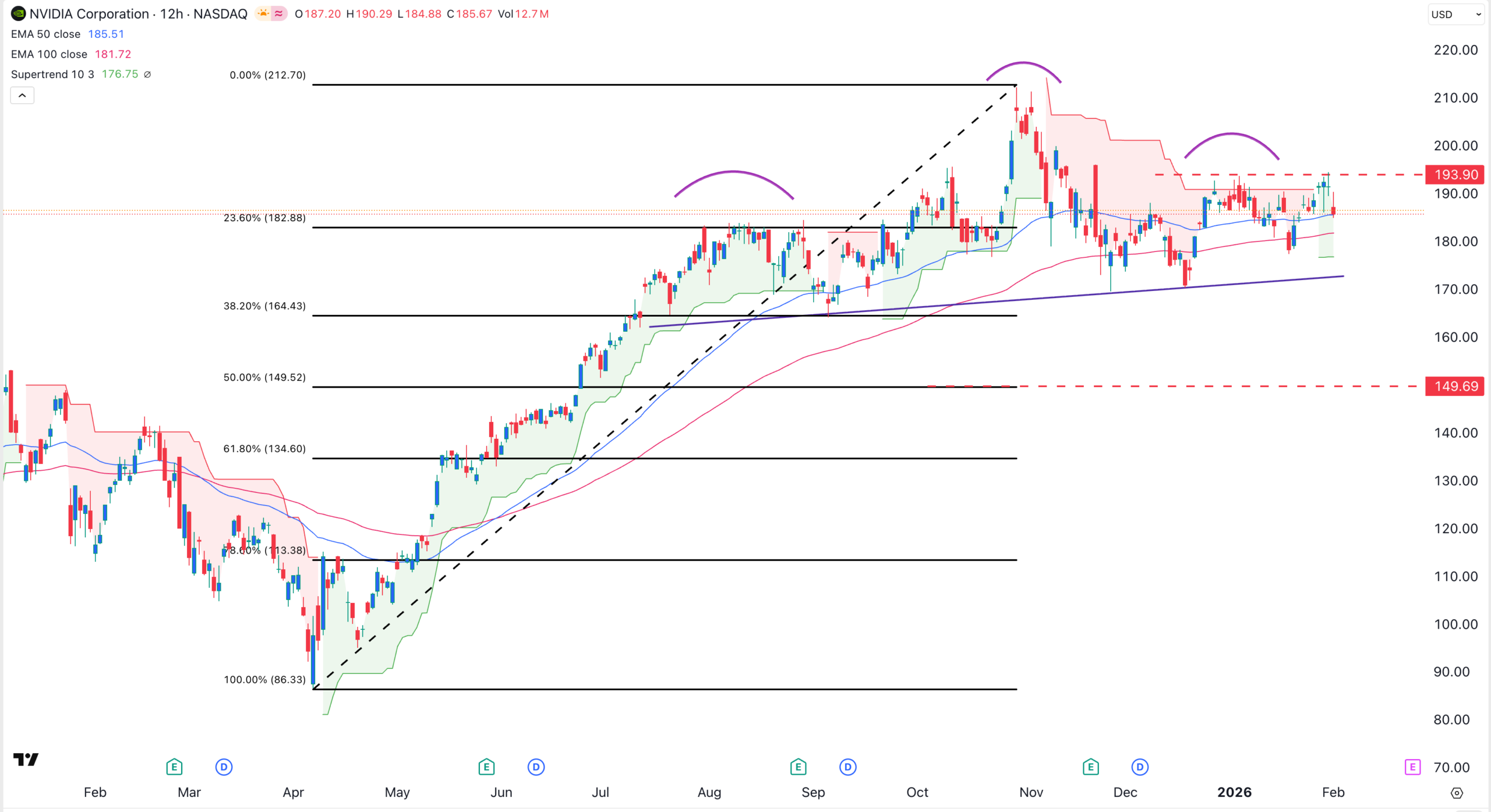
NVIDIA Stock Price Analysis as OpenAI Issues Concerns About its Chips

NVIDIA Stock Price Analysis as OpenAI Issues Concerns About its Chips

Key Insights NVIDIA stock started the week in the red. It crashed by over 2%. Meanwhile, the S&P 500, Dow Jones, and Nasdaq 100 moved close to their all-time highs
Share
Themarketperiodical2026/02/04 11:27
Ondo Finance Launches USDY Yieldcoin on Stellar, Bringing Tokenized U.S. Treasuries to Users

Ondo Finance Launches USDY Yieldcoin on Stellar, Bringing Tokenized U.S. Treasuries to Users

Ondo Finance, a U.S.-based digital asset firm specializing in bringing traditional financial products on-chain through tokenization, is expanding its yieldcoin USDY to the Stellar network. This lates update marks a step forward in merging tokenized real-world assets with a global payments infrastructure, unlocking new opportunities for users worldwide. The announcement was made at the Stellar Meridian event in Copacabana, Rio de Janeiro, on September 17. USDY Joins the Stellar Ecosystem Ondo Finance, a recognized leader in tokenized real-world assets, announced the deployment of United States Dollar Yield (USDY) on Stellar, the payments-focused blockchain known for speed and low transaction costs. USDY is the most widely available “yieldcoin,” offering investors access to onchain assets backed by U.S. Treasuries. This launch allows Stellar’s global user base to tap into permissionless, yield-bearing assets tied to one of the safest financial instruments in the world. It also aligns with Stellar’s mission of driving fast, affordable cross-border payments. Combining Yield with Payments Infrastructure “Stablecoins unlocked global access to the U.S. dollar. With USDY, we’re taking the next step by bringing U.S. Treasuries onchain in a form that combines stability, liquidity, and yield,” said Ian De Bode, Chief Strategy Officer at Ondo Finance. “Fast, affordable cross-border payments are at the center of what Stellar was designed to do. The global reach of the Stellar ecosystem combined with a yield-bearing asset like USDY levels up what is possible onchain, allowing wallets and businesses to offer yield opportunities to their users,” said Denelle Dixon, CEO of the Stellar Development Foundation. Ondo claims by pairing USDY with Stellar’s infrastructure, new possibilities open up in treasury management, collateralization, and everyday financial applications. Unlocking Institutional and Retail Use Cases USDY currently manages over $650 million in total value locked (TVL) across nine blockchains and offers a 5.3% APY. By launching on Stellar, Ondo Finance extends these benefits to global retail and institutional users. The firm explains balances on Stellar can now become productive, supporting use cases such as onchain savings, institutional treasury strategies, cost-efficient collateral for DeFi protocols, and remittance flows that carry yield rather than remaining static. A Milestone for Tokenized Treasuries With the integration of USDY, Stellar users gain more than just access to stable-value assets—they gain access to institutional-grade yield. For investors outside the U.S., the launch represents a new way to combine the safety of Treasuries with the accessibility of blockchain technology. As tokenization accelerates globally, Ondo Finance’s decision to deploy USDY on Stellar reinforces the narrative that blockchain is not just about speculation, but about reimagining the global financial system through secure, yield-bearing digital assets
Share
CryptoNews2025/09/18 00:46
