

Ripple CEO Predicts 2026 Will Be A Breakout Year For Crypto
At Binance Blockchain Week on December 3, Ripple Labs CEO Brad Garlinghouse argued that a rare alignment of regulatory change, institutional demand and real-world utility is setting up crypto for what he called powerful “macro tailwinds” heading into 2026.
“I personally will echo some of the things Richard said: there are so many macro factors that are continuing to provide tailwinds for this industry that I think as we go into 2026 I don’t remember being this optimistic in the last handful of years,” the Ripple CEO told CNBC’s Dan Murphy, speaking alongside Binance CEO Richard Teng and Solana Foundation President Lily Liu.
Ripple CEO Is Optimistic For 2026: Here’s Why
He framed the latest drawdown not as the start of a structural bear market but as a risk-off interlude against a fundamentally improved backdrop. “Crypto has gone through cycles and when you have risk-on people are excited […] now you have kind of a risk-off moment, there’s uncertainty,” he said. The difference this time, he argued, is that the United States—the largest single economy and roughly “22% of global GDP”—is finally moving away from what he described as years of open hostility toward the sector.
“This is a market that has been really openly hostile to crypto for four or five years or maybe longer, and now you have that that has changed significantly, pretty quickly,” he said. Institutions, in his view, are only beginning to adjust. He pointed to the visible presence of traditional asset managers at the event: “You saw Franklin Templeton on stage here, you saw BlackRock on stage just this week. I think Vanguard has now opened up […] Vanguard historically has said ‘we won’t touch crypto’ and now they’ve had a massive sea change.”
On crypto ETFs, the Ripple CEO rejected the idea that the trade was over-hyped. “Definitely no,” he said when asked whether the ETF “floor” narrative had been exaggerated. He stressed how new these vehicles still are in the United States and highlighted early demand for XRP products. “In the last two or three weeks over $700 million have flowed into XRP ETFs, which is just pent-up demand from institutional investors, from investors who want access because they don’t want to custody themselves,” he said.
He argued that the key metric is crypto’s still-small slice of the overall ETF universe. “The total ETF market—only one or two percent of the total ETF market is crypto. I will bet anybody here that a year from now that will be more than one or two percent,” he said. Short-term outflows from Bitcoin products, he suggested, should be viewed in context: “Over 2026 do we really think crypto ETFs are only going to be one or two percent of the total ETF market? No chance.”
Garlinghouse said Ripple’s own prime brokerage business is already seeing that shift in behavior. Institutions that had remained “on the sidelines” due to regulatory uncertainty or risk aversion are now “getting involved and they’re starting small, and they’re going to walk, then they’re going to crawl—or crawl then walk then run.” Asked directly whether recent volatility had deterred institutional capital, he replied: “Definitely not.”
Stablecoins Will Be A Key Pillar
Stablecoins were another pillar of his 2026 thesis. He agreed that in the latest risk-off phase, capital largely rotated into stablecoins rather than exiting on-chain rails, which he said reflects both utility and trust. “People are recognizing stablecoins can be stable and easier to manage,” he said.
Garlinghouse highlighted that Ripple’s own stablecoin, launched “just over a year ago,” has “just passed about a billion market cap,” is “approved and whitelisted in Abu Dhabi,” and is being used as “good collateral on various platforms from a lending point of view.” For him, stablecoins are an entry ramp to broader adoption, alongside other applications that will be built across Solana, Binance and Ripple ecosystems.
On US policy, he said the trajectory has clearly improved, especially for payment tokens. He cited the GENIUS Act as “regulatory clarity for stablecoins” and linked it to growing corporate interest in on-chain payments. After Ripple’s acquisition of GTreasury, which has visibility into “over 10 trillion dollars of payments,” he said “the number of those customers that are already approaching us interested in leveraging stablecoins […] because of that clarity, people are leaning in.”
The Ripple CEO noted that XRP has already received a form of clarity from US federal courts but said broader legislation is still needed. He referenced the “Clarity Act” for crypto, saying there is “still forward momentum” and predicting that “sometime in the first half of next year we’ll see passage of legislation, which will continue to unlock and create more tailwinds for the whole industry.”
He closed with an explicit price target for the next cycle, acknowledging he was “going out on a limb”: “I’ll say Bitcoin $180,000 December 23rd—or December 31st—2026.”
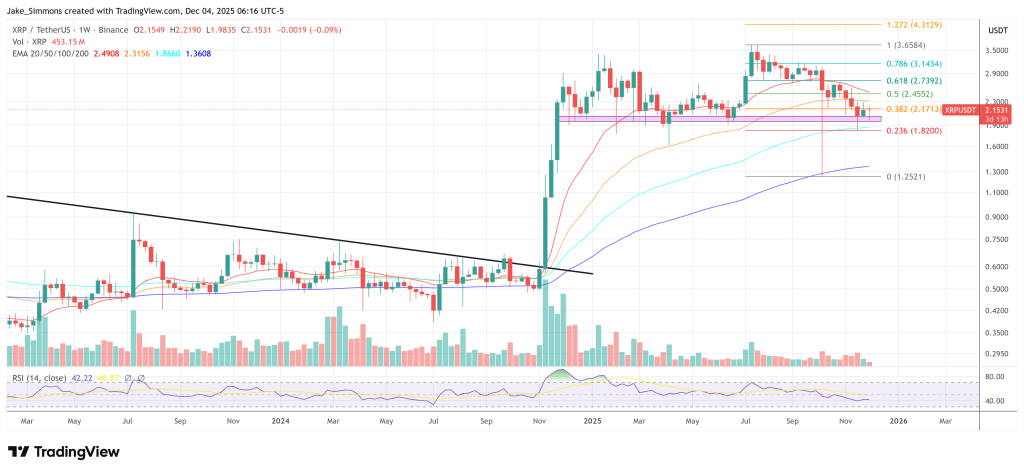
At press time, XRP traded at $2.15.
You May Also Like

Protectt.ai Launches New Version of Its AI & Behaviour-Driven Mobile App Security Platform, AppProtectt, in Dubai

Wormhole Unleashes W 2.0 Tokenomics for a Connected Blockchain Future
