Modern messaging apps are protocol based, which is why we need a Universal Messaging Highway (UMH) that abstracts platform complexities. The UMH acts as a platform agnostic communication interface designed to bridge the gap between disparate messaging ecosystems.Modern messaging apps are protocol based, which is why we need a Universal Messaging Highway (UMH) that abstracts platform complexities. The UMH acts as a platform agnostic communication interface designed to bridge the gap between disparate messaging ecosystems.

Building the "TCP/IP" of Modern Messaging: Architecting a Universal Communication Highway

2025/12/05 18:20

We have a paradox: We are more connected than ever, yet our communication is more fragmented than ever.

If I want to send a file to a colleague, I have to remember: "Do they use WhatsApp? Slack? Signal? Or was it Teams?" Unlike Email (SMTP), which is a protocol, modern messaging apps are walled gardens.

But the problem gets worse when you add AI Agents and IoT devices to the mix. How does your Fridge communicate with your ChatGPT bot? How does a Customer Support AI on Telegram route an alert to a Supervisor on Teams?

We need a Universal Messaging Highway (UMH).

In this architectural guide, we are going to design a middleware layer that abstracts platform complexities. We will look at how to route messages between Humans (P2P), Machines (M2M), and AI Agents (P2M) using a unified JSON envelope and GenAI-powered routing.

The Concept: From "Apps" to "Highways"

The goal is to stop thinking about "Apps" and start thinking about "Routing." The UMH acts as a hybrid between a DNS resolver and a Message Broker (like RabbitMQ or Kafka).

It creates a standardized fabric where:

  1. Identity is Abstracted: A user isn't just +1-555-0199; they are a Universal ID linked to multiple endpoints.
  2. Payloads are Standardized: A message is just a JSON blob with a header and a body.
  3. Context is King: GenAI enriches messages in transit to translate "Human Speak" into "Machine Commands."

The Architecture

Here is the high-level data flow. Notice how the Message Enrichment Layer sits in the middle to handle translation between different "species" of nodes (Humans vs. Bots).Phase 1: The Universal Message Format (UMF)

\ UMH Data Flow Diagram
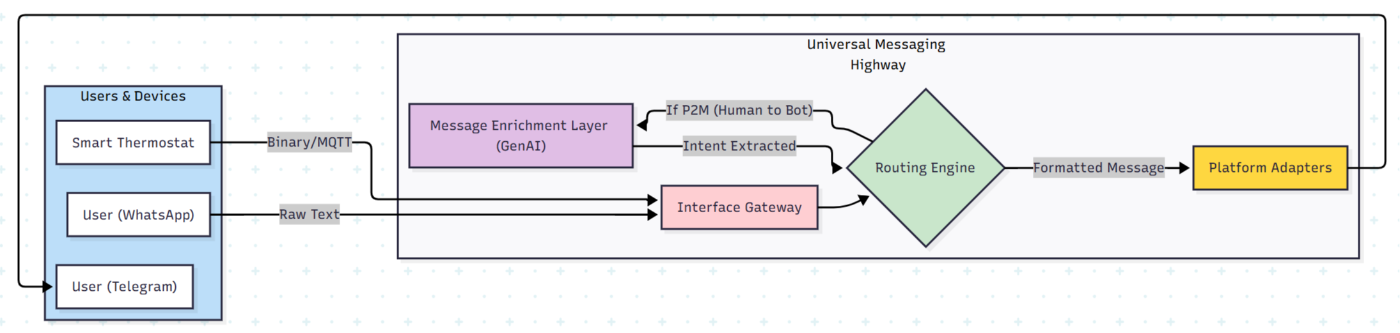
Phase 1: The Universal Message Format (UMF)

To make Telegram talk to an IoT device, we need a common language. We can't use proprietary schemas. We need a JSON Envelope strategy.

We separate the message into Metadata (Headers) and Payload (Body). This allows us to encrypt the payload end-to-end (E2EE) while leaving the routing headers visible to the highway.

The JSON Structure

Here is the schema we will use. It supports P2P (Person-to-Person) and M2P (Machine-to-Person) flows.

{ "umh_version": "1.0", "message_id": "uuid-1234-abcd", "timestamp": "2025-11-27T10:00:00Z", // ROUTING LAYER (Visible) "source": { "type": "person", "platform": "whatsapp", "id": "user_a_handle" }, "destination": { "type": "machine", "platform": "mqtt_broker", "id": "device_thermostat_01" }, // METADATA LAYER (For Handling) "metadata": { "priority": "high", "encryption": "aes-256-gcm", // Payload is encrypted "schema_id": "urn:umh:schema:command:v1", "expiration": 3600 }, // DATA LAYER (Encrypted/Private) "payload": { "type": "command", "content_type": "application/json", "body": { "intent": "set_temperature", "value": 22, "unit": "C" } } }

Note: By using a schema_id in the metadata, we can support versioning. If an IoT device sends a binary payload (Protobuf/Avro), the header tells the receiver how to decode it.

Phase 2: The Three Traffic Flows

The power of UMH lies in Polymorphism. The payload object changes structure based on who is talking to whom.

1. P2P (Person-to-Person)

Standard chat. Cross-platform (e.g., WhatsApp to Signal). \n The payload is simple, text-heavy, and formatted for UI display.

"msg_type": "P2P", "payload": { "type": "text", "content": "Hey, are you coming to the deployment party tonight?", "format": "plain", "attachments": [] }

2. P2M (Person-to-Machine)

Intent-driven. This flow triggers the GenAI layer. \n A human sends a vague command ("Turn on the AC"). The GenAI layer processes it and replaces the payload with a structured Intent before it reaches the machine.

"msg_type": "P2M", "payload": { "intent": "SetRoomTemperature", "confidence": 0.98, "parameters": { "value": 22, "unit": "Celsius", "target_device": "LivingRoom_AC" }, "original_utterance": "Set the living room to 22 degrees." }

3. M2P (Machine-to-Person)

Data-driven. Alerts and Insights. \n Machines usually send raw logs. The UMH converts these into human-readable notifications.

"msg_type": "M2P", "payload": { "alert_type": "ThresholdExceeded", "severity": "critical", "data": { "sensor": "Temp_Sensor_04", "current_value": 85, "threshold": 70, "unit": "C" }, "action_required": true }

Phase 3: The "Message Enrichment" Layer (GenAI)

This is where standard message brokers fail. If a human sends a message to a machine, the machine expects structured data. The human sends chaos.

  • User says: "It's freezing in here, turn up the heat."
  • Machine needs: {"command": "set_temp", "target": 24}

We inject a Message Enrichment Step (GenAI) into the pipeline. This layer uses LLMs (like GPT-4 or local Llama-3) to perform Named Entity Recognition (NER) and Intent Detection.

The Enrichment Pipeline

We can model this process using a Python pseudo-code structure that sits within our message consumer.

import json from umh_core import llm_engine, router def process_message(message_packet): msg_type = message_packet['metadata']['msg_type'] payload = message_packet['payload'] # 1. Check if Enrichment is needed (P2M context) if msg_type == 'P2M' and payload['format'] == 'text': # 2. Extract Intent via GenAI (LLM NER) # Input: "It's freezing in here, turn up the heat." enriched_data = llm_engine.extract_intent( text=payload['content'], context=message_packet['source'] ) # Output: {"intent": "increase_temp", "entities": {"value": "high"}} # 3. Transform for Machine Consumption final_payload = { "action": enriched_data['intent'], "parameters": enriched_data['entities'] } # 4. Update Packet message_packet['payload'] = final_payload message_packet['metadata']['enriched'] = True # 5. Forward to Routing router.dispatch(message_packet)

Message Enrichment Core Functionalities:

Phase 4: The Tech Stack

You don't need to build this from zero. We can compose this architecture using existing open-source tools.

| Component | Recommended Technology | Role | |----|----|----| | Transport Core | Kafka / RabbitMQ | Handles the high-throughput message queue. | | Protocol Adapter | Matrix / XMPP | The "Federation" layer. Matrix is excellent for bridging Slack/Discord/Telegram. | | Integration | Apache Camel | For routing rules and protocol transformation (HTTP to MQTT). | | Identity | OAuth / DID | Decentralized Identity (DID) to map a user to multiple apps. | | AI Engine | LangChain + Local LLM | To run the "Enrichment" logic without leaking privacy. |

Real-World Use Case: The Smart Support Bot

  1. Input: A user complains on Telegram"My order #999 is broken."
  2. Enrichment: GenAI detects Sentiment: Negative and extracts Order: #999.
  3. Routing: The Router sees "High Priority" and routes the message not to the standard chatbot, but to the Human Agent's Dashboard on Teams.
  4. Reply: The agent replies on Teams. UMH translates it back to Telegram.

The user never leaves Telegram; the Agent never leaves Teams. The "Highway" handles the traffic.

\

Conclusion

The era of "App Silos" is ending. By combining JSON-based routingProtocol Adapters, and GenAI Enrichment, we can build a Universal Messaging Highway that finally connects our fragmented digital lives.

Ready to build? Start by spinning up a local Matrix Synapse server and writing a simple bridge to an MQTT broker. That’s your first step onto the highway.

Disclaimer: The articles reposted on this site are sourced from public platforms and are provided for informational purposes only. They do not necessarily reflect the views of MEXC. All rights remain with the original authors. If you believe any content infringes on third-party rights, please contact service@support.mexc.com for removal. MEXC makes no guarantees regarding the accuracy, completeness, or timeliness of the content and is not responsible for any actions taken based on the information provided. The content does not constitute financial, legal, or other professional advice, nor should it be considered a recommendation or endorsement by MEXC.

You May Also Like

Polygon Tops RWA Rankings With $1.1B in Tokenized Assets
Polygon Tops RWA Rankings With $1.1B in Tokenized Assets

The post Polygon Tops RWA Rankings With $1.1B in Tokenized Assets appeared on BitcoinEthereumNews.com. Key Notes A new report from Dune and RWA.xyz highlights Polygon’s role in the growing RWA sector. Polygon PoS currently holds $1.13 billion in RWA Total Value Locked (TVL) across 269 assets. The network holds a 62% market share of tokenized global bonds, driven by European money market funds. The Polygon POL $0.25 24h volatility: 1.4% Market cap: $2.64 B Vol. 24h: $106.17 M network is securing a significant position in the rapidly growing tokenization space, now holding over $1.13 billion in total value locked (TVL) from Real World Assets (RWAs). This development comes as the network continues to evolve, recently deploying its major “Rio” upgrade on the Amoy testnet to enhance future scaling capabilities. This information comes from a new joint report on the state of the RWA market published on Sept. 17 by blockchain analytics firm Dune and data platform RWA.xyz. The focus on RWAs is intensifying across the industry, coinciding with events like the ongoing Real-World Asset Summit in New York. Sandeep Nailwal, CEO of the Polygon Foundation, highlighted the findings via a post on X, noting that the TVL is spread across 269 assets and 2,900 holders on the Polygon PoS chain. The Dune and https://t.co/W6WSFlHoQF report on RWA is out and it shows that RWA is happening on Polygon. Here are a few highlights: – Leading in Global Bonds: Polygon holds 62% share of tokenized global bonds (driven by Spiko’s euro MMF and Cashlink euro issues) – Spiko U.S.… — Sandeep | CEO, Polygon Foundation (※,※) (@sandeepnailwal) September 17, 2025 Key Trends From the 2025 RWA Report The joint publication, titled “RWA REPORT 2025,” offers a comprehensive look into the tokenized asset landscape, which it states has grown 224% since the start of 2024. The report identifies several key trends driving this expansion. According to…
Share
BitcoinEthereumNews2025/09/18 00:40
Team Launches AI Tools to Boost KYC and Mainnet Migration for Investors

Team Launches AI Tools to Boost KYC and Mainnet Migration for Investors

The post Team Launches AI Tools to Boost KYC and Mainnet Migration for Investors appeared on BitcoinEthereumNews.com. The Pi Network team has announced the implementation of upgrades to simplify verification and increase the pace of its Mainnet migration. This comes before the token unlock happening this December. Pi Network Integrates AI Tools to Boost KYC Process In a recent blog post, the Pi team said it has improved its KYC process with the same AI technology as Fast Track KYC. This will cut the number of applications waiting for human review by 50%. As a result, more Pioneers will be able to reach Mainnet eligibility sooner. Fast Track KYC was first introduced in September to help new and non-users set up a Mainnet wallet. This was in an effort to reduce the long wait times caused by the previous rule. The old rule required completing 30 mining sessions before qualifying for verification. Fast Track cannot enable migration on its own. However, it is now fully part of the Standard KYC process which allows access to Mainnet. This comes at a time when the network is set for another unlock in December. About 190 million tokens will unlock worth approximately $43 million at current estimates.  These updates will help more Pioneers finish their migration faster especially when there are fewer validators available. This integration allows Pi’s validation resources to serve as a platform utility. In the future, applications that need identity verification or human-verified participation can use this system. Team Releases Validator Rewards Update The Pi Network team provided an update about validator rewards. They expect to distribute the first rewards by the end of Q1 2026. This delay happened because they needed to analyze a large amount of data collected since 2021. Currently, 17.5 million users have completed the KYC process, and 15.7 million users have moved to the Mainnet. However, there are around 3 million users…
Share
BitcoinEthereumNews2025/12/06 16:08
Taiko Makes Chainlink Data Streams Its Official Oracle

Taiko Makes Chainlink Data Streams Its Official Oracle

The post Taiko Makes Chainlink Data Streams Its Official Oracle appeared on BitcoinEthereumNews.com. Key Notes Taiko has officially integrated Chainlink Data Streams for its Layer 2 network. The integration provides developers with high-speed market data to build advanced DeFi applications. The move aims to improve security and attract institutional adoption by using Chainlink’s established infrastructure. Taiko, an Ethereum-based ETH $4 514 24h volatility: 0.4% Market cap: $545.57 B Vol. 24h: $28.23 B Layer 2 rollup, has announced the integration of Chainlink LINK $23.26 24h volatility: 1.7% Market cap: $15.75 B Vol. 24h: $787.15 M Data Streams. The development comes as the underlying Ethereum network continues to see significant on-chain activity, including large sales from ETH whales. The partnership establishes Chainlink as the official oracle infrastructure for the network. It is designed to provide developers on the Taiko platform with reliable and high-speed market data, essential for building a wide range of decentralized finance (DeFi) applications, from complex derivatives platforms to more niche projects involving unique token governance models. According to the project’s official announcement on Sept. 17, the integration enables the creation of more advanced on-chain products that require high-quality, tamper-proof data to function securely. Taiko operates as a “based rollup,” which means it leverages Ethereum validators for transaction sequencing for strong decentralization. Boosting DeFi and Institutional Interest Oracles are fundamental services in the blockchain industry. They act as secure bridges that feed external, off-chain information to on-chain smart contracts. DeFi protocols, in particular, rely on oracles for accurate, real-time price feeds. Taiko leadership stated that using Chainlink’s infrastructure aligns with its goals. The team hopes the partnership will help attract institutional crypto investment and support the development of real-world applications, a goal that aligns with Chainlink’s broader mission to bring global data on-chain. Integrating real-world economic information is part of a broader industry trend. Just last week, Chainlink partnered with the Sei…
Share
BitcoinEthereumNews2025/09/18 03:34